
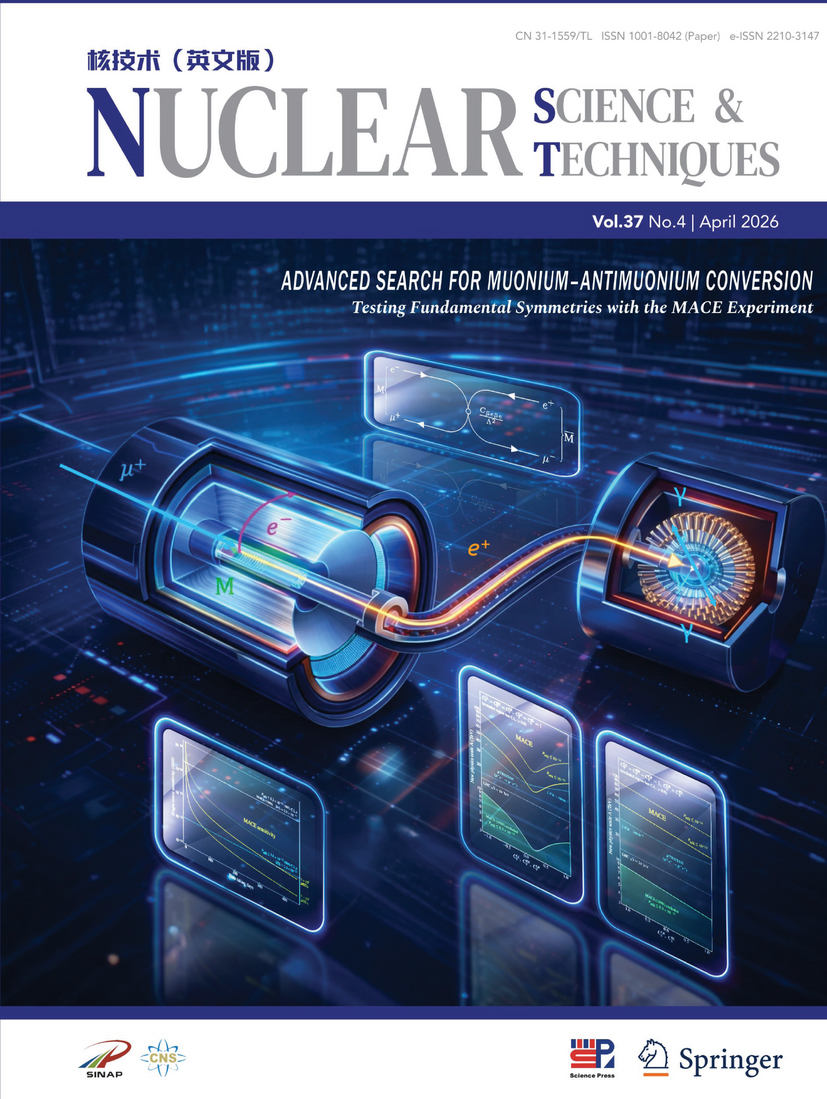
The spontaneous conversion of muonium to antimuonium is an interesting charged lepton flavor violation phenomenon that offers a sensitive probe for potential new physics and serves as a tool to constrain the parameter space beyond the Standard Model. The Muonium-to-Antimuonium Conversion Experiment (MACE) was designed to utilize a high-intensity muon beam, a Michel electron magnetic spectrometer, a positron transport system, and a positron detection system to either discover or constrain this rare process with a conversion probability of O(10−13). This article presents an overview of the theoretical framework and a detailed description of the experimental design for muonium-to-antimuonium conversion.
Vol.37, No.4
Select issueYearIssue
1216
NUCLEAR PHYSICS AND INTERDISCIPLINARY RESEARCH
Research article 28 Jan 2026
Jian Tang,Xiao-Dong Wang,Ai-Yu Bai,Han-Jie Cai,Chang-Lin Chen,Si-Yuan Chen,Xu-Rong Chen,Yu Chen,Wei-Bin Cheng,Ling-Yun Dai,Rui-Rui Fan,Li Gong,Zi-Hao Guo,Yuan He,Zhi-Long Hou,Yin-Yuan Huang,Huan Jia,Hao Jiang,Han-Tao Jing,Xiao-Shen Kang,Hai-Bo Li,Jin-Cheng Li,Yang Li,Da-Ming Liu,Shu-Lin Liu,Gui-Hao Lu,Han Miao,Yun-Song Ning,Jian-Wei Niu,Hua-Xing Peng,Alexey A. Petrov,Yuan-Shuai Qin,Ming-Chen Sun,Jing-Yu Tang,Ye Tian,Rong Wang,Yi Wang,Zhi-Chao Wang,Chen Wu,Tian-Yu Xing,Wei-Zhi Xiong,Yu Xu,Bao-Jun Yan,De-Liang Yao,Tao Yu,Ye Yuan,Yi Yuan,Yao Zhang,Yongchao Zhang,Zhi-Lv Zhang,Guang Zhao,Shi-Han Zhao
keyword:Microchannel plate;Muon beam;Drift chamber;Electromagnetic calorimeter;Muonium;Lepton flavor violation;
Research article 28 Jan 2026
Tao Ye,Xu Han,Zhen-Peng Chen,Hai-Rui Guo,Wei-Li Sun,Zhi-Hao Sun,Hao-Yang Fan
Based on the generalized reduced R-matrix theory, the R-matrix analysis code (RAC program) was used to analyze the experimental data of all the nuclear reaction channels related to the 5He system. The current calculations provide accurate and reliable evaluation data and are in good agreement with the experimental data. In this study, self-consistent evaluation data for each reaction were obtained using multi-channel and multi-energy fitting. In particular, the error propagation theory of Generalized Least Squares was used to determine the error of the evaluation data and the covariance matrix of the integral cross section. This R-matrix analysis for the 5He system has three features. First, for the first time, the error in the evaluation data of the T(d,n)4He reaction cross section and the covariance matrix of the integral cross section are provided. Second, we used only one set of R-matrix parameters to depict the reaction cross section of each reaction channel of the 5He system for the entire energy region in our work. Third, in this evaluation, we considered some of the latest measured experimental data, especially after 2000. The T(d,n)4He reaction cross section at 0.1 MeV and below was carefully studied. The effect of different energy levels in T(d,n)4He was analyzed, with the energy levels 3/2+ making a major contribution to the cross section, and the role of the S-wave and P-wave from 3/2- determines the lean forward trend of the angular distributions at 0.01–0.1 MeV.
keyword:Nuclear reaction cross section;R-matrix theory;Evaluation of data;Generalized least squares;5He system;
Research article 29 Jan 2026
Huai-Yong Bai,Hang Li,Hong-Jun Zhang,Cheng-Guo Pang,Ming Su,Zhong-Hua Xiong,Ji Wen,Fan Gao,Chen-Guang Li,Xiao-Dong Wang,Li-Sheng Yang
The energy correlations of prompt fission neutrons have not yet been considered in the related coincidence and multiplication measurement techniques. To measure and verify the energy correlations, an experiment was performed with a total measurement duration of approximately 1200 h. In the experiment, eight CLYC detectors and sixteen EJ309 liquid scintillation detectors were utilized, and the fission moment was tagged with the measured fission γ-rays. The relative ratios of the energy spectra of the neutrons correlated with different energy neutrons to the 252Cf fission neutron energy spectra were obtained. The present results may be helpful for studying fission physics and nuclear technology applications.
keyword:Energy spectrum;Energy correlations;Prompt fission neutrons;Fission γ-rays;
Research article 31 Jan 2026
Han-Zhong Zhang,Li-Qiang Zhu,Ou-Yang Luo,Xun Chen,Kai Zhou,De-Fu Hou
Leveraging high-precision lattice QCD data on the equation of state and baryon number susceptibility at a vanishing chemical potential, we constructed a Bayesian holographic QCD model and systematically analyzed the thermodynamic properties of heavy quarkonium in QCD matter under varying temperatures and chemical potentials. We computed the quark-antiquark interquark distance, potential energy, entropy, binding energy, and internal energy. We present detailed posterior distribution results of the thermodynamic quantities of heavy quarkonium, including maximum a posteriori (MAP) value estimates and 95% confidence levels (CL). Through numerical simulations and theoretical analysis, we find that an increase in the temperature and chemical potential reduces the quark distance, thereby facilitating the dissociation of heavy quarkonium and leading to a suppressed potential energy. The increase in temperature and chemical potential also raises the entropy and entropy force, further accelerating the dissociation of heavy quarkonium. The calculated results of binding energy indicate that a higher temperature and chemical potential enhance the tendency of heavy quarkonium to dissociate into free quarks. The internal energy also increases with rising temperature and chemical potential. These findings provide significant theoretical insights into the properties of strongly interacting matter under extreme conditions and lay a solid foundation for the interpretation and validation of future experimental data. Finally, we also present the results for the free energy, entropy, and internal energy of a single quark.
keyword:Bayesian inference;Holographic QCD;In-medium heavy quarkonium;Thermodynamics of heavy quarkonium;
Research article 31 Jan 2026
Xi-Jun Wu,Xiao-Hua Li,Leng-Jun Liao,Lin-Jing Qi,Ming Li
In this study, the effects of laser fields that can be achieved in the near future on cluster penetration probability and half-life are quantitatively investigated. The calculation results show that extreme laser fields can slightly change the cluster decay half-life by affecting the penetration probability within a narrow range. Subsequently, we discuss the correlation between the change rate of the penetration probability and the tunneling path. The results indicate that for different parent nuclei emitting the same cluster, nuclei with longer tunneling paths are more easily affected by the laser fields. The shell effect on this correlation is also observed. In addition, the impact of laser fields on the penetration probability in any direction is investigated.
keyword:Half-life;Extreme laser field;Penetration probability;Cluster radioactivity;
ACCELERATOR, RAY AND APPLICATIONS
Research article 28 Jan 2026
Xiao-Li Wang,Shu-Cheng Shi,Chen-Yao Han,Yi-Ming Ma,Quan-Qi Shi,Shuai Wang,Jiao Feng
In recent years, there have been fewer missions to detect neutrons in low Earth orbits (LEO), and the data obtained have been extremely limited. Studying the distribution of the neutron energy spectrum in LEO satellites through detection can help solve three major scientific problems: the source of particles in the inner radiation belt, information on solar-accelerated particles, and the proportion of neutrons from different sources in near-Earth space. The detection efficiency and accuracy of neutrons are affected by charged and primary particles in the environment and secondary neutrons produced by the spacecraft itself, which has been a hot research topic. The neutron spectrometer developed in this study adopts two combinations of 15 silicon detectors in terms of detector type and arrangement, which are used for neutron detection via the nuclear reaction method and recoil proton method, respectively, in which a 27 μm-thick 6LiF conversion layer is used for thermal neutron detection up to 0.4 eV and a 300 μm-thick high-density polyethylene conversion layer is used for fast neutron detection up to 14 MeV and below. The design of the detector set can also remove the influence of primary charged particles and secondary neutrons in the detection environment to a certain extent, thereby improving the accuracy of neutron detection. In this study, the neutron spectrometer hardware, firmware, software design, and basic performance of the front-end readout chip SKIROC2A were tested. The readout circuit of each channel baseline ADC code was less than 17; thus, the channel consistency was good. The RMS noise of the channel baseline was only 7.1 mV and exhibited good stability. The maximum number of events that could be processed per second is 75. The overall power consumption was 3 W, the weight was 792 g, and the volume was less than 1 dm3. Furthermore, the neutron spectrometer was tested for principle and detection efficiency using various neutron sources, such as 241Am-Be neutron source, 2.5 MeV neutron beam, and 14 MeV neutron beam, and the experiments were analyzed with corresponding simulations. The experimental data and simulation results were in good agreement and met the design requirements. The intrinsic detection efficiency of the probes used in the neutron spectrometer was 1.05% for 14 MeV fast neutrons.
keyword:Geant4;Neutron spectrometer;Satellite payload;Prototype design;SKIROC2A;
Research article 28 Jan 2026
Wan-Long Wu,Xiong-Hong He,Yan-Yu Ren,Di-Yu Shen,Shu-Su Shi,Xu Sun
The Cooling-Storage-Ring External-target Experiment (CEE) at the Heavy Ion Research Facility in Lanzhou (HIRFL) is designed to study the properties of nuclear matter created in heavy-ion collisions at beam energies from a few hundred MeV/u up to 1 GeV/u. It aims to facilitate research on the quantum chromodynamics (QCD) phase structure in the high-baryon-density region. Collective flow is a fundamental observable in heavy-ion collision experiments, providing information on the bulk properties of the produced matter. Although the standard event plane method has been widely used to measure collective flow, it is still important to validate and optimize this method for the CEE spectrometer. In this paper, we study the experimental procedures for measuring directed flow in 238U+238U collisions at 500 MeV/u, using event planes reconstructed by Multi Wire Drift Chamber and Zero Degree Calorimeter, respectively. Jet AA Microscopic (JAM) transport generator is used to generate events, and the detector response is simulated by the CEE Fast Simulation (CFS) package. Finally, the optimal kinematic region for proton directed-flow measurements is discussed for the future CEE experiment.
keyword:Heavy-ion collisions;CEE;Directed flow;Event plane;
Research article 29 Jan 2026
Tong-Ning Hu,Hai-Meng Wang,Yi-Feng Zeng,Hao Hu,Jun-Yang Li
X-rays are widely used in the non-destructive testing (NDT) of electrical equipment. Radio frequency (RF) electron linear accelerators can generate MeV high-energy X-rays with strong penetrating ability; however, the system generally has a large scale, which is not suitable for on-site testing. Compared with the S-band (S-linac) at the same stage of beam energy, the accelerator working in the X-band (X-linac) can compress the facility scale by over 2/3 in the longitudinal direction, which is convenient for the on-site NDT of electrical equipment. To address the beam quality and design complexity simultaneously, the non-dominated sorting genetic algorithm II (NSGA-II), which is a multi-objective genetic algorithm (MOGA), was developed to optimize the cavity chain design of the X-linac. Additionally, the designs of the focusing coils, electron gun, and RF couplers, which are other key components of the X-linac, were introduced in this context. In particular, the focusing coil distributions were optimized using a genetic algorithm. Furthermore, after designing such key components, PARMELA software was adopted to perform beam dynamics calculations with the optimized accelerating fields and magnetic fields. The results show that the beam performance was obtained with a capture ratio of more than 90%, an energy spread of less than 10%, and an average energy of approximately 3 MeV. The design and simulation results indicate that the proposed NSGA-II-based approach is feasible for X-linac accelerator design. Furthermore, it can be generalized as a universal technique for industrial electron linear accelerators provided that specific optimization objectives and constraints are set according to different application scenarios and requirements.
keyword:Electron gun;Non-destructive testing;X-band linac accelerator;Focusing coils;Radio frequency couplers;
Research article 29 Jan 2026
Tao Qiu,Ning Gao,Yan-Kui Chang,Xi Pei,Huan-Li Luo,Fu Jin
This study aimed to integrate Monte Carlo(MC) simulation with deep learning(DL)-based denoising techniques to achieve fast and accurate prediction of high-quality electronic portal imaging device (EPID) transmission dose (TD) for patient-specific quality assurance (PSQA). A total of 100 lung cases were used to obtain the noisy EPID TD by the ARCHER MC code under four kinds of particle numbers (1×10⁶, 1×10⁷, 1×10⁸ and 1×10⁹), and the original EPID TD was denoised by the SUNet neural network. The denoised EPID TD was assessed both qualitatively and quantitatively using the structural similarity (SSIM), peak signal-to-noise ratio (PSNR), and gamma passing rate (GPR) with respect to 1×10⁹ as a reference. The computation times for both the MC simulation and DL-based denoising were recorded. As the number of particles increased, both the quality of the noisy EPID TD and computation time increased significantly (1×10⁶: 1.12 s, 1×10⁷: 1.72 s, 1×10⁸: 8.62 s, and 1×10⁹: 73.89 s). In contrast, the DL-based denoising time remained at 0.13–0.16 s. The denoised EPID TD shows a smoother visual appearance and profile curves, but differences between 1×10⁶ and 1×10⁹ still remain. SSIM improves from 0.61 to 0.95 for 1×10⁶, 0.70 to 0.96 for 1×10⁷, and 0.90 to 0.97 for 1×10⁸. PSNR increases by > 20% for 1×10⁶ and 1×10⁷, and > 10% for 1×10⁸. GPR improves from 48.47% to 89.10% for 1×10⁶, 61.04% to 94.35% for 1×10⁷, and 91.88% to 99.55% for 1×10⁸. The method that combines MC simulation with DL-based denoising for EPID TD generation can accelerate TD prediction and maintain high accuracy, offering a promising solution for efficient PSQA.
keyword:Monte Carlo;Deep learning;PSQA;EPID;
Research article 30 Jan 2026
Mei Yang,Fu-San Chen,Jian-Xin Zhou,Ya-Feng Wu,Ying-Shun Zhu,Xian-Jing Sun,Chuang Shen
The Circular Electron Positron Collider (CEPC) proposed in China is a dual-ring collider with electron and positron beams in the energy range of 45.5 GeV to 180 GeV. The main dipole in the CEPC collider is a dual-aperture dipole with a shared coil between the two apertures, forming an I-shaped structure that can reduce power consumption by 50%. Because of its long length and low field strength, the development of this dual-aperture magnet faces challenges regarding its mechanical design, field measurement accuracy, and field performance. Numerical simulations were performed to better understand the Earth’s field and the effect of different BH curves on field performance. The field results of the prototype are presented herein, and the field quality satisfies the requirements. The remanent field accounts for 2% of the integral field at 140 Gs, and the hysteresis effect caused an increase in field strength of approximately 0.075% after a standardization cycle of the trim coils. Research on this prototype can provide useful insights for understanding low-field dipole magnets.
keyword:CEPC Collider;Dual aperture magnet;Magnet design;Field measurement;Earth field;
Research article 02 Feb 2026
Feng-Gang Bian,Shu-Min Yang,Xu-Yang Qin,Bing Guo,Nan Pan,Xin-Hao Gao,Chun-Xia Hong,Ying Wang,Xiu-Hong Li,Chun-Ming Yang
With the development of the semiconductor industry below the 7 nm scale, critical dimension small-angle X-ray scattering (CD-SAXS) has emerged as a powerful tool for quantitatively measuring nanoscale deviations. In this study, the effects of X-ray beam size and photon energy on the accuracy of critical dimension measurements were investigated. Critical dimensions measured using beams with different spot sizes showed different deviations from the expected values. Beam sizes that were either too large or too small did not improve confidence intervals. As the incident energy increased, the X-ray transmission rate increased, while the scattering cross-section decreased, resulting in a gradual decrease in the signal-to-noise ratio of the diffraction peaks, which reduced the accuracy of the CD-SAXS measurements. An optimal accuracy was obtained at 12 keV with a smaller beam size. Using an effective trapezoid model, the results yielded an average pitch of 100.4 ± 0.2 nm, width of 49.8 ± 0.2 nm, height of 130.0 ± 0.2 nm, and a sidewall angle below 1.1°±0.1°. These results provide crucial guidance for the future development of CD-SAXS laboratories and the construction of X-ray machines as well as robust support for research in related fields.
keyword:Beam size;Critical dimension small angle X-ray scattering;Nonlinear fitting;X-ray energy;Chip;
NUCLEAR ELECTRONICS AND INSTRUMENTATION
Research article 29 Jan 2026
De-Xin Chen,Ying Wang,Huo-Lin Huang,Yan-Xing Song,Meng-Tian Bao,Fei Cao
This study focuses on a 60 V trench MOSFET device designed for operation in space radiation environments. By increasing the bulk region concentration and placing the etched gate trench after the P+ implantation process, we successfully reduced the threshold voltage shift from 6.5 V to 2.2 V under a total dose of 400 krad(Si) 60Co, allowing the device to operate normally. Structurally, by embedding the source metal in the active and terminal regions, the device demonstrated current degradation without experiencing single-event burnout when subjected to a drain voltage of 60 V and a linear energy transfer value of 75.4 MeV·cm2/mg from tantalum-ion incidence. TCAD simulations verified that the embedded source metal effectively suppressed parasitic transistor conduction and eliminated the base-region expansion effect, thereby lowering the maximum temperature from 8000 K to 1400 K. The irradiation effects of the embedded source metal in the terminal region were also investigated, which can improve the reverse recovery and ensure that the terminal metal does not melt prematurely, thereby significantly enhancing the radiation hardness of the device.
keyword:Total ionizing dose (TID);Single-event burnout (SEB);Trench MOSFET;Hardened structure;Lattice temperature;
Research article 03 Feb 2026
Shou-Long Xu,Cui-Yue Wei,Zhi-Wei Qin,Shu-Liang Zou,Yong-Chao Han,Qing-Yang Wei,You-Jun Huang
In this study, the mechanism and characteristics of the response α particles and the damage caused by them in CMOS active pixel (APS) sensors were investigated. A detection and compensation algorithm for dead pixels caused by α particle ionizing radiation was proposed, and the effects of dead-pixel compensation algorithms were compared and analyzed under different parameter conditions. The experimental results show that α particle response signal has highest accuracy at 9 dB gain, with an obvious “target-ring” distribution. With increasing cumulative dose, the CMOS APS pedestal tends to saturation while dead pixels continue increasing. Though some pixel damage recovers through natural annealing, the dead-to-noise ratio increases with irradiation time, reaching 32.54% after 72 h. A hierarchical clustering dead-pixel detection method is proposed, categorizing pixels into two types: those within and outside the response event. A classification compensation strategy combining mean and majority filtering is proposed. This compensation algorithm can address dead-pixel interference without affecting α particle radiation response data. When iterated multiple times and with integration time exceeding 6.31 ms, the number of dead pixels can be effectively reduced.
keyword:Radiation damage;CMOS active pixel sensor;α particles;Response event;Dead-pixel compensation;
Research article 05 Feb 2026
Zheng-Yun You,Yu-Mei Zhang,Kai-Xuan Huang,Tian-Zi Song,Yu-Ning Su,Cheng-Xin Wu,Xue-Sen Wang
Detector and event visualization are crucial components of high-energy physics (HEP) experimental software. Virtual Reality (VR) technologies and multimedia development platforms, such as Unity, offer enhanced display effects and flexible extensibility for visualization in HEP experiments. In this study, we present a VR-based method for detector and event displays in the Jiangmen Underground Neutrino Observatory (JUNO) experiment. This method shares the same detector geometry descriptions and event data model as those in the offline software and provides the necessary data conversion interfaces. The VR methodology facilitates an immersive exploration of the virtual environment in JUNO, enabling users to investigate the detector geometry, visualize event data, and tune the detector simulation and event reconstruction algorithms. Additionally, this approach supports applications in data monitoring, physics data analysis, and public outreach initiatives.
keyword:JUNO;Unity;Virtual reality;Event display;Detector geometry;
RESEARCH HIGHLIGHT
Research article 29 Jan 2026
Kai-jia Sun
The production of light (anti-)nuclei in high-energy collisions has long posed an apparent paradox: how can loosely-bound systems such as the anti-deuteron with a binding energy of only 2.23 MeV be formed and survive in the extreme hot and dense hadronic environment emerging from proton-proton (pp) and heavy-ion collisions, where characteristic thermal energies exceed 100 MeV? A new femtoscopy analysis published on Nature [1] by the ALICE Collaboration at the Large Hadron Collider (LHC) delivers the clearest answer to date. By measuring pion-deuteron momentum correlations in high-multiplicity pp collisions at s=13 TeV, the experiment demonstrated that most (anti-)deuterons are not produced directly at hadronization, but instead originating from meson-catalyzed reactions [2] following the decay of short-lived baryonic resonances, most notably the Δ(1232). This result provides long-sought microscopic insight into how fragile (anti-)nuclei emerge in ultra-relativistic hadronic environments, from collider events to cosmic rays.
NUCLEAR CHEMISTRY, RADIOCHEMISTRY, AND NUCLEAR MEDICINE
Research article 31 Jan 2026
Meng-Yue Ma,Yi-Shuo Zhang,Kun Li,Guan-Chao Li,Hao-Nan Li,Xiao-Liang Liu,Yan-Jun Du,Muhammad Saeed,Xiao-Yan Li,Yu-Hui Liu,Yi-Bao Liu
A novel layered cobalt-magnesium double hydroxide composite (L-CMs) was successfully prepared using a simple one-step co-precipitation method. Static adsorption experiments were conducted to examine the removal efficacy of U(VI) from aqueous solutions by the L-CMs and analyze the removal mechanism. L-CMs efficiently removed U(VI) from the aqueous solution under an adsorption time of 60 min, dosage of 0.4 g/L, and pH of 5.5 at room temperature, and the removal efficiency of U(VI) reached 94.59% with an initial U(VI) concentration of 10 mg/L. The adsorption process was fitted to the pseudo-second-order kinetic and Langmuir models, indicating that monolayer chemical adsorption occurred primarily. The maximum adsorption capacity fitted using the Langmuir model, was 105.49 mg/g. Thermodynamic analysis revealed that U (VI) adsorption by L-CMs was endothermic. Structural characterization results showed that the primary mechanism involved the complexation of U(VI) by -OH, CO32- and ion exchange by Mg2+ and the presence of layered Co(OH)2 in the L-CMs, which potentially facilitated ion exchange. The preparation of the composite materials was simple, and the synergistic effect between the materials enhanced the ion exchange of Mg2+ in the materials and enriched the content of functional groups, making it a potential candidate for the treatment of uranium-containing wastewater.
keyword:Adsorption;Uranium;Mechanism;Property;Environmental governance;
Research article 03 Feb 2026
Kai-Yong Tang,Li Fu,Si-Yuan Zhang,Hai-Jun Fan,Yan Zeng,Mo Zhou
Five samples of LiMgPO4:Gd were prepared via five different production processes using a solid-state reaction method. The effects of the preparation process on optically stimulated luminescence (OSL) and thermoluminescence (TL) were investigated. Considering its high sensitivity, low fading, and minimum detectable dose (MDD), the LiMgPO4:Gd phosphor heated to 900 °C for 15 h is concluded to be optimal. The effects of annealing on the OSL sensitivity, relative residual OSL signals measured after 24 h of irradiation, and MDD of LiMgPO4:Gd phosphors heated to 900 °C for 15 h were also investigated. Considering its high sensitivity, low fading, and MDD, annealing at 350 °C for 1 h is concluded to be optimal. The OSL signal of LiMgPO4:Gd was derived from the principal TL glow peak. For a maximum integration time of 5 s, the OSL signal was stable, with no fading 30 days after irradiation. LiMgPO4:Gd eliminated approximately 2.2% of the OSL signal at each readout for a readout time of 0.1 s, which is sufficient for fast and multiple OSL readout. The sensitivity of LiMgPO4:Gd phosphor, annealed for 1 h at 350 °C with a reading time of 0.1 s, was found to be approximately 98% of that observed for α-Al2O3:C(TLD-500k), which should be sufficient for low-dose measurements in personal, workplace, and environmental dosimetry.
keyword:Thermoluminescence;Optically stimulated luminescence;Fading;LiMgPO4:Gd;Phosphors;
NUCLEAR ENERGY SCIENCE AND ENGINEERING
Research article 02 Feb 2026
Klemen Ambrožič,Hubert Carcreff,Vladimir Radulović,Damien Fourmentel,Christophe Destouches,Nicolas Thiollay,Luka Snoj
Nuclear heating plays an important aspect in design and deployment of both fission and fusion reactors and experimental devices in terms of cooling requirements. Two experimental campaigns in the framework of a collaboration project between the French Atomic and Alternative Energy Commission (CEA) and Jožef Stefan Institute (JSI), Slovenia, have been performed at the JSI TRIGA reactor for the experimental assessment of nuclear heating in fission and fusion relevant materials by the differential calorimetry technique, based on the CALMOS and CARMEN differential calorimeters, previously developed at CEA. The results of the first campaign performed at reactor powers between 100 kW to 250 kW have already been reported, highlighting some measurement difficulties. Therefore, the second campaign was performed at a lower reactor power of 30 kW to overcome these issues. Moreover, a computational analysis of the experiments was performed using the JSIR2S code package to calculate the nuclear heating levels. Both experiments and their reproduction by simulations are described in detail. We present a comparison of the previously reported measured nuclear heating values of the first campaign with the computational results, with consistent underestimation by simulations by 8% to 35%. We report the experimental and computational results for the second experimental campaign performed at a reactor power of 30 kW. The simulated heating values were in agreement with the measurements within the measured heating uncertainty, with simulated heating 2.7% to 11.3% lower than the experimental values.
keyword:MCNP;tungsten;Nuclear heating;Differential calorimeter;R2S;Eurofer97;
Published on 20 Apr 2026
