
Multiscale multiphysics simulation is a key technology for nuclear reactor system design and analysis. However, its application and development are limited by the complexity of cross-scale simulation coupling and long calculation times. To satisfy the real-time simulation requirements of modern reactor digital twins, this study establishes a digital twin of the reactor circuit using multiphysics and multiscale reduced-order methods. This digital twin is based on the plug-and-play approach, and all simulations of the components are replaced by independent 1D and 3D multi-physical reduced-order surrogate models. The complete system circuit can be composed of a combination of these surrogate models, which allows for the easy integration of new components and modification of existing components. A digital twin circuit is established for the test case. The reactor core is described using the 3D neutronics-thermal-hydraulics model, whereas the steam generator is described using the 3D CFD model. The other components, including the heat and cold pipes, are described using a 1D reduced-order model. The numerical results show that the digital twin can accurately predict the multiphysics and multiscale behavior of the reactor circuit. The maximum relative error of the tested circuit is not larger than 0.05%, and the simulation time can be reduced to less than 2 ms. The proposed plug-and-play digital twin can be used to develop a new real-time digital twin system that can support reactor system design and analysis.
Vol.37, No.6
Select issueYearIssue
1219
NUCLEAR ENERGY SCIENCE AND ENGINEERING
Research article 21 Mar 2026
Yu Ma,Ya-Hui Wang,Ze-Long Zhao,Hong-Hang Chi,Zhe-Xian Liu
keyword:Primary circuit;Reduced-order;Plug-and-play;Digital twin;Multi-scale multi-physics;
Research article 21 Mar 2026
Shi-Lin Chen,Qing-Xi Yang,Qing-Zhou Yu,Hao Xu,Jian Chen,Zhao-Xi Chen
Liquid-containing structures, including steam generators, water-cooling systems, in-containment refueling water storage tanks, suppression tanks, and tritiated water storage facilities, are integral components of nuclear reactor systems and are crucial for ensuring operational safety and stability. Traditional seismic analysis methods often struggle to accurately predict the dynamic behavior of such structures, particularly under transient events such as earthquakes. This paper presents a comprehensive study that applies the hybrid Eulerian–Lagrangian method to analyze fluid–structure interactions within these structures. The efficacy of this method for capturing the complex dynamics induced by liquid movement is demonstrated through simulations conducted primarily in a vertical storage tank. A comparative analysis with traditional response-spectrum analysis methods underscores the limitations of conventional approaches, particularly in terms of accounting for nonlinear free-surface motions and dynamic velocity distributions. The structural response of the tank containing liquid calculated using the hybrid Eulerian–Lagrangian method is approximately twice that calculated using the response-spectrum method, whereas in the case of a tank without liquid, the response is the same. Additionally, a high dynamic stress distribution exists near the liquid level of the structure. This study addresses the intricate interplay between structural components and fluid dynamics, thereby extrapolating insights from tanks to enhance safety protocols and design considerations for future nuclear devices.
keyword:Nuclear reactors;Liquid-containing structures;Seismic analysis methods;Hybrid Euler-Lagrangian method;Complex dynamics;
Research article 24 Mar 2026
Qiang Lian,Kui Zhang,Shan-Shan Bu,Liang-Ming Pan,Wen-Xi Tian,Sui-Zheng Qiu,Guang-Hui Su,Xing-Hua Wu,Xiao-Yu Wang
To accelerate the development and utilization of fusion energy, the China Fusion Engineering Test Reactor (CFETR) has been proposed as a bridge between the International Thermonuclear Experimental Reactor and demonstration fusion reactors. The primary objective of the CFETR is to achieve fusion energy transformation and tritium self-sufficiency, which is realized through the function of the blanket. In this study, a neutronics/thermal-hydraulics/mechanics coupling method is developed and applied to a helium-cooled ceramic breeder (HCCB) blanket, which is one of the two blanket candidates for the CFETR. A three-dimensional full-scale model is utilized in the coupling analysis to obtain the distributions of the neutronic, thermal-hydraulic, and mechanical parameters. A structural assessment of the CFETR HCCB blanket is then conducted considering steady-state conditions and two transient scenarios. The results demonstrate that following optimization of the blanket structure, the maximum temperatures of the different components remain below the safety limit of the corresponding materials. The structural assessment indicates that the blanket maintains its structural integrity under steady-state conditions. However, immediately after an in-box loss of coolant accident, structural failure owing to stress concentration may occur. Additionally, in the early stage of a loss-of-flow accident, the stress at the joint point between the cooling plate and cap exceeds the allowable stress of the material, potentially leading to structural failure within 17 s if no protective response is implemented. These findings provide comprehensive insights into the performance and safety of the CFETR HCCB blanket design.
keyword:Structural assessment;Fusion blanket;Three-dimensional full-scale model;Coupling analysis;CFETR;
Research article 24 Mar 2026
He-Lin Gong,Rui-Zhi Zhang,Sheng-Feng Zhu,Kan Wang,Ding She,Jean-Philippe Argaud,Bertrand Bouriquet,Qing Li
Reactor physics is the study of neutron properties, focusing on the use of models to examine the interactions between neutrons and materials in nuclear reactors. Artificial intelligence (AI) has made significant contributions to reactor physics, such as in operational simulations, safety design, real-time monitoring, core management, and maintenance. This paper presents a comprehensive review of AI approaches in reactor physics, especially considering the category of Machine Learning (ML, which we also refer to as AI/ML to recall the AI name we found in articles), with the aim of describing the application scenarios, frontier topics, unsolved challenges, and future research directions. From equation solving and state parameter prediction to nuclear industry applications, this study provides a step-by-step overview of ML methods applied to steady-state, transient, and burnup problems. Most studies have achieved industry-demanded models by enhancing the efficiency of deterministic methods or correcting uncertainty methods, which leads to successful applications. However, research on ML methods in reactor physics is somewhat fragmented, and the ability to generalize models must be strengthened. Progress is still possible, especially in addressing theoretical challenges and enhancing industrial applications, such as building surrogate models and digital twins.
keyword:Machine learning;Simulation;Monitoring;Reactor physics;Artificial Intelligence;Neutron governing equations;Fuel burnup;Core design;
Research article 24 Mar 2026
Tao Ye,Hai-Rui Guo,Wen-Di Chen,Jia-Hao Chen,Bo Yang,Yang-Jun Ying
The uncertainties and covariance matrices of the fission yield are important in the uncertainty analysis of the decay heat. At present, there are no covariance matrixes of fission yield given in the evaluated nuclear data library, although they provide uncertainties with good estimates. In this study, the generalized least squares (GLS) updating approach was adopted to evaluate the fission yield covariances with constraints from the basic physical conservation equation and chain yield data, using the nuclear data files from ENDF/B-VIII.0, JENDL-5, and JEFF-3.3. Based on the original and updated data, summation calculations were performed for the fission pulse decay heat of thermal neutron-induced fission of 235U. The uncertainties of the decay heat were obtained using the generalized perturbation theory, including the uncertainties propagated from the fission yield, decay energy, decay constant, and branching ratio. The original uncorrelated yield data contributed to a ~4% uncertainty at all times, and dominated the decay heat uncertainty at cooling times longer than 100 s. With the generated covariance matrixes, the uncertainty of the calculated decay heat was significantly reduced, and the decay energy data generally made a major contribution. The relative uncertainties at cooling time 0.1 s were ~10% for ENDF/V-VIII.0, JEFF-3.3, and ~5% for JENDL-5, and those at cooling time 105 s were approximately 1% for the three libraries. The influence of the GLS updating procedure on the contributions of important fission products to the decay heat and their sensitivity coefficients is also discussed.
keyword:Uncertainty analysis;Fission yield;Covariance matrix;Decay heat;
Research article 25 Mar 2026
Wen Luo,Tong-Pu Yu,Qian Dong,Chao-Zhi Li,Chen Xie,Zhi-Dong Chen,De-Bin Zou
An optimization algorithm for pairwise nuclear fusion with arbitrarily weighted macroparticles is proposed and demonstrated using particle-in-cell (PIC) simulations. A faster computation of the Coulomb collision operator is achieved compared with that obtained through the classical nuclear fusion algorithm. Thus, the proposed algorithm can be implemented in the PIC simulation code with marginal effort. The algorithm is benchmarked in scenarios with like-particles, D(d,n)3He, unlike-particles, D(t,n)4He, thermonuclear fusion, and beam-target fusion. Moreover, the CPU time could be reduced significantly without reducing the simulation accuracy.
keyword:Nuclear fusion;Particle-in-cell simulation;Coulomb collision;Binary collision;
Research article 04 Apr 2026
Ji-Pu Wang,Zhen-Wen Wei,Can Huang,William Martin,Brendan Kochunas,Qi-Cang Shen,Si-Juan Chen,Martin Pilch
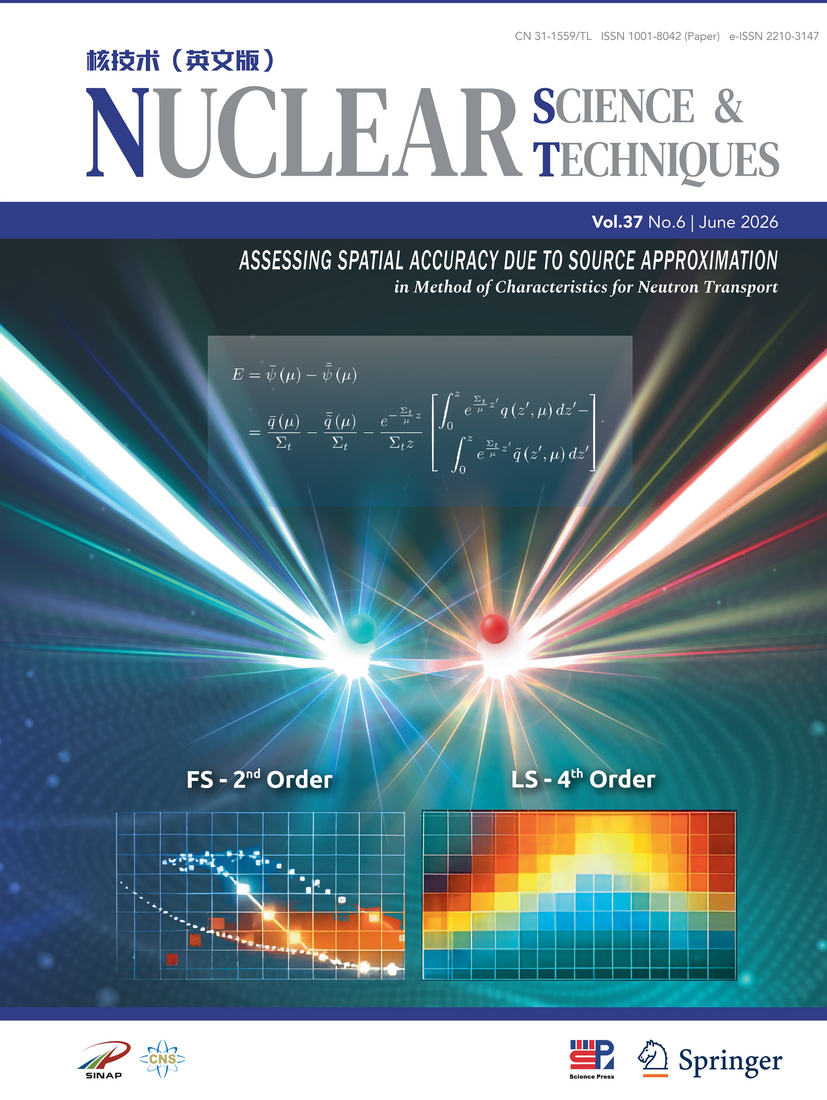
The method of characteristics (MoC) is a well-established tool for lattice physics calculations, offering advantages such as accurate representation of both lattice geometry and boundary conditions. The flat source (FS) approximation is the most commonly used approach, whereas the linear source (LS) approximation enhances the accuracy by preserving the higher-order spatial moments of the neutron source. However, determining the order of accuracy (OoA) for spatial discretization in the MoC is challenging, particularly for the LS approximation. This complexity arises because MoC employs two spatial meshes: the fission source region (FSR) mesh and a set of characteristic rays used to integrate the transport equation over the FSR mesh. In this study, we analyzed the spatial order of accuracy of the MoC in planar geometry for both FS and LS approximations in relation to the distributed source. Our theoretical predictions are consistent with the numerical results obtained using the Method of Manufactured Solutions (MMS). The results demonstrate that the FS approximation achieves second-order accuracy, whereas the LS approximation attains fourth-order accuracy.
keyword:Method of characteristics;Order of accuracy;Flat source approximation;Linear source approximation;Method of manufactured solutions;
NUCLEAR ELECTRONICS AND INSTRUMENTATION
Research article 21 Mar 2026
Samuel Mungai Kinyanjui,Zhonghua Kuang,Zheng Liu,Ning Ren,Yongfeng Yang
Conventional positron emission tomography (PET) scanners use either highly segmented or monolithic scintillator detectors. Depth of interaction (DOI) information is vital for high-resolution PET scanners that use either segmented scintillator detectors with a large crystal-length-to-width aspect ratio or monolithic scintillator detectors with a large crystal-thickness-to-spatial-resolution ratio. Semi-monolithic scintillator detectors maintain the intrinsic DOI encoding capability of monolithic detectors, but with a substantially smaller edge effect. The objective of this study was to compare the performance of semi-monolithic scintillator detectors with different slab thicknesses, slab surface treatments, and reflector types. Four long semi-monolithic detectors consisting of lutetium yttrium oxyorthosilicate (LYSO) slabs of 0.96 mm×56 mm×10 mm and 0.81 mm×56 mm×10 mm, with and without black paint on both the end and front surfaces, were measured. In addition, semi-monolithic detectors using either barium sulfate (BaSO4) or an enhanced specular reflector (ESR) as the inter-slab reflector were compared for the first time. The semi-monolithic detectors were read out by a 4×16 silicon photomultiplier array with a row and column summing readout circuit, and the signals were processed using electronics developed in our laboratory. Black paint treatment of the two end and front surfaces degraded the energy resolution but improved both the spatial resolution in the monolithic direction and DOI resolution, thereby improving the overall detector performance. The detector using an ESR reflector provided clearer individual slab identification in the flood histogram and a similar spatial resolution in the monolithic direction, DOI resolution, and energy resolution. The squared centroid of gravity (COG) method improved the spatial resolution in the monolithic direction by 30% compared with the COG method. The long semi-monolithic scintillator detectors optimized in this work provide clear identification of LYSO slabs of 0.96 and 0.81 thick, a spatial resolution in the monolithic direction of 1.7 ± 0.3 mm, a DOI resolution of 2.1 ± 0.7 mm, and an energy resolution of 17.5±2.0%. These detectors can be used to develop high-performance small animal and organ-specific PET scanners.
keyword:Silicon photomultiplier;Positron emission tomography (PET);PET detector;semi-monolithic scintillator;depth of interaction;
Research article 24 Mar 2026
Qian Liu,Di-Fan Yi,Hong-Bang Liu,Fei Xie,Huan-Bo Feng,Zu-ke Feng,Jin Li,En-Wei Liang,Yang-Heng Zheng
Gaseous X-ray polarimetry refers to a class of detectors used to measure the polarization of soft X-rays. The systematic effects of such detectors introduce residual modulation, which leads to systematic biases in the polarization detection results of the source. This paper discusses the systematic effects and their calibration and correction using a Gas Microchannel Plate–Pixel Detector (GMPD) prototype for the POLAR-2/Low-Energy X-ray Polarization Detector (LPD). Additionally, we propose an algorithm that combines parameterization with Monte Carlo simulation and Bayesian iteration to eliminate residual modulation. The residual modulation after data correction at different energy points was reduced to less than 1%, and a good linear relationship was observed between the degree of polarization and the modulation factor. The improvement in the degree of modulation after correction ranged from 2% to 15%, and the results exceeded those of the Imaging X-Ray Polarimetry Explorer (IXPE) above 5 keV.
keyword:Gaseous X-ray polarimetry;Residual modulation;Bayesian approach;
Research article 26 Mar 2026
Feng Xiao,Yu-Xi Xie,Hong-Bo Xu,Chen-Xi Zu,Xian-Fa Mao,Shi-Cheng Luo,Xin-Yue Yang,Hao-Yu You,Hao You,Yi Liu,Cheng Luo,Jia Liu,Hong-Zhi Yuan,Yan-Liang Tan
The rate of exhalation of radon from porous materials is a key parameter used to study the migration of radon and to assess environmental radiation hazards. Measurements of radon concentrations are often affected by statistical fluctuations and instrument errors, which lead to reduced measurement accuracy. To address this issue, we propose a deep learning method based on a hybrid model that combines a convolutional neural network with a transformer (CNN-Transformer). The proposed method is designed to optimize radon concentration data and improve the accuracy of radon exhalation rate fitting. The proposed method combines the advantages of one-dimensional convolutional neural networks in local feature extraction with the capabilities of the transformer model to represent time-series data. After training the model on 6 million samples of simulated radon concentration data, it exhibited strong generalization capability and high prediction accuracy across different radon concentration ranges. The optimized results from fitting the curves were close to the theoretical true values, with the coefficient of determination (R2) remaining stable between 0.97 and 0.99. These results significantly outperformed simulated instrument measurements and reduced the uncertainty of the data. In an experimental evaluation of the performance of the proposed approach for practical applications, optimization predictions were generated by combining the proposed solid radon source exhalation reference model with measurement data collected from the RAD7 radon detector. The fitting results for each experimental group showed a clear improvement. The optimized radon exhalation rate was much closer to the reference value (43 ± 0.48 mBq m−2 s−1), with a significant reduction in deviation. The optimized fitting coefficient of determination (R2) remained stable between 0.988 and 0.996, which was significantly higher than the results obtained from measurement instruments (R2, which ranged from 0.851 to 0.973). The proposed CNN-Transformer hybrid model provides an innovative approach to optimize data on the rate of radon exhalation from various materials. Thus, the results show that the proposed approach improved measurement accuracy while reducing errors and showed significant potential for practical applications.
keyword:radon exhalation rate;RAD7;Radon concentration prediction;CNN-Transformer hybrid model;Solid radon source exhalation reference model;
Research article 28 Mar 2026
Rui-Yang Zhang,Zhi-Yong Zhang,Zeng-Xuan Huang,Yong Zhou,Jian-Bei Liu,Song-Song Tang,Yuan-Fei Cheng,Chang-Qing Feng,Ming Shao,Yi Zhou
In this study, we present a Time Projection Chamber (TPC) system for low-background beta radiation measurements. The system consists of a TPC with a two-dimensional strip readout Micromegas and an anti-coincidence detector with readout pads for cosmic ray vetoing. The detector system uses an AGET-based waveform sampling system for data acquisition. The beta detection capability of the system was verified through an experimental test using 90Sr beta source. In addition, a dedicated simulation program based on Geant4 was developed to model the entire detection process, including the responses to both the beta source and background radiation. The simulation results were compared with the experimental data for both beta and background samples, and they were in good agreement. Simulation samples were used to optimize and train the classification models for beta and background discrimination. By applying the selected model into test data, the system achieved a background rate of 0.49 cpm/cm2 while retaining more than 55% of 90Sr beta signals within a 7 cm diameter detection region. Further analysis revealed that approximately 70% of the background originated from environmental gamma radiation, while the remaining contribution mainly originated from the intrinsic radioactivity of the detector materials, particularly the FR-4 based field cage and readout plane. Based on the knowledge gained from the experiments and simulations, an optimization of the TPC system was proposed, with the simulation predicting a potential reduction of the background rate to 0.0012 cpm/cm2.
keyword:Detector modelling and simulations;Data processing methods;Time projection chamber;Gaseous detector;Micromegas;Low background beta detection;
Research article 04 Apr 2026
Ran Zheng,Zi-Wei Zhao,Chao Liu,Jia Wang,Xiao-Min Wei,Fei-Fei Xue,Rui-Guang Zhao,Yann Hu
An 8-channel time-to-digital converter (TDC) with high precision and linearity designed for the electromagnetic calorimeter (EMC) in the Super Tau-charm Facility (STCF) is presented. A 3-level quantization structure is employed in the proposed TDC to achieve high time resolution and wide dynamic range simultaneously. A double-edge-triggered counter characterized by the elimination of metastability is used as the first level. The second and third levels are respectively implemented with a polyphase clock sampler and a modified Vernier delay loop (VDL) with an automatic reset mechanism. Two low-jitter delay-locked loops (DLLs) with different lengths are utilized to assist in vernier measurement and polyphase clocks are also provided by one of the DLLs. A theoretical analysis with respect to the optimal combination of DLL length and reference clock frequency is presented. The proposed 8-channel TDC was implemented using 180 nm standard CMOS process with 1.8 V power supply. Under a reference clock frequency of 100 MHz, the TDC is realized with a resolution of 41.7 ps and a dynamic range of 2560 ns. According to the results of an experimental evaluation, the best single-shot precision was 46 ps, and good consistency was observed among all channels. The results also establish that the sliding scale technique improved conversion linearity. In asynchronous measurements, the maximum differential nonlinearity (DNL) and the integral nonlinearity (INL) were less than 0.4 LSB and 0.5 LSB, respectively.
keyword:STCF;TDC;Vernier;Sliding scaled technique;High linearity;
NUCLEAR PHYSICS AND INTERDISCIPLINARY RESEARCH
Research article 24 Mar 2026
Wang-Mei Zha,Jia-Xuan Luo,Xin-Bai Li,Ze-Bo Tang,Xin Wu,Shuai Yang,Zhan Zhang
The initial collision geometry, including the reaction plane, is crucial for interpreting the collective phenomena in relativistic heavy-ion collisions; however, it remains experimentally inaccessible through conventional measurements. Recent studies have proposed the utilization of photon-induced processes as a direct probe, leveraging the complete linear polarization of emitted photons, whose orientation strongly correlates with the collision geometry. In this study, we employed a QED-based approach to systematically investigate dilepton production via two-photon processes in heavy-ion collisions at RHIC and LHC energies and detector acceptances. Our calculations reveal that dilepton emission exhibits significant sensitivity to the initial collision geometry through both the azimuthal angles of their emission (defined by the relative momentum vector of the two leptons) and the overall momentum orientation of dilepton pairs. These findings highlight the potential of two-photon-generated dileptons as a novel polarization-driven probe for quantifying the initial collision geometry and reducing uncertainties in the characterization of quark-gluon plasma properties.
keyword:Heavy-ion collisions;Collision geometry;Two-photon processes;Collective motion;
Research article 26 Mar 2026
Ming-Hao Zhang,Mei-Chen Wang,Ying Zou,Gen Zhang,Qing-Lin Niu,Feng-Shou Zhang
In the synthesis of new superheavy nuclei, the various long half-lives of Pu and Cm isotopes render them promising target materials for fusion reactions. Investigating the isotopic dependence of actinide targets is important for selecting optimal reaction systems. Based on the dinuclear system model, the impact of the target isotope is investigated for the reactions 48Ca+239,240,242,244Pu. The reaction systems with the 242-248Cm targets and the 45Sc, 50Ti, 51V, 54Cr, 55Mn projectiles are investigated for the synthesis of new isotopes 284-290Ts, 289-293,295Og, 290-296119, 293-299120, 294-300121. The isotopic dependence of the Cm targets revealed an ascending trend of the maximal ER cross section coupled with an odd-even effect as the neutron number of the target increased, and the 247Cm target emerged as promising for future experiments. The optimal reactions for producing new superheavy elements with Z = 119–121 are predicted to be the reactions 51V+245Cm, 54Cr+247Cm, and 55Mn+247Cm with maximal ER cross sections of 144 fb, 0.877 fb, and 0.052 fb, respectively.
keyword:Dinuclear system model;Superheavy nuclei;Fusion reaction;Isotopic dependence;
Research article 26 Mar 2026
Yuan-Ming Xing,Yin-Fang Luo,Jia-Hao Lv,Min Zhang,Yu-Hu Zhang,Meng Wang,Yury A. Litvinov,Xiao-Hong Zhou
Bρ-defined isochronous mass spectrometry (Bρ-IMS), established at a storage ring, is a valuable tool for determining the masses of short-lived nuclei. In previous Bρ-IMS experiments, the effects of magnetic field drifts had to be corrected to improve the mass resolving power of Bρ-IMS [Eur. Phys. J. A 59, 27 (2023)]. The correction procedures are complicated and require multiple reference ions with well-known masses in each injection, which may not be the case in the measurements of exotic nuclei with tiny production yields. In this study, we propose a novel approach to Bρ-IMS that requires only single reference ion for mass determination in an individual injection, avoiding tedious and complicated correction procedures. This approach achieves mass precision comparable to that of previous Bρ-IMS results and is proven to be suitable for future mass measurements of exotic nuclei with extremely low production yields.
keyword:Storage ring;Bρ-defined isochronous mass spectrometry;Double time-of-flight (TOF) detectors;Nucleus mass measurement;
Research article 28 Mar 2026
Chun-Wang Ma,Kun-Hao Li,Pei-Yan Wang,Jian-Guo Li,Nicolas Michel,Meng-Ran Xie,Wei Zuo
The mirror energy difference (MED) of the mirror state, particularly for states exhibiting the Thomas-Ehrman shift, serves as a sensitive probe of mirror symmetry breaking. We employ the Gamow shell model, which includes the inter-nucleon correlation and continuum coupling, to investigate the MED for sd-shell nuclei by taking 18Ne/18O and 19Na/19O as examples. Our GSM provides good descriptions of the excitation energies and MEDs for the 18Ne/18O and 19Na/19O. Moreover, our calculations also reveal that the large MED of the mirror states is caused by the significant occupation of the weakly bound or unbound s1/2 waves, giving the radial density distribution of the state in the proton-rich nucleus more extension than that of mirror states in deeply bound neutron-rich nuclei. Moreover, our GSM calculation shows that the contribution of Coulomb is different for the low-lying states in proton-rich nuclei, which significantly contributes to the MEDs of mirror states, which is well recognized. Furthermore, our GSM calculation indicates that the contributions of the nucleon-nucleon interaction are different for the mirror state, especially for the state of proton-rich nuclei bearing the Thomas-Ehrman shift, which also contributes to the significant mirror symmetry breaking with a large MED.
keyword:Mirror symmetry breaking;Thomas-Ehrman shift;Mirror energy difference;Continuum coupling;Gamow shell model;
ACCELERATOR, RAY AND APPLICATIONS
Research article 26 Mar 2026
Gong-Tao Fan,Xiang-Fei Wang,Kai-Jie Chen,Hang-Hua Xu,Zi-Rui Hao,Zhen-Wei Wang,Long-Xiang Liu,Yue Zhang,Sheng Jin,Qian-kun Sun,Zhi-Cai Li,Pu Jiao,Meng-Die Zhou,Yu-Long Shen,Meng-Ke Xu,Hong-Wei Wang
Polarized high-energy photon gamma rays are excellent probes for nuclear and particle physics research. Recently, a unique method for generating MeV energy-tunable gamma rays, the Laser Compton Slant Scattering (LCSS) mode, was implemented at the Shanghai Laser Electron Gamma Source (SLEGS). A study of the polarization properties of the LCSS gamma beam at SLEGS combined theoretical simulations with experimental measurements. The intensity of spatial distributions and Stokes parameters were systematically simulated for LCSS of linearly/circularly polarized laser photons and unpolarized relativistic electrons. The measured scattered gamma spatial distributions at three typical slant incidence angles were in agreement with the simulation for the linearly polarized laser. The results imply that the polarization degree of the incident photon is almost completely transferred to the scattered gamma rays for any incident angle, while the direction of polarization of the scattered gamma ray changes with the incident and scattering angles.
keyword:SLEGS;Laser Compton slant scattering;Polarized gamma beam;Stokes parameter;
Research article 27 Mar 2026
Feng Qiu,Yuan He,Cheng-Ye Xu,Ri-Hua Zeng,Shi-Hui Wei,Jia-Yi Peng,Li-Juan Yang,Zi-Qin Yang,Zhou-Li Zhang,Zhi-Jun Wang,Mu-Yuan Wang,Cecilia Maiano,Paolo Pierini
Accurate calibration of the beam phase (i.e., the phase of the beam arrival relative to the cavity accelerating field) is essential for maintaining the stability and efficiency of linear accelerators. Conventional offline phase-scan methods, such as the ΔT phase scan and phase-scan signature matching, are typically performed during commissioning or maintenance, requiring the accelerator to be taken out of normal operation. Moreover, these methods cannot effectively track the gradual drifts caused by ambient conditions. An online beam-phase calibration technique using beam-induced radio-frequency (RF) transients was initially developed at DESY for superconducting cavities operating under open-loop conditions. Extending the DESY method to normal-conducting cavities at the European Spallation Source (ESS) introduces challenges. When the beam pulse length approaches the cavity time constant τ=1/ω0.5, where ω0.5 is the cavity half-bandwidth, the detuning effects distort the trajectory of the beam-induced RF transient and degrade the beam phase measurement accuracy. Furthermore, open-loop operation is generally not advisable for high-current proton linacs because of stability and safety concerns associated with the operation. To address these issues, we revisited the cavity differential equations and proposed a detuning compensation method that corrects the distorted trajectory in the in-phase/quadrature plane of the laser beam. In addition, by analyzing the initial 1.4 μs transient response before low-level RF (LLRF) feedback becomes active, beam phase calibration can be achieved under closed-loop operation. The experimental results indicate that the proposed method agrees well with beam position monitor (BPM)-based measurements. This approach enables real-time beam phase monitoring without interrupting the closed-loop operation and can be adapted to similar accelerator systems.
keyword:Particle accelerator;Beam phase calibration;Transient beam-loading;Detuning effect;Closed-loop operation;Low-level RF systems;Normal-conducting cavity;
Published on 20 Jun 2026
