
In this paper, a novel method for investigating the particle-crushing behavior of breeding particles in a fusion blanket is proposed. The fractal theory and Weibull distribution are combined to establish a theoretical model, and its validity was verified using a simple impact test. A crushable discrete element method (DEM) framework is built based on the previously established theoretical model. The tensile strength, which considers the fractal theory, size effect, and Weibull variation, was assigned to each generated particle. The assigned strength is then used for crush detection by comparing it with its maximum tensile stress. Mass conservation is ensured by inserting a series of sub-particles whose total mass was equal to the quality loss. Based on the crushable DEM framework, a numerical simulation of the crushing behavior of a pebble bed with hollow cylindrical geometry under a uniaxial compression test was performed. The results of this investigation showed that the particle withstands the external load by contact and sliding at the beginning of the compression process, and the results confirmed that crushing can be considered an important method of resisting the increasing external load. A relatively regular particle arrangement aids in resisting the load and reduces the occurrence of particle crushing. However, a limit exists to the promotion of resistance. When the strain increases beyond this limit, the distribution of the crushing position tends to be isotropic over the entire pebble bed. The theoretical model and crushable DEM framework provide a new method for exploring the pebble bed in a fusion reactor, considering particle crushing.
Vol.37, No.1
Select issueYearIssue
1213
NUCLEAR ENERGY SCIENCE AND ENGINEERING
Research article 05 Dec 2025
Jian Wang,Ming-Zhun Lei,Ming-Zong Liu,Qi-Gang Wu,Zi-Cong Cai,Kai-Song Wang,Hai-Shun Deng
keyword:Pebble bed;Discrete element method;Crushing behavior;Granular material;Fractal theory;
Research article 05 Dec 2025
Gui-Feng Zhu,Jin-Tong Cao,Chang-Qing Yu,Ya-Fen Liu,Yang Zou,Rui Yan,Hong-Jie Xu
Molten salt reactors, being the only reactor type among Generation IV advanced nuclear reactors that utilize liquid fuels, offer inherent safety, high-temperature, and low-pressure operation, as well as the capability for online fuel reprocessing. However, the fuel-salt flow results in the decay of delayed neutron precursors (DNPs) outside the core, causing fluctuations in the effective delayed neutron fraction and consequently impacting the reactor reactivity. Particularly in accident scenarios—such as a combined pump shutdown and the inability to rapidly scram the reactor—the sole reliance on negative temperature feedback may cause a significant increase in core temperature, posing a threat to reactor safety. To address these problems, this paper introduces an innovative design for a passive fluid-driven suspended control rod (SCR) to dynamically compensate for reactivity fluctuations caused by DNPs flowing with the fuel. The control rod operates passively by leveraging the combined effects of gravity, buoyancy, and fluid dynamic forces, thereby eliminating the need for an external drive mechanism and enabling direct integration within the active region of the core. Using a 150 MWt thorium-based molten salt reactor as the reference design, we develop a mathematical model to systematically analyze the effects of key parameters—including the geometric dimensions and density of the SCR—on its performance. We examine its motion characteristics under different core flow conditions and assess its feasibility for the dynamic compensation of reactivity changes caused by fuel flow. The results of this study demonstrate that the SCR can effectively counteract reactivity fluctuations induced by fuel flow within molten salt reactors. A sensitivity analysis reveals that the SCR’s average density exerts a profound impact on its start-up flow threshold, channel flow rate, resistance to fuel density fluctuations, and response characteristics. This underscores the critical need to optimize this parameter. Moreover, by judiciously selecting the SCR’s length, number of deployed units, and the placement we can achieve the necessary reactivity control while maintaining a favorable balance between neutron economy and heat transfer performance. Ultimately, this paper provides an innovative solution for the passive reactivity control in molten salt reactors, offering significant potential for practical engineering applications.
keyword:Molten salt reactor;DNP flow-induced reactivity;Passive control;Suspended control rod;
Research article 07 Dec 2025
Shuichiro Miwa,Ruicong Xu,Avadhesh Kumar Sharma,Zeeshan Ahmed,Ravinder Kumar,Laffolley Hugo,Ryo Yokoyama,Shunichi Suzuki,Atsushi Kosuge
Laser-induced aerosols, predominantly submicron in size, pose significant environmental and health risks during the decommissioning of nuclear reactors. This study experimentally investigated the removal of laser-generated aerosol particles using a water spray system integrated with an innovative system for pre-injecting electrically charged mist in our facility. To simulate aerosol generation in reactor decommissioning, a high-power laser was used to irradiate various materials (including stainless steel, carbon steel, and concrete), generating aerosol particles that were agglomerated with injected water mist and subsequently scavenged by water spray. Experimental results demonstrate enhanced aerosol removal via aerosol-mist agglomeration, with charged mist significantly improving particle capture by increasing wettability and size. The average improvements for the stainless steel, carbon steel, and concrete were 40%, 44%, and 21%, respectively. The results of experiments using charged mist with different polarities (both positive and negative) and different surface coatings reveal that the dominant polarity of aerosols varies with the irradiated materials, influenced by their crystal structure and electron emission properties. Notably, surface coatings such as ZrO2 and CeO2 were found to possibly alter aerosol charging characteristics, thereby affecting aerosol removal efficiency with charged-mist configurations. The innovative aerosol mist agglomeration approach shows promise in mitigating radiation exposure, ensuring environmental safety, and reducing contaminated water during reactor dismantling. This study contributes critical knowledge for the development of advanced aerosol management strategies for nuclear reactor decommissioning. The understanding obtained in this work is also expected to be useful for various environmental and chemical engineering applications such as gas decontamination, air purification, and pollution control.
keyword:Laser-induced aerosol generation;Aerosol removal;Electrically charging mist;Agglomeration;Water spray scavenging;Reactor decommissioning;
Research article 07 Dec 2025
Xin-Ling Dai,De-Chang Cai,Yan-Min Zhang,Jin Cai
To ensure the safe transportation of radioactive materials, numerous countries have established specific standards. For the transfer of fissile materials, it is imperative that the material within the packaging remains in a subcritical state during routine, normal, and accidental transport conditions. In the event of an accident, the rods within the storage tank may become rearranged, introducing uncertainty that must be accounted for to ensure that criticality analysis results are conservative. Historically, this uncertainty was addressed overly conservatively due to limited research on non-uniform arrangement scenarios, which proved unsuitable for criticality safety analysis of spent fuel packages. This paper introduced three distinct methods to non-uniformly rearrange fuel rods—Uniform Arrangement by Blocks, Layer-by-Layer Determination, and Birdcage Deformation—and meticulously evaluates the influences of rod rearrangement on the effective multiplication factor of neutrons, keff, utilizing the Monte Carlo method. Ultimately, this study presents a holistic method capable of encompassing the entire spectrum of potential effects stemming from the rearrangmenet of fuel rods during rods mispositioning accident. By augmenting the safety margin, this approach proves to be adeptly suited for the criticality safety analysis of nuclear fuel transport containers.
keyword:Criticality safety analysis;Fuel transports;Rods mispositioning accident;Non-uniform arrangement;
Research article 09 Dec 2025
S. Abedi,S. Z. Kalantari,J. Mokhtari,M. H. Choopan Dastjerdi,A. Asgari
Subcritical Reactors (SCR) or Subcritical Assemblies (SCA) are the main infrastructure for designing power reactors. These reactors are widely used for training and research because of their high level of inherent safety. The objective of this study is to design a subcritical reactor using a pressurized water reactor (PWR) conventional fuel following two safety points. In the first approach, deeply placed SCR cores with an infinite multiplication factor (k∞) of less than unity were identified using the DRAGON lattice code. In the second approach, subcritical reactor cores with an effective multiplication factor (keff) of less than unity were determined by coupling the cell calculations of the DRAGON lattice code and core calculations of the DONJON code. For the deeply subcritical reactor design, it was found that the reactor would remain inherently subcritical while using fuel rods with 235U enrichment of up to 0.9%, regardless of the pitch of the fuel rods. In the second approach, the optimal pitches (1.3 to 2.3 cm) were determined for different fuel enrichment values from 1% to 5%. Subsequently, the keff was obtained for a fuel rod arrangement of 8×8 to 80×80, and the states in which the reactor would be subcritical were determined for different fuel enrichments at the corresponding optimal pitch. To validate the models used in the DRAGON and DONJON codes, the keff of the Isfahan Light Water Subcritical Reactor (LWSCR) was experimentally measured and compared with the results of the calculations. Finally, the effects of fuel and moderator temperature changes were investigated to ensure that the designed assemblies remained in the subcritical state at all operational temperatures.
keyword:Subcritical reactor design;Multiplication factor;Light Water Subcritical Reactor (LWSCR);Moderator Temperature Coefficient (MTC);Fuel Temperature Coefficient (FTC);
Research article 09 Dec 2025
Shu-Chang Yan,Rui Qiu,Xi-Yu Luo,An-Kang Hu,Zhen Wu,Jun-Li Li
Computational phantoms play an essential role in radiation dosimetry and health physics. Although mesh-type phantoms offer a high resolution and adjustability, their use in dose calculations is limited by their slow computational speed. Progress in heterogeneous computing has allowed for substantial acceleration in the computation of mesh-type phantoms by utilizing hardware accelerators. In this study, a GPU-accelerated Monte Carlo method was developed to expedite the dose calculation for mesh-type computational phantoms. This involved designing and implementing the entire procedural flow of a GPU-accelerated Monte Carlo program. We employed acceleration structures to process the mesh-type phantom, optimized the traversal methodology, and achieved a flattened structure to overcome the limitations of GPU stack depths. Particle transport methods were realized within the mesh-type phantom, encompassing particle location and intersection techniques. In response to typical external irradiation scenarios, we utilized Geant4 along with the GPU program and its CPU serial code for dose calculations, assessing both computational accuracy and efficiency. In comparison with the benchmark simulated using Geant4 on the CPU using one thread, the relative differences in the organ dose calculated by the GPU program predominantly lay within a margin of 5%, whereas the computational time was reduced by a factor ranging from 120 to 2700. To the best of our knowledge, this study achieved a GPU-accelerated dose calculation method for mesh-type phantoms for the first time, reducing the computational time from hours to seconds per simulation of ten million particles and offering a swift and precise Monte Carlo method for dose calculation in mesh-type computational phantoms.
keyword:Heterogeneous;GPU Monte Carloference;Mesh-type phantom;External exposure;
ACCELERATOR, RAY AND APPLICATIONS
Research article 05 Dec 2025
Xiu-Jie Deng,Alexander Wu Chao,Wen-Hui Huang,Zi-Zheng Li,Zhi-Long Pan,Chuan-Xiang Tang
In this study, three specific scenarios of a novel accelerator light source mechanism called steady-state micro-bunching (SSMB) were studied: longitudinal weak focusing, longitudinal strong focusing and generalized longitudinal strong focusing (GLSF). At present, GLSF is the most promising method for realizing high-power short-wavelength coherent radiation with mild requirements on modulation laser power. Its essence is to exploit the ultrasmall natural vertical emittance of an electron beam in a planar storage ring for efficient microbunching formation, like a partial transverse-longitudinal emittance exchange in the optical-laser wavelength range. Based on an in-depth investigation of related beam physics, a solution for a GLSF SSMB storage ring that can deliver 1 kW average-power EUV light is presented. The work in this paper, such as the generalized Courant-Snyder formalism, analysis of theoretical minimum emittances, transverse-longitudinal coupling dynamics, and derivation of the bunching factor and modulation strengths for laser-induced microbunching schemes, is expected to be useful not only for the development of SSMB but also for future accelerator light sources in general that demand increasingly precise electron beam phase space manipulations.
keyword:ARPES;Extreme ultraviolet;Steady-state micro-bunching;Generalized Courant-Snyder formalism;Theoretical minimum emittances;Longitudinal weak focusing;Longitudinal strong focusing;Generalized longitudinal strong focusing;Transverse-longitudinal coupling;Damping wiggler;
Research article 06 Dec 2025
Peng-Xiang Yu,Ying-Bing Yan,Guang-Hua Chen,Qing-Wen Xiao
The Shanghai High Repetition Rate XFEL and Extreme Light Facility (SHINE) is currently under construction as one of the world’s most advanced hard X-ray free-electron laser facilities. The timing system, as an essential part of the free-electron laser facility, provides precise timing of trigger pulse signals for a range of devices to ensure that particles are generated and accelerated to the designed energy while enabling the precise measurement of beam parameters. To precisely distribute and synchronize the 1.003086 MHz (1300/1296) timing signals over a distance of approximately 3.1 km based on White Rabbit technology, three technical routes have been proposed. This paper begins with a description of the design and development process of the timing system for the SHINE project, which culminates with the determination of the design scheme. During the installation and commissioning of the timing system, the jitter accuracy of the timing signal was tested and found to be less than 10 ps, which meets the requirements of the project. Furthermore, the precise clock synchronization signal provided by the timing system supported the joint debugging of various related systems and realization of beam acquisition.
keyword:White Rabbit;Timing system;SHINE;
Research article 06 Dec 2025
Eun-San Kim,Keon Hee Kim
Beam-tracking simulations have been extensively utilized in the study of collective beam instabilities in circular accelerators. Traditionally, many simulation codes have relied on Central Processing Unit (CPU)-based methods, tracking on a single CPU core, or parallelizing the computation across multiple cores via the Message Passing Interface (MPI). Although these approaches work well for single-bunch tracking, scaling them to multiple bunches significantly increases the computational load, which often necessitates the use of a dedicated multi-CPU cluster. To address this challenge, alternative methods leveraging General-Purpose computing on Graphics Processing Units (GPGPU) have been proposed, enabling tracking studies on a standalone desktop personal computers (PCs). However, frequent CPU-GPU interactions, including data transfers and synchronization operations during tracking, can introduce communication overheads, potentially reducing the overall effectiveness of GPU-based computations. In this study, we propose a novel approach that eliminates this overhead by performing the entire tracking simulation process exclusively on the GPU, thereby enabling the simultaneous processing of all bunches and their macro-particles. Specifically, we introduce MBTRACK2-CUDA, a Compute Unified Device Architecture (CUDA) ported version of MBTRACK2, which facilitates efficient tracking of single- and multi-bunch collective effects by leveraging the full GPU-resident computation.
keyword:Code development;GPU computing;Collective effects;
Research article 07 Dec 2025
Hai-Hao Wang,Yu-Cun Hou,Jian-Lang Hua,Zi-Quan Yuan,Chen-Xi Li,Run-Ze Liao,Jian-Yong Jiang
We present a prototype for hybrid Compton and positron emission tomography (PET) imaging aimed at enhancing data utilization and enabling concurrent imaging of multiple radiopharmaceuticals. The prototype comprises two detectors that utilize LYSO-SiPM and were available in our laboratory. One detector consists of a 50×50 array of LYSO crystals, each measuring 0.9 mm0.9 mm10 mm with 1 mm pitches, whereas the other detector comprises a 25×25 array of LYSO crystals, each measuring 1.9 mm × 1.9 mm × 10 mm with 2 mm pitches. These detectors are mounted on a rotational stage, which enables them to function as either a Compton camera or a PET detector pair. The 64-channel signals from the SiPMs of each detector are processed through a capacitive multiplexing circuit to yield four position-weighted outputs. Distinct energy windows were used to discriminate Compton events from PET events. Energy resolution and energy-channel relationships were calibrated via multiple sources. The measured average energy resolutions (full widths at half maximum, FWHMs) for the detectors at 511 keV were 17.5% and 15.2%, respectively. The initial experimental results indicate an angular resolution (FWHM) of 8.6° for the system in Compton imaging mode. A V-shaped tube injected with 18F solution was clearly reconstructed, which further verified the imaging capabilities of the system in Compton imaging mode. The results of simulation and experimental imaging studies show that the system can detect tumors as small as 1 mm in diameter when working in PET imaging mode. Mouse bone PET imaging was successfully conducted, with the results matching well with the corresponding CT images. This technology holds great potential for advancing the development of physiological function modalities.
keyword:Image reconstruction;Compton camera;Positron emission tomography (PET);
Research article 07 Dec 2025
Ren-Zhong Tai,Yong Wang,Shu-Min Yang,Ling-Ling Guo,Bing Nan,Ying Zhao,Yan-Qing Wu,Zhi Guo,Chen Tian,Bo Zhao,Chao-Fan Xue,Jun Zhao,Shuang Song,Zhen-Ye Liang,Li-Na Li
This paper describes the design and performance of the tender energy spectroscopy beamline (BL16U1), a phase II beamline, at the Shanghai Synchrotron Radiation Facility. The beamline, based on an in-vacuum undulator source with 26 mm period, provides an operable energy range between 2.1 keV and 16 keV, covering the K-edges of P to Rb and L3-edges of Zr to Bi. The principal optical elements of the beamline are a toroidal mirror, a liquid-nitrogen-cooled double-crystal monochromator, a high-harmonic-rejection mirror, and two pairs of Kirkpatrick–Baez (KB) mirrors. Three end-stations, including non-focusing, microprobe, and sub-microprobe types, are installed on the beamline. X-ray fluorescence (XRF) and X-ray absorption spectroscopy (XAS), including X-ray absorption near-edge structure (XANES) and extended X-ray absorption fine structure (EXAFS), are performed under vacuum or He atmosphere at the non-focusing end-station (with a beam spot size of ~670 μm×710 μm). Using two KB mirrors systems, micro-XRF (μXRF) mapping and micro-XANES (μXANES) studies can be performed with a spot size of approximately ~3.3 μm×1.3 μm at the microprobe end-station and with a smaller spot size of ~0.5 μm×0.25 μm at the sub-microprobe end-station. The non-focusing end-station was officially opened to users in January 2024. The microprobe and sub-microprobe end-stations will be opened to users in the near future. This paper presents the characteristics, short-term technical developments, and early experimental results of this new beamline.
keyword:X-ray fluorescence;SSRF;Microprobe;X-ray absorption spectroscopy (XAS);Tender energy X-ray spectroscopy;
Research article 09 Dec 2025
Xin Qi,Liang-Sheng Huang,Shou-Yan Xu,Yun-Tao Liu,Yi-Qin Liu,Jian-Liang Chen,Chang-Dong Deng,Ming-Yang Huang,Li Rao,Han-Yang Liu
The Rapid Cycling Synchrotron (RCS) at the China Spallation Neutron Source (CSNS) operates as a high-intensity proton accelerator. The coupled bunch instability was observed during RCS beam commissioning, which significantly limited the beam power. To investigate the dynamics of instability under an increased beam power, a pulsed octupole magnet with a gradient of 900 T/m3 was developed. The magnet system integrated an octupole magnet with a pulsed power supply. The field was carefully measured to examine the performance before its installation into the tunnel. After the installation of the magnets, beam measurements were performed to confirm the effectiveness of the instability mitigation on an actual proton beam. The measurement results show that the instability can be suppressed using the pulsed octupole magnet, particularly at the high energy stage in an acceleration cycle, meeting the requirements for stable operation of the accelerator. Additionally, when the instability is completely suppressed through chromaticity optimization, octupole magnets can significantly enhance the RCS transmission efficiency, which is crucial for controlling beam loss. The pulsed octupole magnet offers significant progress in beam stability in the RCS, providing valuable experience for further beam power enhancement.
keyword:China Spallation Neutron Source;Rapid cycling synchrotron;Coupled bunch instability;Octupole magnet;
Research article 09 Dec 2025
Tong-Ning Hu,Xiao-Yu Peng,Hao Hu,Jian Pang,Jian-Jun Deng,Guang-Yao Feng
Electron beam injectors are pivotal components of large-scale scientific instruments, such as synchrotron radiation sources, free-electron lasers, and electron-positron colliders. The quality of the electron beam produced by the injector critically influences the performance of the entire accelerator-based scientific-research apparatus. The injectors of such facilities usually use photocathode and thermionic-cathode electron guns. Although the photocathode injector can produce electron beams of excellent quality, its associated laser system is massive and intricate. The thermionic-cathode electron gun, especially the gridded electron gun injector, has a simple structure capable of generating numerous electron beams. However, its emittance is typically high. In this study, methods to reduce beam emittance are explored through a comprehensive analysis of various grid structures and preliminary design results, examining the evolution of beam phase space at different grid positions. An optimization method for reducing the emittance of a gridded thermionic-cathode electron gun is proposed through theoretical derivation, electromagnetic-field simulation, and beam-dynamics simulation. A 50% reduction in emittance was achieved for a 50 keV, 1.7 A electron gun, laying the foundation for the subsequent design of a high-current, low-emittance injector.
keyword:Electron gun;Beam dynamics;Beam injector;Gridded;Emittance optimization;
Research article 10 Dec 2025
Xiao Li,Liang-Sheng Huang,Ming-Yang Huang,Bin Wu,Ren-Hong Liu,Biao Tan,Peng-Cheng Wang,Yong-Chuan Xiao,Li-Rui Zeng
In a rapid cycling synchrotron (RCS), the magnetic field is synchronized with the beam energy, creating a highly dynamic magnetic environment. A ceramic chamber with a shielding layer (RF shield), composed of a series of copper strips connected to a capacitor at either end, is typically employed as a vacuum chamber to mitigate eddy current effects and beam coupling impedance. Consequently, the ceramic chamber exhibits a thin-walled multilayered complex structure. Previous theoretical studies have suggested that the impedance of such a structure has a negligible impact on the beam. However, recent impedance measurements of the ceramic chamber in the China Spallation Neutron Source (CSNS) RCS revealed a resonance in the low-frequency range, which was confirmed by further theoretical analysis as a source of beam instability in the RCS. Currently, the magnitude of this impedance cannot be accurately assessed using theoretical calculations. In this study, we used the CST Microwave Studio to confirm the impedance of the ceramic chamber. Further simulations covering six different types of ceramic chambers were conducted to develop an impedance model in the RCS. Additionally, this study investigates the resonant characteristics of the ceramic chamber impedance, finding that the resonant frequency is closely related to the capacitance of the capacitors. This finding provides clear directions for further impedance optimization and is crucial for achieving a beam power of 500 kW for the CSNS Phase II project (CSNS-II). However, careful attention must be paid to the voltage across the capacitors.
keyword:Resonance;Beam coupling impedance;Ceramic chamber;RF shield;High dynamic magnetic environment;
NUCLEAR ELECTRONICS AND INSTRUMENTATION
Research article 06 Dec 2025
Ke Wang,Xiao-Dong Wang,Xiong-Hui Fei
In this study, the dosimetric characteristics (thickness applicability, preheating time, temperature and humidity dependence, in-batch uniformity, readout reproducibility, dose linearity, self-decay, and electron energy response) of engineered polycarbonate films irradiated with an electron beam (0 – 600 kGy) were investigated using photoluminescence spectroscopy. The results show a linear relationship between photoluminescence intensity and radiation dose when the thickness of the polycarbonate film is 0.3 mm. A higher fluorescence intensity can be obtained by preheating at 60 °C for 180 min before photoluminescence-spectrum analysis. As the temperature during spectral testing and the ambient humidity (during and after irradiation) increased, the photoluminescence intensity of the polycarbonate films decreased. The photoluminescence-intensity deviation of the polycarbonate films produced within the same batch at 100 kGy is 2.73%. After ten times of repeated excitations and readouts, the coefficients of variation in photoluminescence intensity are less than 8.6%, and the linear correlation coefficient between photoluminescence intensity and irradiation dose is 0.965 in the dose capture range of 20-600 kGy. Within 60 days of irradiation, the photoluminescence intensity of the polycarbonate film decreased to 60% of the initial value. The response of the 0.3 mm polycarbonate films to electron beams with energies exceeding 3.5 MeV does not differ significantly. This comprehensive analysis indicates the potential of polycarbonate films as a high-radiation dose detection material.
keyword:Polycarbonate;Radiophotoluminescence;Electron-beam irradiation;Dose detection;Dosimetric characteristics;
Research article 06 Dec 2025
Ke-Xin Wang,Zheng-Zhong He,Ya-Song Xiao,Jia-Lu Feng,Yan-Bing Lin,Wen-Jie Xu,Li-Dan Lv,Yu-Qi Xing,Hui-Min Yuan
Owing to the inherent limitation of the internal pulse ionization chamber within the AlphaGUARD PQ2000 radon monitor, that is, its inability to discriminate the energy levels of α particles, the ingress of 220Rn from the surrounding environment, along with its decay progeny, poses a substantive challenge in accurately determining the 222Rn concentration in the measurement outcomes. Among these, the protracted influence primarily stems from the two enduring decay progenies, namely 212Pb with a half-life of 10.64 h and 212Bi with a half-life of 60.54 min. This study explored the influence of 220Rn progeny on the measurement results of an AlphaGUARD PQ2000 radon monitor by developing a theoretical calculation model. The response coefficient related to the residual 220Rn progeny within the AlphaGUARD PQ2000 radon monitor was experimentally validated. In addition, this study investigated the effects of temperature and wind speed on the sensitivity of the instrument to 220Rn gas. The research findings revealed commendable agreement between the experimentally measured response coefficients of the residual 220Rn progeny and the corresponding values derived from the theoretical model. Notably, both the response coefficients of the AlphaGUARD PQ2000 radon monitor to 220Rn gas and its internal residual 220Rn progeny increased with elevated temperatures and increased wind speeds, providing a reference for correcting the impact of 220Rn and its progeny on the measurement results of 222Rn concentration obtained using the AlphaGUARD PQ2000 radon monitor.
keyword:222Rn;220Rn progeny;AlphaGUARD PQ2000;Long-term decay;Response coefficient;220Rn gas;Temperature effects;Wind speed effects;
Research article 06 Dec 2025
Yue-Zhao Zhang,Peng Ma,Zhuang-Yu Lin,Zhen-Fei Tan,Xing-Chi Han,Chen Liu,Shuo Wang,Da-Peng Sun,Zhi-Quan Li,En-Hong Wang,Shou-Yu Wang
A 32-channel charge-sensitive amplifier (CSA) was designed for fast timing in the delay-line readout of a parallel plate avalanche counter (PPAC) array. This is realized on a PCB with operational amplifiers and other discrete components. Each channel consists of an integrator, a pole-zero cancellation net, and a linear amplification stage, which can be adapted to accommodate either positive or negative input signals. The RMS equivalent input noise charges are 3.3 fC, the conversion gains are approximately ±2 mV/fC, and the intrinsic time resolution reaches 32 ps. In the prototype PPAC application, the CSA performs as well as the commercial FTA820A amplifier, providing a position resolution as good as 0.17 mm, and exhibiting reliable stability during several hours of continuous data acquisition.
keyword:Charge-sensitive amplifier;Fast timing;Parallel plate avalanche counter;Delay-line;Discrete components;
Research article 06 Dec 2025
Qiong Zhang,Jun-Yan Chen
Although traditional gamma-gamma density (GGD) logging technology is widely utilized, its potential environmental risks have prompted the development of more environmentally friendly neutron-gamma density (NGD) logging technology. However, NGD measurements are influenced by both neutron and gamma radiations. In the logging environment, variations in the formation composition indicate different elemental compositions, which affect the neutron-gamma reaction cross-sections and gamma generation. Compared to traditional gamma sources such as Cs-137, these changes significantly affect the generation and transport of neutron-induced inelastic gamma rays and hinder accurate measurements. To address this, a novel method is proposed that incorporates the mass attenuation coefficient function to account for the effects of various lithologies and pore contents on gamma-ray attenuation, thereby achieving more accurate density measurements by clarifying the transport processes of inelastic gamma rays with varying energies and spatial distributions in varied logging environments. The proposed method avoids the complex correction of neutron transport and is verified through Monte Carlo simulations for its applicability across various lithologies and pore contents, demonstrating absolute density errors that are less than 0.02g/cm3 in clean formations and indicating good accuracy. This study clarifies the NGD mechanism and provides theoretical guidance for the application of NGD logging methods. Further studies will be conducted on extreme environmental conditions and tool calibration.
keyword:Monte Carlo simulation;Mass attenuation coefficient;Neutron-gamma density;
Research article 07 Dec 2025
Xiao-Fei Yang,Yin-Shen Liu,Han-Rui Hu,Wen-Cong Mei,Yang-Fan Guo,Zhou Yan,Shao-Jie Chen,Shi-Wei Bai,Shu-Jing Wang,Yong-Chao Liu,Peng Zhang,Dong-Yang Chen,Yan-Lin Ye,Qi-Te Li,Jie Yang,Stephan Malbrunot-Ettenauer,Simon Lechner,Carina Kanitz
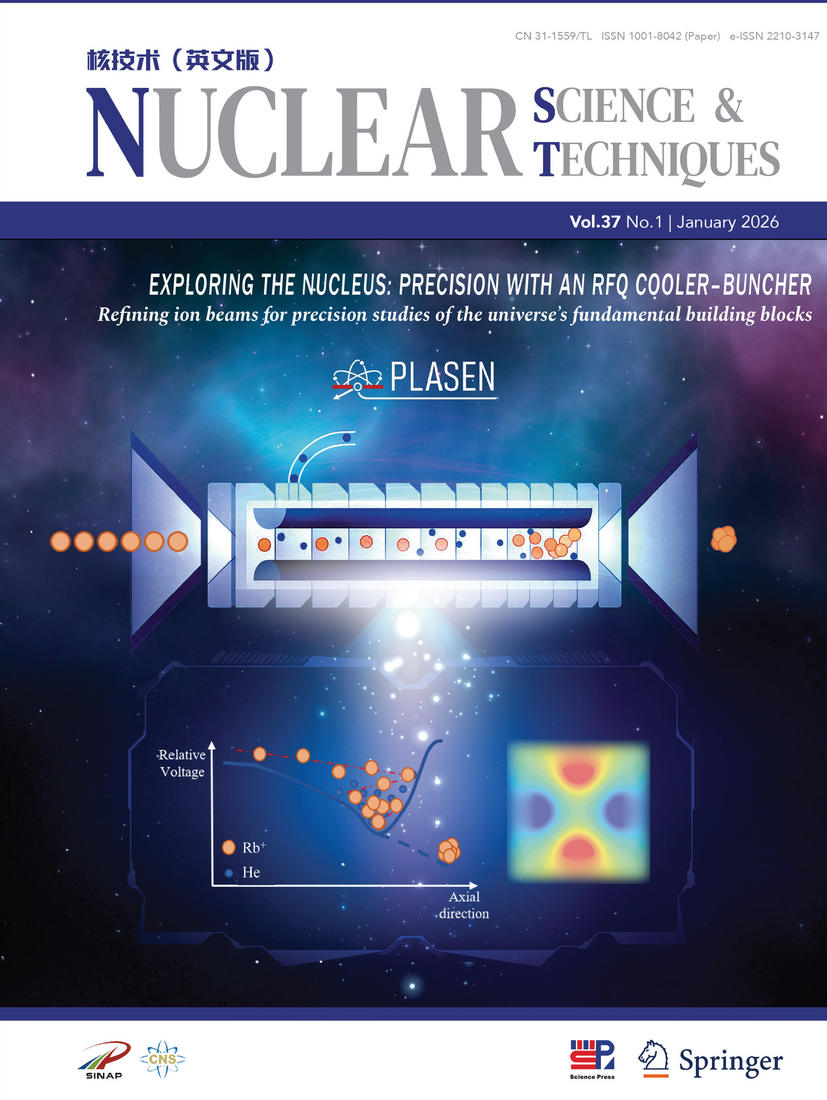
A RadioFrequency Quadrupole (RFQ) cooler-buncher system was developed and implemented in a collinear laser spectroscopy setup. This system converts a continuous ion beam into short bunches while enhancing the beam quality and reducing the energy spread. The functionality of the RFQ cooler buncher was verified through offline tests with stable rubidium and indium beams delivered from a surface ion source and a laser ablation ion source, respectively. Bunched ion beams with a full width at half maximum of approximately 2 μs in the time-of-flight spectrum were successfully achieved with a transmission efficiency exceeding 60%. The implementation of the RFQ cooler-buncher system also significantly improved the overall transmission efficiency of the collinear laser spectroscopy setup.
keyword:Collinear laser spectroscopy;Hyperfine structure;Time of flight;Radiofrequency quadrupole cooler-buncher;
Research article 07 Dec 2025
Xu-Nan Guo,Chang Cai,Fei Gao,Yang Lei,Kai-Hang Li,Chun-Lei Su,Ze-Peng Wu,Xiang Xiao,Ling-Feng Xie,Yi-Fei Zhao,Xiao-Peng Zhou
We present the preparation and measurement of the radioactive isotope 37Ar, which was produced using thermal neutrons from a reactor, as a calibration source for liquid xenon time projection chambers. 37Ar is a low-energy calibration source with a half-life of 35.01 days, making it suitable for calibration in the low-energy region of liquid xenon dark-matter experiments. Radioactive isotope 37Ar was produced by irradiating 36Ar with thermal neutrons. It was subsequently measured in a gaseous xenon time projection chamber (GXe TPC) to validate its radioactivity. Our results demonstrate that 37Ar is an effective and viable calibration source that offers precise calibration capabilities in the low-energy domain of xenon-based detectors.
keyword:37Ar;Gaseous Xenon detector;Low-energy;Calibration source;
Published on 20 Jan 2026
