
In high-energy physics (HEP) experiments, visualization software plays a pivotal role in detector design, offline software development, and event data analysis. The visualization tools integrate detailed detector geometries with complex event data models, providing researchers with invaluable insights into experimental results. Phoenix is an emerging general-purpose visualization platform for current and next-generation HEP experiments. In this study, we developed an event display software based on Phoenix for the CEPC experiment. It offers the necessary functionalities for visualizing detector geometries and displaying event data, allowing researchers to optimize detector design, test simulation and reconstruction algorithms, and analyze event data in a visualized manner. Additionally, we discuss the future applications of the event display software, including its use in online monitoring and the potential to build virtual reality projects for enhanced data visualization.
Vol.37, No.7
Select issueYearIssue
1220
NUCLEAR ELECTRONICS AND INSTRUMENTATION
Research article 10 Apr 2026
Zheng-Yun You,Yu-Mei Zhang,Tian-Zi Song,Xue-Sen Wang,Yu-Jie Zeng,Tao Lin
keyword:Visualization;CEPC;Event display;Phoenix;
Research article 11 Apr 2026
Lei Wang,Hao-Xuan Li,Yu-Kun Du,Meng-Lei Chen,Wei Lu,Ze-Xi Wang
The energy response of an imaging detector based on a monolithic crystal is highly dependent on the position of the gamma-ray interaction, which leads to a spectral drift of the imaging detector, known as the spectral drift related to incident position. This deteriorates the energy resolution of the detector and affects the selection of the energy window for imaging, resulting in artifacts in the reconstructed image. Thus, an energy-response correction method was proposed to improve the positional consistency of the detector-energy response. In both simulation and physical experiments, the method improved the full-energy peak consistency of the monolithic crystal detector, which improved the energy resolution of the detector, led to more accurate selection of the energy window, and improved imaging quality. In particular, in physical experiments after correction, the peak sites converged to 365 keV at each location, which reduced the half-height width of the characteristic peak (@365 keV) from 53 to 38 channels, and improved the energy resolution by 28.3%. Moreover, the incomplete mask was transformed into a complete mask projection, and the signal-to-noise ratio increased from 2.38 to 5.37.
keyword:SiPM array;Monolithic crystal detector;Spectral drift;Energy-response correction method;
Research article 11 Apr 2026
Shu-Kui Liu,Shin-Ted Lin,Xiao-Yu Peng,Chang-Hao Fang,Han-Yu Li,Qian-Yun Li,Ren-Ming-Jie Li,Yu Liu,Hao-Yu Shi,Qin Wang,Hao-Yang Xing,Yu-Lu Yan,Li-Tao Yang,Qian Yue,Jing-Jun Zhu
We present the results of an experiment conducted to measure cosmic-ray muons and muon-induced fluxes at the China Jinping Underground Laboratory (CJPL). Utilizing a 28-liter 0.5% gadolinium-doped liquid scintillator detector, which operated stably for 412 days in a 1-meter-thick polyethylene shielding, we reconstructed saturated signal pulses and pulse shape discrimination to facilitate measurements across a range starting from 0.2 MeV. The event rates incorporating the mountain geometry effects for cosmic rays and their induced particles were derived. The experimental results show that the cosmic ray muon flux is (3.64± 0.69stat.±0.25syst.) × 10-10 cm-2 s-1, muon-induced electron flux is (5.59 ± 1.06stat. ± 0.40syst.) × 10-10 cm-2 s-1, and the upper limit of the muon-induced neutron flux was 3.52 × 10⁻⁹ cm-2 s-1. They indicated that no significant excess was observed at a 90% confidence level, and no muon-induced neutrons above 10 MeVee were detected.
keyword:Neutron detector;Saturated signals;Cosmic ray;Muon flux;Signal reconstruction;
Research article 11 Apr 2026
Zhi-Gang Xiao,Yan Zhou,Da-Wei Si,Sheng Xiao,Jun-Huai Xu,Yu-Hao Qin,Xin Chen
The Čerenkov detector has a distinct advantage in constructing the reaction vertex and incident direction of energetic particles, thereby enabling the identification of emission sources. A novel approach is proposed to measure neutrino sources by employing a modular photomultiplier tube (PMT) array, utilizing clean and transparent deep seawater as the sensitive medium. The feasibility of detecting solar neutrinos was demonstrated through extensive simulations using the Geant4 package. These simulations incorporate the production and transport of Čerenkov photons generated by electron scattering, with the Hough transform method applied to enhance the accuracy of the vertex and direction reconstruction, particularly in the presence of noisy or incomplete data. The dominant background from γ-radiation due to 40K in seawater can be suppressed by a factor of 107 by introducing a threshold on the number of triggered PMTs. The total reconstruction efficiency increases with the incident energy, achieving 25% for 6 MeV neutrinos and 52% for 10 MeV neutrinos. For source localization, a sufficient number of neutrino events must be detected, depending on the background intensity above the threshold. The Hough transform was also applied to manage high noise levels during this process. The simulation results confirm the feasibility of detecting solar neutrinos using deep seawater, paving the way for future underwater neutrino detection systems.
keyword:Geant4;Energy resolution;Čerenkov;Direction Reconstruction;Hough Transform;Neutrino;
Research article 29 Apr 2026
Hai-Tao Wang,Yan Zhang,Chi Liu,Jian-Qiang Xu,Li-Jiao Zhang,Zhi-Feng Liu,Xiong-Jie Zhang,Rui Chen,Qi Liu,Ren-Bo Wang,Shu-Min Zhou,Bin Tang
The domestically developed prompt fission neutron uranium logging (PFNUL) instrument for uranium exploration represents a significant advancement in China’s deep uranium mining efforts, although it has considerable challenges and complexity. This paper presents the development of a new prompt fission neutron uranium logging instrument (named UNL4) that integrates a domestic D-T neutron generator, two 3He proportional detectors, a lanthanum bromide (LaBr3) gamma-ray detector, and a digital multi-channel pulse amplitude analyzer. The near 3He detector is shielded with 1 mm of cadmium (Cd) and 5 mm of high-density polyethylene (HDPE), enabling efficient epithermal neutron detection, whereas the far 3He detector measures thermal neutrons. A LaBr3 detector is employed for gamma-ray detection, primarily originating from uranium decay. High-speed Analog-to-Digital Converter (ADC) and Field Programmable Gate Array (FPGA) technologies are used to achieve rapid acquisition and transmission of both dual neutron time spectra and gamma spectra. Moreover, this paper proposes a fast signal shaping method, which reduces the dead time effect in 3He detectors on neutron time spectra. Experiments conducted in standard model boreholes with varying uranium contents demonstrated a strong linear relationship between the epithermal-to-thermal neutron ratio (E/T) and uranium content, with a fitting coefficient of R2>0.999, confirming the accuracy of the instrument. The E/T value repeatability, both in short-term (3.16% RSD) and long-term (1.2% RSD) measurements, showed excellent stability. In addition, the instrument demonstrated good performance at neutron-logging speeds of 0.3~3 m/min (E/T values) and gamma logging speeds of 1~10 m/min. Through measurements in two ore sections of the PU model with lithium contents of 87.1 ppm and 45.6 ppm, RD was found to be less than approximately 10% in both logging cases, satisfying the requirements for engineering applications. This marks the first successful development of a neutron-logging instrument for uranium exploration based on a domestic neutron generator and signifies an important contribution to uranium resource exploration.
keyword:Uranium exploration;Neutron-logging instrument;Pulsed neutron;Neutron time spectrum detection;
NUCLEAR PHYSICS AND INTERDISCIPLINARY RESEARCH
Research article 10 Apr 2026
Jian Li,Hao-Zhao Liang,Chuan-Xin Wang,Tomoya Naito
We propose an enhanced machine learning method to calculate the ground state of two-body systems. Compared to the original method [Phys. Rev. Research 5, 033189 (2023)], the present method enables consideration of the spin and isospin degrees of freedom by employing a non-fully-connected deep neural network and unsupervised machine learning technique. The validity of this method is verified by calculating the unique bound state of the deuteron.
keyword:Nuclear structure;Deep Neural Network;Unsupervised machine learning;Deuteron;
Research article 10 Apr 2026
Zhi-Qiang Chen,Pei-Yan Zhang,Rui Han,Roy Wada,Guo-Yu Tian,Bing-Yan Liu,Hui Sun,Xin Zhang,Rui Guo,Ze-Kun Zhang,Qin Li,Fu-Dong Shi
High-energy neutron-induced fission data for actinide nuclides are vital role in the foundation for designing advanced nuclear energy systems, such as accelerator-driven subcritical systems and fast neutron reactors. In this study, the INCL++ code was used to calculate neutron-induced fission cross sections in the energy range of 100 MeV to 1.2 GeV. Bayesian optimization was employed to refine the parameters in the ABLA++ and GEMINI++ codes, ensuring closer agreement between the computational results and experimental data. We trained a Bayesian neural network using neutron-induced fission data and systematically compared the extrapolations with both theoretical calculations and experimental measurements. The results show that the Bayesian optimization method effectively reduces the chi-squared statistic between the theoretical predictions and the experimental data. Additionally, the Bayesian neural network demonstrates the ability to accurately reflects the trends of fission cross sections when sufficient training data are provided.
keyword:Bayesian neural network;Spallation reaction;Bayesian optimization;Fission;INCL;
Research article 11 Apr 2026
Rui-Rui Xu,Wen Luo,Xin-Xiang Li,Yu-Long Shen,Zhi-Cai Li,Ting-Kai Ma,Wen-Yu Tan,Ting Wu,Ji-Min Wang,Xi Tao,Gong-Tao Fan
Systematic disagreements exist mainly in the available partial photoneutron cross sections σ(γ, inX)(i=1, 2), which were measured using quasimonoenergetic annihilation photons at the Saclay (France) and Livermore (USA) laboratories based on neutron multiplicity sorting methods. In this study, the reliability of the σ(γ, inX) for 142-146,148,150Nd isotopes obtained at Saclay was evaluated using an experimental-theoretical method that satisfies the data reliability criteria proposed based on the theoretical model in TALYS. Our evaluations were then compared with the major Evaluated Nuclear Data Libraries, and the differences from the available experimental data were analyzed. It was found that the σ(γ, 1nX) data of Saclay were overestimated and the σ(γ, 2nX) data were underestimated in the 144-146,148,150Nd cases, which is consistent with the conclusion of Varlamov; on the contrary, the σ(γ, 1nX) were underestimated and the σ(γ, 2nX) were overestimated in the 142,143Nd cases. Possible reasons for the above inconsistency in the Nd isotopes were further analyzed. Interestingly, subtracting the contribution of isotopic target impurities significantly reduced the discrepancy in the 143Nd case. However, this is no longer applicable to the 142Nd case, and other factors, including the detector efficiency and accidental-coincidence events, should be fully considered to resolve such discrepancies.
keyword:TALYS;Partial photoneutron cross sections;142-146;148;150Nd;Experimental-theoretical method;Evaluated data;
Research article 11 Apr 2026
Xian-Ye Wu,En-Fu Zhou,Jian Xiang,Jiang-Ming Yao,Peter Ring
We present a new development in the multireference covariant density functional theory (MR-CDFT) for the low-lying states of odd-mass nuclei by mixing configurations with different intrinsic quadrupole shapes and different K quantum numbers. All configurations are projected onto the good particle numbers and angular momenta. The success of this newly developed framework is illustrated in its application to the low-lying states of 43S near the neutron magic number N=28 with shape coexistence. Our results indicate that the ground state, 3/21−, is predominantly composed of the intruder prolate one-quasiparticle (1qp) configuration ν1/2-[321]. In contrast, the 7/21− state is identified as a high-K isomer, primarily built on the prolate 1qp configuration ν7/2-[303]. Additionally, the 3/22− state is found to be an admixture dominated by an oblate configuration with Kπ = 1/2-, along with a small contribution from a prolate configuration with Kπ = 3/2-. These results demonstrate the capability of MR-CDFT to capture the intricate interplay among shape coexistence, configuration mixing, and isomerism in the low-energy structure of odd-mass nuclei around N = 28, without invoking triaxiality.
keyword:Generator Coordinate Method;Nuclear Density Functional Theory and extensions;Collective levels;Quantum number projection;
Research article 15 Apr 2026
Guo-Liang Ma,Xiang-Pan Duan,Tan Luo
We present a comprehensive study of jet substructure observables in pp and PbPb collisions at sNN=5.02 TeV using a multi-phase transport model. To suppress background contamination, the constituent subtraction method was employed for both PbPb and smeared pp events. The jet splitting momentum fraction (zg) and the ratio of the groomed jet mass to the ungroomed jet transverse momentum (Mg / pT,jet) were reconstructed using the Soft Drop algorithm with two grooming parameter settings. With zcut = 0.1 and β = 0.0, a slight modification in the zg distribution is observed in central PbPb collisions, whereas a pronounced enhancement in the high Mg / pT,jet region is found, particularly at low pT,jet and in more central events. A detailed analysis of the dynamical evolution stages revealed that this enhancement primarily originates from jet-medium interactions, whereas the contributions from hadronization and hadronic rescatterings are largely mitigated by the grooming procedure. In contrast, under a stronger grooming condition (zcut = 0.5, β = 1.5), no significant changes in Mg/pT,jet are observed, indicating that the medium-induced modifications are predominantly associated with large-angle scattering within the AMPT framework.
keyword:Quark-Gluon Plasma;Heavy-ion collisions;Transport model;Jet quenching;
Research article 15 Apr 2026
Marina Chadeeva,Platon Rogozhin,Timofey Uglov
A detailed study of particle identification by the Focusing Aerogel Ring Imaging CHerenkov subsystem at the future charm superfactory detector is presented. A dedicated signal ring reconstruction algorithm was implemented in the detector simulation, considering realistic operating conditions. The algorithm performance was tested using single particles generated within the Aurora framework. Two boosted decision trees-based classifiers for particle identification were developed for moderate and the most conservative assumptions about photosensor noise levels. The approach is validated with the analysis of the D0→Kμνμ decays, for which the systematic uncertainty and background contribution related to the π/μ separation performance can be minimized owing to the high efficiency of the particle identification algorithm.
keyword:Particle identification;Boosted Decision Trees;Charm superfactories;Cherenkov detector;
Research article 16 Apr 2026
Ye Yan,Qi Huang,Qian Wu,Hong-Xia Huang,Jia-Lun Ping
Inspired by recent research on the pΩ and pΛ¯ systems, we investigate the pΩ¯ systems within the framework of the quark delocalization color-screening model. Our results indicate that the nucleon-Ω¯ interaction is slightly stronger than the nucleon-Ω interaction, implying a higher likelihood of the pΩ¯ system to forming bound states. Dynamic calculations show that the pΩ¯ systems with JP=1- and 2- form bound states, whose binding energies are deeper than that of the pΩ system with JP=2+. The scattering phase shifts and extracted scattering parameters also support the existence of pΩ¯ bound states. Additionally, we discuss the behavior of the femtoscopic correlation function for pΩ¯ pairs for the first time. Building on the recent experimental progress on the pΩ correlation function, future femtoscopic investigations of the pΩ¯ system in heavy-ion collisions will be particularly valuable for constraining baryon-antibaryon interactions.
keyword:pΩ¯]]>; systems;Femtoscopic correlation function;Bound states;Hadron-hadron interaction;Scattering phase shifts;
Research article 22 Apr 2026
Chun-Wang Ma,Gong-Tao Fan,Jin-Gen Chen,Pu Jiao,Meng-Die Zhou,Chun-Yuan Qiao,Hong-Wei Wang,Hui-Ling Wei
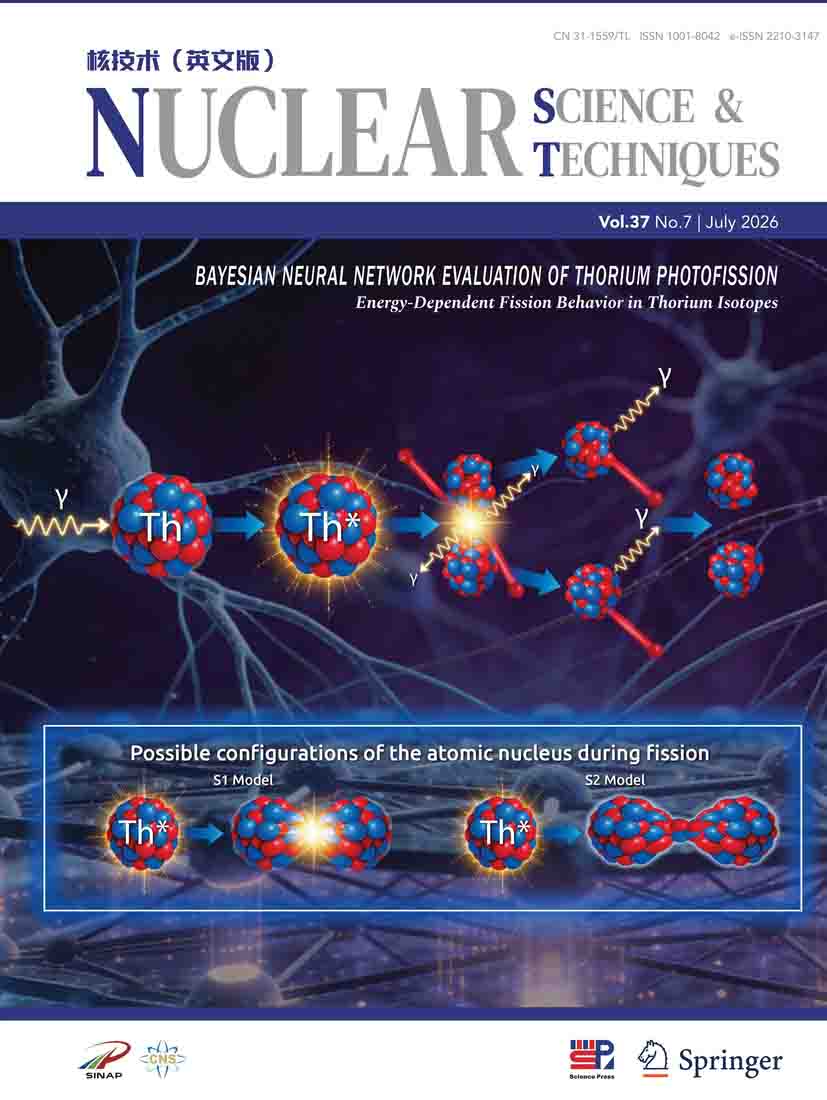
The fragment yields in photon-induced fission reactions of thorium (Th) isotopes are important in modern nuclear energy applications and in the evolution of the nuclear structures of their isotopic chains. Bayesian neural network (BNN) models were constructed to describe the fragment yields in photonuclear fission reactions of thorium isotopes, ranging from 216Th to 232Th, including those of 232Th, at various incident photon energies. The predicted results of the optimized BNN models were in good agreement with the measured data for these reactions. The double-layer BNN models successfully illustrated the systematic transition from asymmetric to symmetric fission in thorium isotopes, including the associated odd-even effects, energy dependence, and leftward shift in mass yield distributions. The developed BNN models provide a new tool for predicting the fragment yields in thorium photonuclear fission reactions.
keyword:Bayesian neural network;232Th;Photonuclear fission reaction;Thorium isotopes;Total element yield;Mass chain yield;Odd-even staggering phenomenon;
ACCELERATOR, RAY AND APPLICATIONS
Research article 10 Apr 2026
Yuan He,Guo-Chang Liu,Tian-Cai Jiang,Zong-Heng Xue,Ji-Yu Wang,Ke-An Jin,Meng-Xin Xu,Zhou-Li Zhang,Chun-Long Li,Qi-Tong Huang,Sheng-Xue Zhang,Sheng-Hu Zhang
The Institute of Modern Physics (IMP) of the Chinese Academy of Sciences (CAS) has designed and prototyped fundamental power couplers for 81.25 MHz superconducting quarter-wave resonators (QWR) in the High-Intensity Heavy-Ion Accelerator Facility (HIAF). The QWR coupler operates in the pulsed or continuous-wave mode with an average power of 6 kW. This coupler is designed with a 50 Ω coaxial structure and a dual-disk warm-window assembly. Focusing on the optimized heat leakage, a double-walled structure is applied to the outer conductor of the coupler for helium gas cooling at 5 K. To suppress multipacting (MP), a 10 nm titanium nitride (TiN) coating is applied to the vacuum side of the ceramic window, whereas a DC bias voltage is applied to the inner conductor. To reduce the production cost of the coupler and make it suitable for mass production, various coupler fabrication materials were tested, and the feasibility of the fabrication process was verified. The coupler includes two types of diagnostic ports for vacuum and ARC monitoring. Two prototype couplers were fabricated and tested for high-power conditioning. The QWR couplers proved their robustness with 10 h of 9 kW traveling wave conditioning and 12 h of 9 kW standing wave conditioning, achieving a stabilized 9 kW power level and a stable vacuum. As predicted, MP barriers were encountered at input powers ranging from 1 kW to 9 kW, and a DC bias voltage of 800 V effectively suppressed the occurrence of MP.
keyword:81.25 MHz fundamental power coupler;Superconducting quarter-wave resonator;High power conditioning;
Research article 16 Apr 2026
Ji-Wei Lai,Tong-Tong Zhu,Ming-Ming Yu,Yun-Peng Cao,Hong-Wen Cao,Yi-Han Wang,Kun Zhang
Time-of-flight secondary-ion mass spectrometry (TOF-SIMS) is a powerful molecular imaging tool used in biomedical research. To overcome the low yield of non-fragmented molecular ions obtained by conventional (keV) SIMS, a novel SIMS method using MeV heavy primary ions (MeV-SIMS) has gained increasing scientific attention in recent years. We intend to develop an MeV-SIMS setup with a capillary microprobe system based on the 3 MV tandem accelerator as the first MeV-SIMS system in China. Instead of conventional magnetic or electrostatic lenses, a tapered glass capillary is used to collimate the ion beam in this device. To verify the feasibility of collimating or focusing MeV heavy ions using this capillary, understanding the main physical behaviors of MeV heavy ions interacting with the capillary is crucial. In this study, a Monte Carlo simulation program based on the Stopping and Range of Ions in Matter software is developed. The calculated energies and trajectories of heavy ions (e.g., I ions) are less affected by scattering, and both the scattered ions and recoil atoms ejected from the capillary are well separated from the direct beam in the target area. Under multiple scatterings, the contribution of the first scattering predominates. These results indicate that the capillary exhibits better collimation for heavy ions. In addition, the transmission of direct beams at different air pressures is observed. Heavy ions lose less energy at the same pressure; however, their trajectories are more divergent. The direct beam ions are not affected by the scattered ions at 100 Pa, making it feasible to perform MeV-SIMS analysis under ambient pressure.
keyword:Monte Carlo simulation;MeV-SIMS;Glass capillary;Focusing effect;Ion-capillary interactions;Air pressure;
Research article 17 Apr 2026
Jun-Xia Wu,Guang-Yu Zhu,Jia-Jian Ding,Jian-Chuan Zhang,Wei-Ping Chai,Guo-Dong Shen,Zi-Shuai Qiu,Yong-Liang Yang,Jun Meng,Jian-Cheng Yang
The dynamic vacuum effect is the primary constraint on beam intensity in high-intensity heavy-ion synchrotrons. The dynamic vacuum effect induced by the charge exchange beam loss significantly limits the ion intensity and beam lifetime in the booster ring (BRing) of the HIAF. The collimator is a critical and indispensable component for mitigating the dynamic vacuum effect in high-intensity heavy-ion circular accelerators. A dedicated collimation system was designed for BRing to decrease ion-induced gas desorption and suppress the dynamic vacuum effect. Nevertheless, this intercepting structure may introduce longitudinal and transverse beam coupling impedances in BRing. In this study, comprehensive investigations were conducted to characterize the beam-coupling impedance of a movable collimator. Furthermore, we systematically describe the results of the single- and two-wire bench transmission measurements and numerical simulations. Satisfactory agreement was obtained between the numerical simulations and wire transmission bench measurements. The heat deposition power on each part of the collimator due to the longitudinal impedance was evaluated. The 24 movable collimators were processed and entered the online installation stage of the Booster Ring.
keyword:Impedance bench measurement;Collimator;Longitudinal impedance;Booster Ring (BRing);Transverse impedance;Wire transmission method;
Research article 02 May 2026
Cao-Lin Zhang,Jiang-Mei Zhang,Hao-Lin Liu,Shu-Ya Qin,Jia-Qi Wang
Qualitative identification and analysis of radioactive nuclides in unknown environments are essential for the remote monitoring and prompt early warning of radioactive contamination. In recent years, deep-learning techniques have made significant strides in automated qualitative identification. However, the quantitative analysis of radioactive nuclides still depends on traditional methods to determine peak positions and boundaries. These methods often require extensive manual expertise and parameter tuning and thus fail to meet the demands of unmanned remote monitoring. This paper presents a novel framework for automatic full-energy peak segmentation, called YOLOSpecNN. We introduce a multi-root mean square error joint optimization function and a unified regression model capable of simultaneously predicting the central position, boundaries, and confidence of full-energy peaks. To address the challenge of low recall rates due to narrow, low-intensity, and overlapping peaks, we propose a new multiscale context feature extraction module (MSNN module). This module effectively enhances the local detailed features and significantly improves the recall rates. The effectiveness of the proposed method is validated using six artificial radioactive nuclides (241Am, 57Co, 131I,134Cs,137Cs, and 60Co) along with 40K, and a mixed-energy spectrum dataset is constructed for quantitative evaluation. The experimental results show that the proposed method significantly outperforms traditional approaches, achieving a precision of 0.998, a recall of 0.95, the best F1 score of 0.974@0.427, and an average precision of 0.946. Compared with traditional morphological methods, the proposed method improves the precision, recall, and best F1 score by 0.512, 0.199, and 0.391, respectively. Ablation experiments further reveal that the MSNN module notably enhances the recall by 0.067. Moreover, the proposed method performs excellently even in challenging environments with low gross counts and a low signal-to-noise ratio (SNR), achieving state-of-the-art results. Additionally, the model achieves an average real-time inference performance of 16.1941 ms on a 15-W low-power device. Overall, the proposed method demonstrates exceptional performance in the automatic search and segmentation of full-energy peaks, offering robust support for the implementation of unmanned remote radiation monitoring systems.
keyword:Gamma spectroscopy;Gamma-ray spectral analysis;Peak searching and segmentation;Interdisciplinary;
NUCLEAR ENERGY SCIENCE AND ENGINEERING
Research article 10 Apr 2026
Jin-Sen Xie,Zhi-Cheng Qian,Zhi-Hong Zhang,Jun Cai,Jian-Hua Wang,De-Feng Chen,Chang-Yuan Li,Xian-Wei Guo,Hui-Quan Li
Boron-containing compounds have gained significant attention as effective additives for enhancing the performance of composite materials. This study systematically investigates the key factors influencing the neutron shielding efficiency of various boron compounds, including mass density, boron content, and boron number density (atoms/nm3), to establish guidelines for their optimal selection in radiation shielding applications. The effective removal cross-section (∑R) for fast neutrons was evaluated using Phy-X and NXcom software, whereas the macroscopic cross-section (∑) for thermal neutrons was calculated via Monte Carlo N-Particle (MCNP) simulations and manual computations. The results demonstrate that mass density and boron number density are the dominant factors for fast neutron shielding, with ∑R values ranging from 0.082 cm-1 (KBH4) to 0.225 cm-1 (WB2). For thermal neutrons, the boron number density is the primary determinant of shielding performance, with ∑ values of 4070.34 cm-1 for GdB6, 474.67 cm-1 for ZrB12, and 447.37 cm-1 for B4C. Notably, GdB6 exhibits exceptional thermal neutron shielding owing to the high absorption cross-section of 157Gd. These findings provide critical insights for designing advanced shielding materials, emphasizing the synergistic effects of density and boron number density to optimize neutron attenuation.
keyword:Boron-containing compounds;Neutron shielding properties;Shielding impact factors;
Research article 17 Apr 2026
Yang-Bo Nie,Xin-Yi Pan,Shi-Yu Zhang,Yan-Yan Ding,Qi Zhao,Kuo-Zhi Xu,Xiao-Yu Wang,Bei-Bo He,Hong-Tao Cheng,Xi-Chao Ruan,Jie Ren
Zirconium (Zr) and its alloys are critical materials in nuclear reactors because of their low neutron absorption cross-section, high-temperature stability, and excellent corrosion resistance. The accuracy and reliability of nuclear data evaluated for Zr isotopes are directly related to the safety and efficiency of nuclear engineering. To provide experimental data for refining Zr nuclear data, we obtained the leakage neutron time-of-flight (TOF) spectra of natural Zr samples with three thicknesses at six angles using the D-T fusion neutron source in an integral experimental setup. The experimental results were compared with simulated TOF spectra generated using the Monte Carlo N-Particle Transport Code and nuclear data libraries, including CENDL-3.2, ENDF/B-VIII.0, JEFF-3.3, and JENDL-5. An analysis of the calculated-to-experimental ratios revealed the following: (1) The CENDL-3.2 library lightly underestimated elastic scattering at small angles but significantly overestimated it at larger angles and in discrete inelastic scattering ranges. (2) The ENDF/B-VIII.0 library significantly underestimated the discrete inelastic scattering ranges. (3) The JEFF-3.3 library consistently overestimated the measurements in both the elastic and discrete inelastic scattering ranges. (4) The JENDL-5 library demonstrated the best agreement with the experimental data among all libraries. These results highlight the inconsistencies in existing nuclear data for Zr isotopes and emphasize the necessity for further refinement to enhance their accuracy and reliability.
keyword:Evaluated nuclear data;Leakage neutron spectra;Shielding integral experiment;Slab Zr;
Research article 17 Apr 2026
Yi-Qing Zhang,Ai-Kou Sun,Cheng-Wei Liu,Ya-Nan Zhao,Tao Yu,Qian Guo,Zhen-Ping Chen
The interaction and feedback between 3D neutronics and thermal hydraulics are of great significance in reactor safety analyses, particularly for the TRIGA reactor. Owing to the TRIGA reactor’s pulse-transient operation status, the power changes by six to eight orders of magnitude within an extremely short duration; this operation is significantly different from PWRs and imposes some challenges for conventional neutronics methods. To describe the transient status of rod insertion or withdrawal, a novel time-dependent particle transport algorithm based on the combined and moving geometry methods is developed and integrated into the neutronics code MagicMC, which is a Monte Carlo particle transport code developed by the Nuclear Energy and Application Laboratory (NEAL). Combined with subchannel model, this work presents neutronics and thermal-hydraulics coupling methods for high-fidelity simulation of the TRIGA reactor. First, a steady-state coupling method is established based on overrelaxation iteration, and the number of neutrons in the Monte Carlo simulation is adaptively controlled according to convergence. Subsequently, a transient coupling method is proposed based on the semi-implicit coupling strategy, and a dynamically changing time-step strategy is designed for the coupling iterative process to achieve reasonable convergence. The parameter mapping strategy between neutronics and thermal hydraulics was constructed using one-to-one mapping and volume weight methods. To verify the reliability of the methods, a JSI TRIGA Mark II reactor was selected as the validation benchmark. The coupling results were in good agreement with the experimental data of the JSI TRIGA Mark II reactor, and the coupling methods achieved a high-fidelity numerical simulation of TRIGA reactor. Therefore, the coupling methods proposed in this paper can provide technical support for reactor experiments and the safe operation of the TRIGA reactor.
keyword:Thermal-hydraulics;Neutronics;Time-dependent Monte Carlo;Transient coupling;TRIGA reactor;
Research article 12 May 2026
Zhao-Yang Yu,Shi-Hua Qiao,Liang Chen,Yao Shen,Ling-Ti Kong,Zheng-Cao Li
Developing an irradiation embrittlement predictive model for low-Cu reactor pressure vessel steels is essential for extending the life of modern pressurized water reactors. Irradiation-produced dislocation loops are recognized as the leading causes of embrittlement, surpassing the mechanism of Cu clustering with a reduction in Cu content in modern steels. Extensive data have been accumulated from surveillance programs on high-Cu steels used in old reactors. The extrapolation of these data to low-Cu systems for embrittlement prediction requires a comprehensive understanding of the interactions between Cu, particularly Cu-rich clusters, and radiation defects. Therefore, in this study, ab initio calculations of vacancy aggregation in solute clusters containing Cu, Ni, Mn, and Si were performed. The interactions between the solute elements and vacancies in the solute clusters and Fe matrix were analyzed. The results demonstrated the occurrence of attractive interactions between the Cu clusters and vacancies. The addition of Si and the synergistic effect between Ni and Mn facilitated vacancy aggregation in the solute clusters. The behavior of Mn correlated with its magnetic state, and the size effects of the solute elements were analyzed.
keyword:Reactor pressure vessel;Irradiation embrittlement;Ab initio calculations;Solute clusters;Radiation defects;
NUCLEAR CHEMISTRY, RADIOCHEMISTRY, AND NUCLEAR MEDICINE
Research article 12 May 2026
Zhi-Wei Zheng,Xue-Zheng Yue,Jin-Cheng Wang,Juan Hou
Microstructural characterization of materials is fundamental for predicting macroscopic properties; however, it is typically influenced by characterization techniques and user subjectivity. In terms of irradiated materials, electron microscopy reveals significant variations in helium-bubble characteristics owing to diverse imaging conditions and task-specific requirements, thus necessitating robust statistical analysis. This study presents a novel approach that combines deep-learning and machine-learning methodologies to address these challenges. We introduce an Interactive image-segmentation technique that utilizes minimal user annotations to guide a model in identifying and segmenting regions of interest. To overcome the limitations of existing deep-learning methods in detecting helium nanobubbles, we implement advanced computer vision-based machine-learning algorithms. This user-guided interactive machine-learning framework enables the extraction of relevant helium bubbles customized to specific user requirements, thereby mitigating the potential biases inherent in previous model annotations. Our methodology demonstrates enhanced accuracy and adaptability in helium-bubble analysis within irradiated materials, thereby contributing to more precise microstructural characterizations. The proposed approach is applicable to a wide range of material-science applications, thus offering a more objective and user-centric method for analyzing complex microstructural features.
keyword:helium bubble;Artificial Intelligence;Nuclear irradiation;TEM analysis;Microstructural analysis;
Published on 20 Jul 2026
