
As the primary functional component of a fusion reactor, the fusion blanket pebble bed, composed of numerous particles, is crucial for tritium breeding, neutron multiplication, and radiation shielding. Particles within tritium-breeding pebble beds are subjected to prolonged neutron irradiation, high thermal loads, and strong magnetic fields in fusion environments. Such conditions render them susceptible to pulverization and fragmentation. The resulting fragments and powders migrate and are deposited into the gas channel, driven by the purge gas. The reduction in the effective flow area of the gas increases the flow resistance, resulting in tritium retention, degraded heat transfer, and other adverse effects. These conditions impair the thermodynamic properties of the pebble beds and hinder the self-maintenance of tritium. Limited information exists on powder migration and clogging mechanisms in fusion blanket pebble beds, particularly under diverse physical conditions. The aim of this study was to use a computational fluid dynamics model coupled with the discrete element method (CFD-DEM) to numerically explore powder migration and clogging in pebble beds. The model considers factors such as breeder orientation, purge velocity, powder size distribution, and friction coefficient. We propose two migration and clogging mechanisms. One involves powder with a large particle size, and the other does not. The results indicate that the powder migration velocity progresses through three stages: rapid decay, linear decay, and stability. Pebble-bed clogging manifests in two forms: extensive superficial clogging and uniform internal clogging. Two fitted curves were used to depict the migration and clogging tendencies. The powder size distribution significantly influenced the powder migration. The breeder orientation, powder size, and friction coefficient affected the distribution of the clogging powders. However, the impact of the purge velocity on powder migration and clogging in pebble beds was limited, and this effect varied significantly with different particle size ratios. Based on the analysis, a formula is proposed to characterize the behavior of the powder in the pebble beds. The results of this study can aid in analyzing and predicting powder dynamics in pebble beds.
Vol.37, No.2
Select issueYearIssue
1214
NUCLEAR ENERGY SCIENCE AND ENGINEERING
Research article 02 Jan 2026
Ming-Zhun Lei,Xue-Tao Cui,Qi-Gang Wu,Jian Wang,Yun-Tao Song
keyword:Coupled CFD-DEM;Pebble beds;Purge gas;Powder flow;Migration and clogging mechanism;
Research article 03 Jan 2026
Gui-Feng Zhu,Chang-Qing Yu,Ya-Fen Liu,Yang Zou,Rui Yan,Shu-Yang Jia,Jian Guo,Bo Zhou,Xue-Chao Zhao,Xiao-Han Yu
Knowing the precise relationship between fuel loading and reactivity is essential for guiding reactor criticality extrapolation and online refueling in molten salt reactors (MSRs). This study aims to explore and explain the linear relationship between reactivity and the reciprocal of uranium concentration in thermal-spectrum MSRs. By applying neutron balance theory, we analyzed the neutron absorption cross sections of various nuclides in single-lattice models with varying fuel concentrations. Our findings reveal a simple linear correlation between reactivity and the reciprocal of uranium concentration, which can be explained from the perspective of nuclear reaction cross sections that adhere to the 1/v law in the thermal neutron spectrum. Furthermore, we identified that the neutron absorption single-group cross sections of structural materials and carrier salts exhibit an approximately linear relationship with the fission single-group cross section of 235U; similarly, the reciprocal of 235U’s fission cross section exhibits an approximately linear relationship with uranium concentration. This linear relationship deviates as the volume fraction of molten salt increases, due to a greater proportion of neutrons being captured in the resonance energy spectrum. However, it remains valid for molten salt volume fractions up to 25% and demonstrates broad applicability in the physical design and operation of thermal molten salt reactors.
keyword:Molten salt reactor;Reactivity;Cross sections;Uranium concentration;Linear;
Research article 03 Jan 2026
Fu-Lin Zeng,Xiao-Long Zhang,Peng-Cheng Zhao,Zi-Jing Liu
Amidst the growing global emphasis on nuclear safety, the integrity of nuclear reactor systems has garnered attention in the aftermath of consequential events. Moreover, the rapid development of artificial intelligence technology has provided immense opportunities to enhance the safety and economy of nuclear energy. However, data-driven deep learning techniques often lack interpretability, which hinders their applicability in the nuclear energy sector. To address this problem, this study proposes a hybrid data-driven and knowledge-driven artificial intelligence model based on physics-informed neural networks to accurately compute the neutron flux distribution inside a nuclear reactor core. Innovative techniques, such as regional decomposition, intelligent keff (effective multiplication factor) search, and keff inversion, have been introduced for the calculation. Furthermore, hyper-parameters of the model are automatically optimized using a whale optimization algorithm. A series of computational examples are used to validate the proposed model, demonstrating its applicability, generality, and high accuracy in calculating the neutron flux within the nuclear reactor. The model offers a dependable strategy for computing the neutron flux distribution in nuclear reactors for advanced simulation techniques in the future, including reactor digital twinning. This approach is data-light, requires little to no training data, and still delivers remarkably precise output data.
keyword:Effective multiplication factor;Neutron diffusion equation;Physics informed neural network;Whale optimization algorithm;
Research article 04 Jan 2026
Wei-Jun Wang,Jing-Gang Qin,Yong-Sheng Wu,Jing Jin,Jin-Hao Shi,Yi-Fei Wu,Zheng-Ping Tu,Xiao-Wei Chen,Jian-Gang Li,Huan Jin
A low-temperature-resistant and high-strength stainless-steel jacket is a key component in the superconducting magnet of a fusion reactor. The development of cryogenic structural materials with high strength and toughness poses a challenge for the future development of high-field superconducting magnets in fusion reactors. The yield strength of the International Thermonuclear Experimental Reactor developed for low-temperature structural materials at 4.2 K is below 1100 MPa, which fails to meet the demand for structural components with yield strengths exceeding 1500 MPa at 4.2 K in future fusion reactors. CHSN01 (formerly N50H), which is a low-temperature structural material developed in China, exhibits exceptional strength and toughness, thereby making it highly promising for practical applications. Recently, a 30 t jacket measuring approximately 5000 m in total length was produced. Its low-temperature mechanical properties were tested using a sampling method to ensure compliance with application requirements. This paper presents the experimental data of the CHSN01 jacket and tests of the physical properties of the material in the temperature range of 4 K–300 K. The physical properties were unaffected by magnetic field. Furthermore, this paper discusses the feasibility of employing CHSN01 as a cryogenic structural material capable of withstanding high-magnetic fields in next-generation fusion reactors.
keyword:Fusion reactor;CHSN01;CICC jacket;Cryogenic steel;
NUCLEAR CHEMISTRY, RADIOCHEMISTRY, AND NUCLEAR MEDICINE
Research article 03 Jan 2026
Qing-Zhi Zhou,Shao-Hua Hu,Qi Qiu,De-Tao Xiao,Xiang-Yuan Deng,Xiang-Yu Xu,Peng-Hao Fan,Lei Dai,Zhi-Wen Hu,Tao Zhu
Physics-informed neural networks (PINNs) are vital for machine learning and exhibit significant advantages when handling complex physical problems. The PINN method can rapidly predict 220Rn progeny concentration and is very important for regulating and measuring this property. To construct a PINN model, training data are typically preprocessed; however, this approach changes the physical characteristics of the data, with the preprocessed data potentially no longer directly conforming to the original physical equations. As a result, the original physical equations cannot be directly employed in the PINN. Consequently, an effective method for transforming physical equations is crucial for accurately constraining PINNs to model the 220Rn progeny concentration prediction. This study presents an equation adaptation approach for neural networks, which is designed to improve prediction of 220Rn progeny concentration. Five neural network models based on three architectures are established: a classical network, a physics-informed network without equation adaptation, and a physics-informed network with equation adaptation. The transport equation of the 220Rn progeny concentration is transformed via equation adaption and integrated with the PINN model. The compatibility and robustness of the model with equation adaption is then analyzed. The results show that PINNs with equation adaption converge consistently with classical neural networks in terms of the training and validation loss, and achieve the same level of prediction accuracy. This outcome indicates that the proposed method can be integrated into the neural network architecture. Moreover, the prediction performance of classical neural networks declines significantly when interference data are encountered, whereas the PINNs with equation adaption exhibit stable prediction accuracy. This performance demonstrates that the proposed method successfully harnesses the constraining power of physical equations, significantly enhancing the robustness of the resultant PINN models. Thus, the use of a physics-informed network with equation adaption can guarantee accurate prediction of 220Rn progeny concentration.
keyword:Machine learning;220Rn progeny;Physics-informed neural networks;Equation adaption;
Research article 04 Jan 2026
Si-Yi Qiu,Yan-Lin Gu,Yu-Yu Guo,Hui Liu,Lei Huang,Ai-Jun Huang,Juan Hou
350 keV He+ ions were injected into laser powder bed fusion (LPBF)–processed 304L stainless steel and traditional rolled 304L stainless steel with a flux of 1×10¹⁷ ions/cm2 at room temperature, followed by annealing at 750 °C for 10, 100, and 300 h, respectively. The results showed that material swelling due to helium bubble coarsening was almost not observed in either the LPBF or rolled samples after 10 h of annealing duration. Rapid coarsening and swelling of bubbles occurred in the rolled samples, but only moderate bubble growth occurred in the LPBF sample after annealing for 100 h. After annealing for 300 h, the helium bubbles in both samples tended to grow steadily. For 10 h of annealing, the irradiated samples were in a disequilibrium state, and the apparent activation energy (Eact) calculated by the Arrhenius model determined that helium atoms tended to diffuse through the displacement mechanism, and helium bubbles grew under the migration and coalescence (MC) mechanism. With annealing times over 100 h, the high-density dislocations and nano-oxide particles in the LPBF sample still had a strong trapping effect on the movement and growth of helium bubbles. After annealing for 300 h, the cellular subgrains in the LPBF sample decomposed, and the nano-oxide particles had no trapping effect on the helium bubbles. At this time, the dislocation structure played a primary role in suppressing the growth of helium bubbles, and the radiation resistance of the LPBF sample remained superior to that of the rolled samples.
keyword:Helium atom diffusion;Helium bubble growth;Selective laser melting of stainless steel;Annealing time;Local microstructure;
Research article 05 Jan 2026
Li-Qing Zhang,Yang Gao,Shuang Liu,Qin-Wei Wang,Ya-Xun Zhang,Rui Li,Chong-Hong Zhang,Lei Zhou,Qiang Zhou,Chen-Chun Hao,Rong Qiu
Single crystal GaN epilayers were irradiated with heavy inert-gas ions (2.3-MeV Ne8+, 5.3-MeV Kr19+) to fluences ranging from 1.0×1.011 to 1.0×1.015 ions/cm2. The strain-related damage accumulation versus ion fluences was studied using high-resolution X-ray diffraction (HRXRD) and ultraviolet–visible (UV-Vis) spectroscopy. The results showed that the damage accumulation was mainly dominated by nuclear energy loss. When the ion fluence was less than ~0.055 displacement per atom (dpa), the lattice expansions and lattice strains markedly increased linearly with increasing ion fluences, accompanied by a slow enhancement in the dislocation densities, distortion parameters, and Urbach energy for both ion irradiations. Above this fluence (~0.055 dpa), the lattice strains presented a slight increase, whereas a remarkable increase was observed in the dislocation densities, distortion parameters, and Urbach energy with the ion fluences after both ion irradiations. ~0.055 dpa is the threshold ion fluence for defect evolution and lattice damage related to strain. The mechanisms underlying the damage accumulation are discussed in detail.
keyword:GAN;UV-Vis spectra;Gas-ion irradiation;HRXRD;Strains;Urbach energy;
Research article 05 Jan 2026
Jian-Qiang Wang,Qing Shao,Yue Lu,Dun Jin,Ling-Hong Luo,Xiu-Lin Wang,Hui-Chao Yao,Ruo-Yun Dai,Cheng-Zhi Guan,Guo-Ping Xiao
When the operating temperature of a Solid Oxide Electrolysis Cell (SOEC) is lower than the outlet temperature of a nuclear reactor, the reactor can be directly coupled with the SOEC as a high-temperature heat source. However, the key to the efficiency and return on investment of this hybrid energy system lies in the expected lifetime of the SOEC. This study assessed Ni-YSZ|YSZ|GDC|LSC fuel electrode support cells’ long-term stability during electrolysis at 650 °C with a current density of -0.5 A cm-2 over 1818 h. The average voltage degradation rate of 2.63% kh-1 unfolded in two phases: an initial rapid decay (90 to 1120 h at 3.58% kh-1) and a stable decay (1120 to 1818 h at 2.14% kh-1), emphasizing SOECs’ probability coupling with nuclear reactors at 650 °C. Post-1818-hour electrolysis revealed nickel particle formation associated with Ni(OH)x diffusion and re-deposition, alongside a strontium-containing layer causing interface cracking. Despite minimal strontium segregation in the EDS, XPS data indicated surface segregation of Sr. This study provides crucial insights into prolonged SOEC operation, highlighting both its potential and challenges.
keyword:Stability;Nuclear hydrogen production;SOEC;Intermediate temperature;
NUCLEAR PHYSICS AND INTERDISCIPLINARY RESEARCH
Research article 03 Jan 2026
Zi-Hao Jia,Yong-De Fang,Si-Cheng Wang,Wei Hua,Hong-Yi Wu,Guang-Xin Zhang,Cen-Xi Yuan,Zhi-Xuan Wang,Jun-Hong Xu,Jian-Hong Li,Wen Liang,Yu-Hong Tan,Wen-Jun Pan,Yu-Xuan Ren,M. Kumar Raju,Song Guo,Guang-Shun Li,Yun-Hua Qiang,Min-Liang Liu,Bing Ding,Ming-Hui Huang,Ning-Tao Zhang,Bing-Shui Gao,Peng Ma,He-Run Yang,Ruo-Fu Chen,Hai-Xia Li,Rong-Hua Li,Xiu-Hua Wang,Cui-Hong Chen,Hai-Bo Yang,Jian-Song Wang,Xiao-Hui Sun,Zhi-Huan Li,Hui Hua,Wei Wang,Xin-Xing Xu,Xiao-Hong Zhou,Zai-Guo Gan,Yu-Hu Zhang
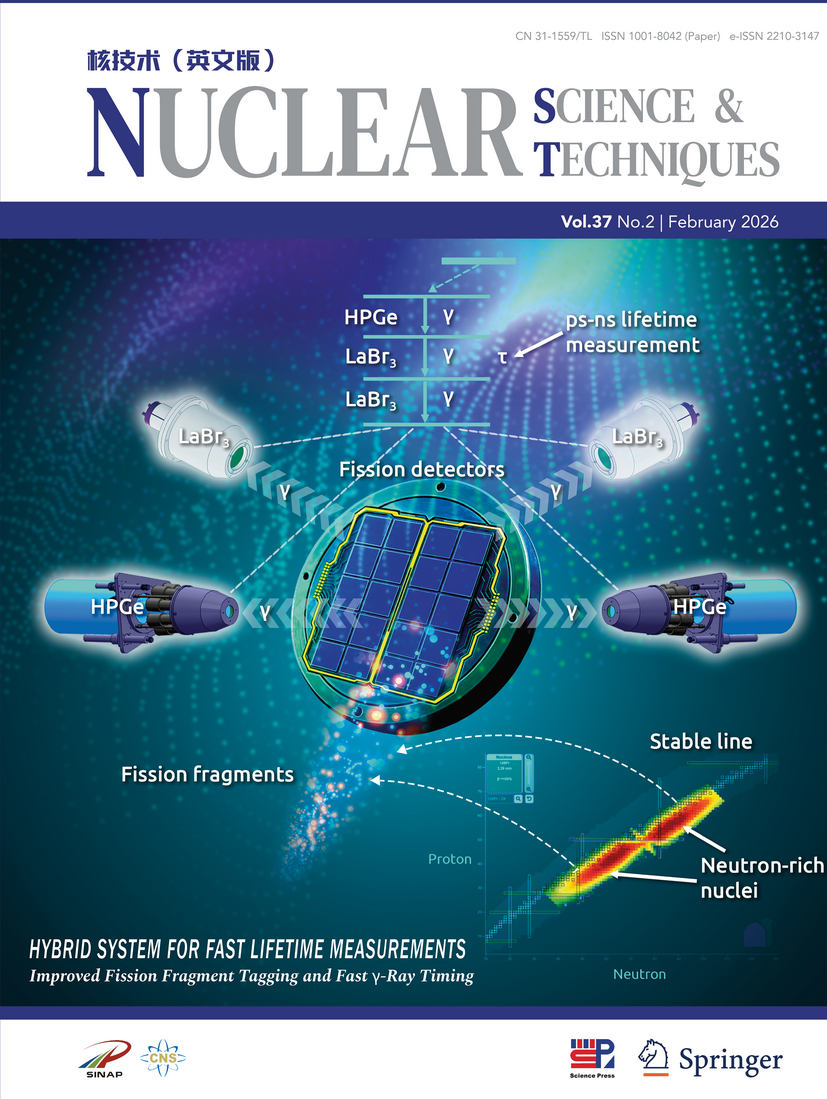
A new multi-detector array named HALIMA (Hybrid Array for LIfetime MeAsurement) has been developed at Lanzhou for nuclear structure studies in fission. The array comprises eight BGO-shielded High-Purity Germanium (HPGe) detectors and twenty fast Ce-doped Lanthanum Bromide [LaBr3(Ce)] detectors shielded with CsI(Tl). HALIMA is further complemented by two ancillary detector systems: fission fragment (FF) detectors and β detectors. This configuration enables precise sub-nanosecond lifetime measurements using the four-fold FF/β-Ge-LaBr3(Ce)-LaBr3(Ce) coincidence technique. The performance and specifications of the detectors, associated electronics, and the data acquisition system are presented in detail. The advantage of FF selectivity is emphasized, which significantly enhances sensitivity to specific fission channels. Using this approach, the lifetimes of the nuclear excited states populated in the spontaneous fission of 252Cf were measured, showing good agreement with the established literature values.
keyword:Selectivity;Lifetime measurement;FFs/β-γ rays coincidences;Spontaneous fission;LaBr3(Ce);HPGe;Solar cells;
Research article 05 Jan 2026
C. Yalçın
In recent years, terbium radioisotopes have been investigated for their potential therapeutic and diagnostic applications in nuclear medicine. This study aimed to investigate the production of 152Tb and 155Tb by alpha-induced reactions in detail, with a specific focus on determining the optimum production parameters and testing existing nuclear models. Given the limited number of experiments conducted on reactions related to terbium isotope production, it is necessary to perform theoretical calculations of cross sections over a wide energy range to gain a detailed understanding of terbium isotope production. To achieve this objective, the cross sections of the 151Eu(α,n)154Tb reactions were calculated up to 60 MeV using the TALYS computer code with 432 different combinations of optical model parameters, level density, and strength function models. The theoretical reaction cross section results were compared with the experimental results in the literature. The best input parameters were determined using the Threshold Logic Unit method, and these parameters were used in all isotope production calculations. Once the optimal model combination was determined, the total activity production and isotopic fraction of 152Tb and 155Tb isotopes were calculated in detail for beam energies of 17-50 MeV, different irradiation times, and varying 151Eu and 153Eu target thicknesses.
keyword:Cross section;Alpha induced reactions;Threshold Logic Unit method;Medical isotope production;Terbium radioisotopes;
NUCLEAR ELECTRONICS AND INSTRUMENTATION
Research article 04 Jan 2026
Kun Hu,Song-Qing Liu,Bo Wang,Wei-Wei Xu,Xin-Sheng Wang
Traditional digitizers for signal readout of PET detectors are based on commercial analog-to-digital converters (ADC). However, the cost and power consumption of an entire electronic readout system based on digitizers for a PET scanner are high. To address this problem, a soft-core ADC based on a field-programmable gate array (FPGA) was proposed. An FPGA-based ADC (FPGA-ADC) combines low loss and high performance. To achieve good performance, the FPGA-ADC requires three calibrations: time-to-digital converter (TDC) length calibration, TDC alignment calibration, and TDC-to-ADC calibration. A prototype front-end electronics based on FPGA-ADC was built to evaluate the performance of time-of-flight positron emission tomography (TOF PET) detectors. Each PET detector consists of a LYSO crystal single-ended coupled to a silicon photomultiplier (SiPM). The experimental results show that the full-width at half-maximum (FWHM) energy resolution for 511 keV gamma photons after saturation correction of the SiPM was 12.3%. The FWHM coincidence timing resolution (CTR) of the TOF PET detector with the readout of the front-end electronic prototype is 385.2 ps. FPGA-ADC-based front-end electronics are very promising for multichannel, low-cost, highly integrated, and power-efficient readout electronic systems for radiation detector applications.
keyword:FPGA;Radiation detector;PET;Front-end electronics;Analog-to-digital converter;
Research article 05 Jan 2026
Lin-Jun Hou,Peng Xu,Zhi-Meng Hu,Jie Cheng
The pulse shape discrimination technique plays a pivotal role in neutron field measurements using organic scintillator detectors, and the particle-type labeling accuracy of the pulse waveform dataset has a significant impact on its performance, especially with the growing use of machine learning methods. In this study, a high-accuracy labeling method for pulse-waveform datasets based on the time-of-flight (TOF) filtering method, an improved charge comparison method (CCM), and the coincidence measurement method is proposed. The relationship between the experimental parameters and the chance coincidence proportion in the TOF measurement was derived to reduce contamination from chance coincidences at the experimental level. Based on this, an experiment was conducted to obtain raw data using the 241AmBe source, and a piled-up identification algorithm based on reference waveform cross-correlation and differential analysis was designed to filter out piled-up pulses. To improve the labeling accuracy, the CCM was optimized, a simple method of selecting the TOF interval for a lower chance coincidence proportion was proposed, and a low-amplitude pulse waveform dataset construction method based on coincidence measurements was developed. To verify these methods, eight pulse waveform datasets were constructed using different combinations of the proposed approaches. Three neural network structures and a corresponding evaluation parameter were designed to test the quality of these datasets. The results showed that the particle identification performance of the CCM was significantly improved after optimization, with the neutron-to-gamma-ray misidentification rate reduced by more than 35%. The proposed accuracy-improvement methods reduced ambiguous identification results from these artificial neural networks by more than 50%.
keyword:Machine learning;Pulse Shape Discrimination;Time of flight;Charge comparison method;Organic liquid scintillator;
Research article 07 Jan 2026
Yong-Shuai Ge,Han Cui,Yu-Hang Tan,Xin Zhang,Hao-Di Wu,Ting Su,Jiong-Tao Zhu,Hai-Rong Zheng,Dong Liang,Xiang-Ming Sun
This study aims to investigate the responses of a perovskite-based direct-conversion dual-layer flat-panel detector (DL-FPD) numerically. To this end, the X-ray sensitivity, spatial resolution quantified by the modulation transfer function (MTF), and detective quantum efficiency (DQE) of the DL-FPD are evaluated numerically using a linear cascade model. In addition, both the single-crystal (SC) and polycrystalline (PC) structures of MAPbI3 are investigated, along with various other key parameters such as the material thickness, electric field strength, X-ray beam spectrum, and electronic readout noise. The results demonstrate that SC perovskite consistently exhibits better performance than PC perovskite owing to fewer material defects. Increasing the layer thickness may decrease the MTF, but can also enhance the sensitivity and DQE. Moreover, appropriately increasing the external electric field within the material can improve the sensitivity, MTF, and DQE. Finally, reducing the electronic readout noise can significantly enhance the DQE for low-dose imaging. This study demonstrates the potential of high-quality dual-energy X-ray imaging using direct-conversion perovskite DL-FPDs.
keyword:X-ray imaging;Dual-layer flat-panel detector;Perovskite X-ray detector;
ACCELERATOR, RAY AND APPLICATIONS
Research article 04 Jan 2026
Xuan Zhang,Jian-Wei Huang,Lin-Jian Wan,Jia-Cheng Liu,Xiao-Le Zhang,De-Hong Li,Fei Tuo,Zhi-Jun Yang
The rapid identification of γ-emitting radionuclides with low activity levels in public areas is crucial for nuclear safety. However, classical methods rely on full-energy peaks in the integral spectrum, requiring sufficient count accumulation for evaluation, thereby limiting response time. The sequential Bayesian approach, which utilizes prior information and considers both photon energies and interarrival times, can significantly enhance the performance of radionuclides identification. This study proposes a theoretical optimization method for the traditional sequential Bayesian approach. Each photon is processed sequentially, and the corresponding posterior probability is updated in real time using a noninformative prior from the Bayesian theory. By comparing the posterior probabilities of the background and radionuclides based on the energy variance and time interval, the type of γ-rays can be identified (background characteristic γ-rays, Compton plateaus γ-rays, or radionuclide-specific characteristic γ-rays). By integrating the information from these multiple characteristic γ-rays, the presence and type of radionuclides were determined based on the final decision function and a set threshold. Based on theoretical research, verification experiments were conducted using a LaBr3(Ce) detector in both low-and natural background radiation environments with typical radionuclides (137Cs, 60Co, and 133Ba). The results show that this approach can identify 137Cs in 7.9 s and 8.5 s (source dose rate contribution: approximately 6.5×10⁻³ μGy/h), 60Co in 8.1 s and 9.8 s (approximately 4.8×10⁻² μGy/h), and 133Ba in 4.05 s and 5.99 s (approximately 3.4×10⁻² μGy/h) under low and natural background radiation, respectively, with a miss rate below 0.01%. This demonstrates the effectiveness of the proposed approach for fast radionuclides identification, even at low activity levels and highlights its potential for enhancing public safety in diverse radiation environments.
keyword:LaBr3(Ce) detector;Sequential Bayesian approach;Fast radionuclides identification;Low background radiation laboratory;
Research article 04 Jan 2026
Heng Zhang,Yun-Ling He,Dong Liu,Qin Hang,He-Min Yao,Di Xiang
The neutron diffusion equation plays a pivotal role in nuclear reactor analysis. Nevertheless, employing the physics-informed neural network (PINN) method for its solution entails certain limitations. Conventional PINN approaches generally utilize a fully connected network (FCN) architecture that is susceptible to overfitting, training instability, and gradient vanishing as the network depth increases. These challenges result in accuracy bottlenecks in the solution. In response to these issues, the residual-based resample physics-informed neural network (R2-PINN) is proposed. It is an improved PINN architecture that replaces the FCN with a convolutional neural network with a shortcut (S-CNN). It incorporates skip connections to facilitate gradient propagation between network layers. Additionally, the incorporation of the residual adaptive resampling (RAR) mechanism dynamically increases the number of sampling points. This, in turn, enhances the spatial representation capabilities and overall predictive accuracy of the model. The experimental results illustrate that our approach significantly improves the convergence capability of the model and achieves high-precision predictions of the physical fields. Compared with conventional FCN-based PINN methods, R2-PINN effectively overcomes the limitations inherent in current methods. Thus, it provides more accurate and robust solutions for neutron diffusion equations.
keyword:Neutron diffusion equation;Physics-informed neural network;CNN with shortcut;Residual adaptive resampling;
Research article 04 Jan 2026
Xin Wang,Yuan Yuan,Xuan Zhao,Guang-Hao Luo,Qi-Qiao Wei,He-Xi Wu,Chao Xiong
Unmanned Aerial Vehicle (UAV)-borne gamma-ray spectrum survey plays a crucial role in geological mapping, radioactive mineral exploration, and environmental monitoring. However, raw data are often compromised by flight and instrument background noise, as well as detector resolution limitations, which affect the accuracy of geological interpretations. This study aims to explore the application of the Real-ESRGAN algorithm in the super-resolution reconstruction of UAV-borne gamma-ray spectrum images to enhance spatial resolution and the quality of geological feature visualization. We conducted super-resolution reconstruction experiments with 2×, 4× and 6× magnification using the Real-ESRGAN algorithm, comparing the results with three other mainstream algorithms (SRCNN, SRGAN, FSRCNN) to verify the superiority in image quality. The experimental results indicate that Real-ESRGAN achieved a structural similarity index (SSIM) value of 0.950 at 2× magnification, significantly higher than the other algorithms, demonstrating its advantage in detail preservation. Furthermore, Real-ESRGAN effectively reduced ringing and overshoot artifacts, enhancing the clarity of geological structures and mineral deposit sites, thus providing high-quality visual information for geological exploration.
keyword:Image processing;UAV-borne gamma-ray spectrum;Super-resolution reconstruction;Real-ESRGAN;
Research article 04 Jan 2026
Zhen-Hua Chen,Li-Min Zhou,Hai-Tao Li,Ying Zou,Yong Wang,Ren-Zhong Tai
A soft X-ray energy materials research beamline (BL20U2), a branch of energy materials beamline (E-line), has been constructed in the Shanghai Synchrotron Radiation Facility (SSRF) Phase-II project. It is now operational for soft X-ray resonant emission spectroscopy (RXES) and soft X-ray resonant elastic scattering (REXS) investigations. Optical optimization was implemented for high performance, e.g., photon flux, energy-resolving power, and focus spot size. RXES experiments show that the energy range extends from 150 to 1500 eV. The elastic peak measured near titanium absorption edge (@445 eV) indicates an energy resolution of the RXES spectrometer of 65 meV. The measured photon flux is 3×10¹² photons/s at 244 eV at the RXES sample position for an SSRF electron energy of 3.5 GeV and a projected ring current as 300 mA. The spot size at the RXES sample position is 23 μm in the horizontal direction and 7.9 μm in the vertical direction, respectively. Moreover, the angular resolution of elastic REXS scatterometer reaches 0.005° through measurement of X-ray reflection from the single crystal silicon wafers. A sample of the REXS scatterometer is vibrationally decoupled from its chamber and cooled using copper braids connected from an open cycle liquid helium cryo reservoir, whereas the minimum sample temperature is below 15 K.
keyword:Synchrotron radiation;SSRF;Wide energy range;E-line;Materials research beamline;
Research article 05 Jan 2026
Xiao Li,Yi Jiao,Liang-Sheng Huang,Jian-Liang Chen,Yan-Liang Han,Wei-Hang Liu,Sheng Wang,Jia-Xin Chen
The Southern Advanced Photon Source (SAPS) is a diffraction-limited synchrotron light source under design, which employs longitudinal injection as its primary injection scheme. This kind of injection scheme requires that the injected beam has a short bunch length and low emittance, and the preferred injector should offer high stability and low cost. Therefore, an injector based on a booster synchrotron was developed. The proposed injector includes a 250 MeV linac, a booster synchrotron that ramps the beam energy to 3.5 GeV, and two beam transport lines to ensure efficient beam delivery and beam quality preservation. The linac utilizes a thermionic high-voltage DC gun for reliable operation and features a bunching system with an advanced focusing system to preserve the emittance. To meet the injection requirements of the SAPS, a comprehensive design for the booster has been conducted. The booster synchrotron employs a three-fold lattice structure, incorporating modified theoretical minimum emittance cells with a small momentum compaction factor and a high voltage to achieve an emittance of 3.98 nm rad and a bunch length of 4.8 mm. The injector has the potential to deliver a high charge, reducing the injection period of the storage ring to less than 1 min. Simulations demonstrated the expected performance, with a transmission efficiency of 90%, confirming its capability to meet the injection requirement of the SAPS storage ring. This design offers a stable and efficient solution for the SAPS.
keyword:Emittance;Bunch length;Longitudinal injection;Southern advanced photon source;Booster synchrotron;
Published on 20 Feb 2026
