
The precise measurement of the antineutrino spectra produced by isotope fission in reactors is of great significance for studying neutrino oscillations, refining nuclear databases, and addressing the reactor antineutrino anomaly. In this paper, we report a method that utilizes a feedforward neural network (FNN) model to decompose the prompt energy spectrum observed in a short-baseline reactor neutrino experiment and extract the antineutrino spectra produced by the fission of major isotopes such as 235U, 238U, 239Pu, and 241Pu in the nuclear reactor. We present two training strategies for the model and compare them with the traditional χ2 minimization method by applying them to the same set of pseudo-data corresponding to a total exposure of (2.9×5×1800) GWth⋅tonnes⋅days. The results show that the FNN model not only converges faster and better during the fitting process but also achieves relative errors of less than 1% in the 2-8 MeV range in the extracted spectra, outperforming the χ2 minimization method. The feasibility and superiority of this method were validated in the study.
Vol.36, No.10
Select issueYearIssue
1208
ACCELERATOR, RAY TECHNOLOGY AND APPLICATIONS
Research article 16 Jul 2025
Jun Wang,Wei Wang,Jian Chen,Yue-Huan Wei
keyword:Reactor neutrinos;Isotope antineutrino spectra;Feedforward neural network;
Research article 19 Jul 2025
Jun Chen,Yuan Xu,Xiao-Ying Zhang,Jian-Cong Dai,Wang-Jiang Wu
Flat-panel X-ray sources (FPXSs) have many advantages in terms of compactness and low- dose imaging, enhancing their capability for novel X-ray applications. Experimental analysis of the X-ray characteristics and optimizing the anode panel of an FPXS are time-consuming, expensive, and sometimes impractical. In this study, a FPXS was prepared using a ZnO nanowire cold cathode and a molybdenum film anode target. Monte Carlo (MC) simulations were utilized to optimize the anode panel and obtain the average fluence, average energy, and spatial distribution of the X-rays for the ZnO nanowire FPXS. The accuracy of the MC simulations was verified by comparing the measured and simulated energy spectra. Optimization of the anode target considers the material, thickness, and morphology, whereas optimization of the substrate focuses on the material and thickness. The results show that the difference between the positions of the K-shell peaks in the measured and simulated energy spectra is within 0.26 keV. At the acceleration voltages of 30 kV, 60 kV, and 90 kV, the optimal thicknesses of the tungsten array anode were 0.65 μm, 2.45 μm, and 5 μm, respectively, while the molybdenum array anode has the optimal thicknesses of 1.45 μm, 5.25 μm, and 24 μm, respectively. The microsemi-ellipsoidal anode with a recessed design showed a 5% increase in the transmitted X-ray fluence compared with the film target. The sapphire substrate with a thickness of 0.78 mm exhibits a mechanical strength comparable to that of a glass substrate with a thickness of 3 mm, implying that the former can increase the average X-ray fluence by reducing the filtration of X-rays. The findings of this study provide valuable guidance for the fabrication and optimization of the ZnO nanowire FPXS.
keyword:Monte Carlo simulation;ZnO nanowire cold cathode flat-panel X-ray source;Anode optimization;Substrate optimization;
Research article 24 Jul 2025
Rui-Shi Mao,Xin-Le Lang,Zheng-Guo Hu,Zhi-Guo Xu,Juan Li,Kai Zhou,Fa-Ming Luo,Yu-Cong Chen,Chuan Huang,Zu-Long Zhao,Jia-Li Fu,Li-Bin Zhou,Guo-Qing Xiao
The ionization chamber produces significant space-charge and ion recombination effects at ultra-high dose rates, posing a challenge for dose monitoring. In addition, there is no generally accepted ion correction model for dosimetry in FLASH radiotherapy, making it crucial to monitor the dose at ultra-high dose rates accurately and in real time. In this study, the air pressure of the ionization chamber was reduced to perform real-time beam monitoring, and a Faraday cup was used for calibration for active dosimetry. To study the saturation effect of the ionization chamber, the drift, attachment, recombination, and diffusion processes of the electron-ion pairs were modeled using finite-element analysis based on physical phenomenological principles, and the correction factor was calculated. The experimental results showed that the FLASH ionization chamber measures good dose linearity at a dose rate of approximately 0.2 Gy/s. When the air pressure of the chamber was adjusted to 10 mbar, the response of the FLASH ionization chamber was linear at a dose rate of approximately 50 Gy/s, with the residuals within 2%. Furthermore, by using physical phenomenology to resolve the process of electron-ion pair motion in the sensitive volume of the ionization chamber, the analytical model better describes the saturation effect of carbon ions at ultra-high dose rates. The maximum deviation in the calculated correction factor is less than 10%. We studied the saturation effect in dose measurement, achieving accurate and fast dose and profile position measurement across different dose rates in a wide range based on the Heavy Ion Research Facility in Lanzhou.
keyword:Carbon ions;Dosimetry;Correction factor;FLASH radiotherapy;Ultra-high dose rate;Saturation effect;
NUCLEAR PHYSICS AND INTERDISCIPLINARY RESEARCH
Research article 17 Jul 2025
Chun-Wang Ma,Jie Ren,Hong-Wei Wang,Wen Luo,Xin-Xiang Li,Su-Ya-La-Tu Zhang,Jie-Ming Xue,Bing Jiang,Long-Xiang Liu,Ying-Du Liu,De-Xin Wang,Zi-Rui Hao,Wei Jiang,Ya-Ju Chen,Gong-Tao Fan,Song Feng,Wen Xie,Zi-Ang Lin,Ting Jiang,Gao-Le Yang,Zhen-Dong An,Xian-Kai Li,Zhou-Ji Liao,Xin-Yu Li,Ning-Xin Peng,Yue Zhang,Xin-Rong Hu,Xiao-He Wang,Ji-Feng Hu,Yu-Ting Wang,Jian-Jun He,Li-Yong Zhang
147,149Sm are slow neutron capture (s-process) nuclides in nuclear astrophysics, whose (n,γ) cross-sections are important input parameters in nucleosynthesis network calculations in the samarium (Sm) region. In addition, 149Sm is a fission product of 235U with a 1% yield, and its neutron resonance parameters play a critical role in reactor neutronics. According to the available nuclear evaluation databases, a significant disagreement has been observed in the resonance peaks of the 147,149Sm (n,γ) cross-sectional data within the energy range of 20-300 eV. In this study, tutron capture cross-section of a natural samarium target was measured at the back-streaming white neutron beamline of the China Spallation Neutron Source. The neutron capture yield was obtained and the neutron resonance parameters for 147Sm at 107.0, 139.4, 241.7, and 257.3 eV and 149Sm at 23.2, 24.6, 26.1, 28.0, 51.5, 75.2, 90.9, 125.3, and 248.4 eV were extracted using the SAMMY code based on R-matrix theory. For the parameters Γn and Γγ in these energies of 147,149Sm, the percentages consistent with the results of the CENDL-3.2, ENDF/B-VIII.0, JEFF-3.3, JENDL-4.0, and BROND-3.1 database are 27%, 65%, 65%, 42%, and 58%, respectively. However, 27% of the results were inconsistent with those of the major libraries. This work enriches experimental data of the 147,149Sm neutron capture resonance and helps clarify the differences between different evaluation databases at the above energies.
keyword:Neutron capture cross section;Neutron resonance parameters;Back-n facility;
Research article 17 Jul 2025
Wei Wang,Xiao Fang,Jun Su,Cen-Xi Yuan,Long Zhu,Hong-Yi Wu,Yong-Hao Chen,Sheng-Li Chen,Guang-Xin Zhang,Chong Qi,Rui-Rui Fan,Zhi-Xuan Wang,Wei Jiang,Meng-Lan Liu,Bo-Shuai Cai,Zhi-Huan Li,Kang Sun,Yue-Huan Wei,Yu-Mei Zhang,Wei Hua,Bo Mei,Yi-Nu Zhang,Chen-Chen Guo,Xiao-Peng Zhou
This study determined the lifetime of the first excited state (5/21+) in 139La via β–γ time-difference measurement using a LaBr3 + plastic scintillator array. This state is populated following the decay of 139Ba produced in the 138Ba(n,γ) reaction. Compared with previous experiments using only stilbene/plastic crystals, this experiment separates the background contribution in the γ-ray spectrum owing to the high-energy resolution of LaBr3. The L-forbidden M1 transition strength, B(M1, 5/21+→7/21+), in 139La was measured and compared with detailed large-scale shell model calculations, with a special focus on the core-excitation effect. The results showed the importance of both proton and neutron core-excitations in explaining the M1 transition strength. Meanwhile, the effective g-factor for the tensor term of the M1 operator was smaller than the previously reported value in this region or around 208Pb.
keyword:L-forbidden M1 transition;Effective g-factor;LaBr3;Fast-timing measurement;
Research article 17 Jul 2025
Bing Guo,You-Bao Wang,Ming-Hao Zhu,Qiang Wang,Yu-Qiang Zhang,Jin-Long Ma,Zhi-Wei Qin,Jun Su,Fu-Qiang Cao,Zhi-Cheng Zhang,Yu-Wen Chen,Jiang-Lin Hou,Chang-Xin Guo,Sheng-Quan Yan,Yun-Ju Li,Yang-Ping Shen,Wei-Ping Liu
A low-background γ spectrometer named the Gamma spectrometer for Nuclear Activation Studies (GNAS) was developed to detect scarce γ radioactivity, with a special focus on conducting activation experiments in nuclear astrophysics. It consisted of a well-type HPGe detector surrounded by optimized multi-layer shielding, which reduced the laboratory background counting rate by 99.5% and enabled a sensitivity edge as low as 0.044 Bq for the 477.6 KeV γ line of 7Be. The near 4π geometry of the HPGe detector introduces a severe true coincidence summing (TCS) effect along with its high detection efficiency. To determine the intrinsic detection efficiency and correct for the TCS effect, a Monte Carlo simulation method was developed with the Geant4 toolkit. The detector model was optimized by matching the simulated full energy peak (FEP) statistics with those of a 137Cs monoenergetic source and calibrated 55,57,58Co sources produced by low-energy proton beam bombardment of natural iron. The intrinsic detection efficiency curve was obtained, and an algorithm for the correction of the TCS effect was programmed using decay data from the ENSDF library and Nuclear Wallet Cards. The GNAS fulfills the requirements of the ongoing activation measurement of proton- and alpha-induced reactions in nuclear astrophysics on the ground and at the Jinping Underground Nuclear Astrophysics (JUNA) facility.
keyword:Low-background γ spectrometer;GNAS;Well-type HPGe detector;True coincidence summing;Activation measurement at JUNA;
Research article 18 Jul 2025
Rui-Qin Wang,Xin-Lei Hou,Yan-Hao Li,Jun Song,Feng-Lan Shao
This study aims to investigate the production of light nuclei, hypertritons, and Ω-hypernuclei in Pb+Pb collisions at sNN=5.02 TeV using a modified analytical nucleon coalescence model with hyperons. To this end, the momentum distributions of two bodies coalescing into dibaryon states and of three bodies coalescing into tribaryon states are derived. Available data on coalescence factors B2 and B3, transverse momentum spectra, averaged transverse momenta, yield rapidity densities, and yield ratios of the deuteron, antihelium-3, antitriton, and hypertriton measured by the ALICE collaboration are explained. Productions of different species of Ω-hypernuclei H(pΩ-), H(nΩ-), and H(pnΩ-) are predicted. Particularly, the production correlations of different light (hyper-)nuclei are studied, and two groups of interesting observables—the averaged transverse momentum ratios of light (hyper-)nuclei to protons (hyperons) and their corresponding yield ratios—are studied. The averaged transverse momentum ratio group exhibits a reverse hierarchy of the nucleus size, and the yield raito group is sensitive to the nucleus production mechanism as well as the size of the nucleus.
keyword:Light nucleus production;Hypernucleus production;Coalescence model;Relativistic heavy ion collision;
Research article 24 Jul 2025
Hong-Qiang You,Xiao-Tao He,Ren-Hang Wu,Shuang-Shuang Zhang,Jing-Jing Li,Qing-Hua He,Hai-Qian Zhang
An improved formula considering the deformation effect for the α-decay half-lives is proposed based on WKB barrier penetrability. Using the quadrupole deformation values of the daughter nuclei obtained from the WS4 and FRDM models in the improved formula, the root mean square deviation (RMSD) between the calculated results and experimental data decreased from 0.456 to 0.413 and 0.415, respectively. Although the improved formula did not significantly reduce the overall RMSD, it produced results that better matched the experimental values for nuclei with larger deformations. Additionally, eXtreme Gradient Boosting (XGBoost) models were employed to further reduce the deviations between the calculated α-decay half-lives and experimental data, with the corresponding RMSDs decreasing from 0.413 to 0.295 and from 0.415 to 0.302, respectively. Furthermore, the improved empirical formula and XGBoost models were used to predict the α-decay half-lives of nuclei with Z = 117, 118, 119, and 120. The results suggest that N = 184 is the magic number.
keyword:Superheavy nuclei;α-decay;nuclear deformation effects;magic numbers;
Research article 24 Jul 2025
Song Feng,Xiao-Dong Wang,Da-Jun Zhao,Wen Luo,Jie-Ming Xue,Peng Luan,Han Yi,Wei Jiang,Yi-Wei Yang,Pin-Jing Cheng,Ji-Rong Zhao,Bao-Qian Li,Jing Liu,Bo Zheng
The neutron total cross section spectrometer (NTOX) applied on the Back-n beamline at the China Spallation Neutron Source (CSNS) is based on a multicell fission chamber and utilizes 235,238U for neutron detection. To reduce the experimental uncertainty in the resonance energy region of 235,238U and improve the neutron detection efficiency, a fast scintillator-based neutron total cross section (FAST) spectrometer was designed. A prototype based on a large-area square 6Li-enriched Cs2LiLaBr6 (CLLB) scintillator was constructed and beam-tested. The size of the CLLB scintillator was 50.8 × 50.8 × 6 mm, and its side was coupled to an array of 1 × 8 S14160 MPPC to avoid the irradiation from the high-intensity neutrons and γ-rays. The beam test was performed using a broad-energy pulsed neutron and the time-of-flight (TOF) technique on the Back-n beamline. The results demonstrate that the prototype exhibits good neutron/γ discrimination capability under strong γ-flash irradiation. The prototype was applied to measure the neutron total cross section of natPb and the result was compared with that obtained using the NTOX. The two results were consistent in the energy region of 0.3 eV to 1 keV, and the prototype showed a higher detection efficiency and did not exhibit fission resonance effect. This type of spectrometer can be used as a complement to the NTOX in the low-energy range and provides a technical reference and framework for developing the FAST spectrometer on the Back-n beamline.
keyword:Neutron total cross section;FAST spectrometer;Back-n white neutron beamline;
Research article 31 Jul 2025
Chun-Wang Ma,Kai-Xuan Cheng,Rong-Xing He,Chun-Yuan Qiao
A machine learning approach based on Bayesian neural networks was developed to predict the complete fusion cross-sections of weakly bound nuclei. This method was trained and validated using 475 experimental data points from 39 reaction systems induced by 6,7Li, 9Be, and 10B. The constructed Bayesian neural network demonstrated a high degree of accuracy in evaluating complete fusion cross-sections. By comparing the predicted cross-sections with those obtained from a single-barrier penetration model, the suppression effect of 6,7Li and 9Be with a stable nucleus was systematically analyzed. In the cases of 6Li and 7Li, less suppression was predicted for relatively light mass targets than for heavy mass targets, and a notably distinct dependence relationship was identified, suggesting that the predominant breakup mechanisms might change in different mass target regions. In addition, minimum suppression factors were predicted to occur near target nuclei with neutron-closed shell.
keyword:Machine learning;Bayesian neural network;Fusion reaction;Weakly bound nuclei;
Research article 05 Aug 2025
Bao-Hua Sun,Xiu-Lin Wei,Satoru Terashima,Isao Tanihata,Tian-Yu Wu,Chang-Jian Wang
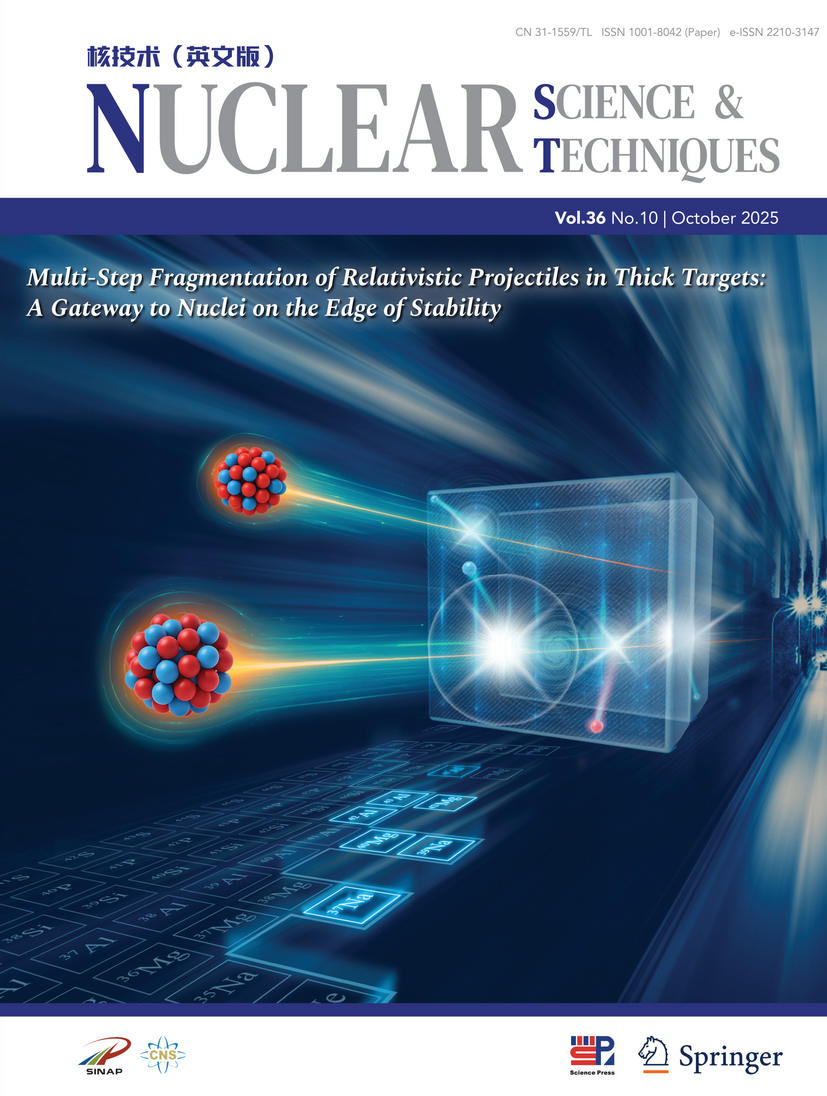
Exploring the limits of neutron binding in atomic nuclei remains a central focus of nuclear physics. However, the experimental determination of the neutron drip line is challenging because of the minuscule production cross sections of the most neutron-rich isotopes. We investigated the effectiveness of multi-step fragmentation for producing extremely neutron-rich nuclides at relativistic energies. We demonstrate that multi-step fragmentation dominates over single-step fragmentation in thick target experiments and can enhance the yields of drip line nuclei by several orders of magnitude in a realistic experiment using fragment separators. Such enhancements open new possibilities for locating drip lines above sodium, and thus significantly expand the research horizon.
keyword:Multi-step fragmentation;Neutron drip line;Ion-optical simulation;
Research article 07 Aug 2025
Yu-Gang Ma,Bo Zhou,Yi-Fan Liu
We employed random distributions and gradient descent methods for the Generator Coordinate Method (GCM) to identify effective basis wave functions, taking halo nuclei 6He and 6Li as examples. By comparing the ground state (0+) energy of 6He and the excited state (0+) energy of 6Li calculated with various random distributions and manually selected generation coordinates, we found that the heavy-tail characteristic of the Logistic distribution better describes the features of the halo nuclei. Subsequently, the Adam algorithm from machine learning was applied to optimize the basis wave functions, indicating that a limited number of basis wave functions can approximate the converged values. These results offer some empirical insights for selecting basis wave functions and contribute to the broader application of machine learning methods in predicting effective basis wave functions.
keyword:Machine learning;Generator Coordinate Method;Effective basis wave functions;Nuclear cluster model;Halo nuclei;
NUCLEAR ENERGY SCIENCE AND ENGINEERING
Research article 17 Jul 2025
Jie Shen,Hong-Niao Chen,D.K.L. Tsang,Xiao Li,Shi-Gui Zhao
Identifying the damage and fracture properties of nuclear graphite materials and accurately simulating them are crucial when designing graphite core structures. To simulate the damage evolution and crack propagation of graphite under stress in a finite element model, compression tests on discs and three-point bending tests on center-notched beams for fine-grained graphite (CDI-1D and IG-11 graphite) were conducted. During these tests, digital image correlation and electronic speckle pattern interferometry techniques were utilized to observe the surface full-field displacements of the specimens. A segmented finite element inverse analysis method was developed to characterize the graphite’s damage evolution by quantifying the reduction in Young’s modulus with tensile and compressive strains in disc specimens. The fracture energy and bilinear tensile softening curve of the graphite were determined by comparing the load-displacement responses of the three-point bending tests and the finite element simulation. Finally, by combining the identified damage laws with a fracture criterion based on fracture energy, a damage-fracture model was established and used to simulate tensile tests on L-shaped specimens with different fillet radii. Simulations indicate that the damage area at the fillet expands with increasing radius, creating a blunting effect that enhances the load-bearing capacity of the specimens. This damage-fracture model can be applied to simulate graphite components in core structures.
keyword:Graphite;Finite element analysis;Fracture energy;Damage characterization;
Research article 21 Jul 2025
He-Fei Huang,Zhen-Bo Zhu,Guan-Hong Lei,Hui Liu,Wei-Chi Ji
The synergistic effects of irradiation and tensile deformation on the corrosion behavior of the GH3535 alloy in FLi-NaK molten salt was explored. He bubbles were introduced into the GH3535 alloy, followed by mechanical loading with the plastic strain up to 10%. After immersion in molten salt for 300 h, all the samples exhibited a corrosion-induced Cr depletion layer. The depth of the Cr depletion layer increased by 40% for the alloy with He ion irradiation and 10% plastic deformation, compared with that for the only corroded sample. Moreover, the proportion of large-sized He bubbles increased with plastic deformation. These results indicate that the coupling effect of irradiation and tensile deformation accelerate the corrosion of the GH3535 alloy. In addition, in a molten salt environment, an unexpected outward migration behavior of He bubbles was observed under different plastic deformation. He bubbles migrated closer to the surface as the strain increased up to 3%, while the migration depth declined when the strain reached 10%. This is ascribed to the interaction between deformation-induced dislocations and He bubbles.
keyword:Molten salt corrosion;helium bubble;Ni-based alloy;Tensile deformation;
NUCLEAR CHEMISTRY, RADIOCHEMISTRY, AND NUCLEAR MEDICINE
Research article 17 Jul 2025
Yao-Lin Zhao,Tao Wu,Jun-Lei Tian,Jia-Xing Feng,Jia-Cong Shen,Lei Yao,Jing-Yan Wang
Missing values in radionuclide diffusion datasets can undermine the predictive accuracy and robustness of the machine learning (ML) models. In this study, regression-based missing data imputation method using a light gradient boosting machine (LGBM) algorithm was employed to impute more than 60% of the missing data, establishing a radionuclide diffusion dataset containing 16 input features and 813 instances. The effective diffusion coefficient (De) was predicted using ten ML models. The predictive accuracy of the ensemble meta-models, namely LGBM-extreme gradient boosting (XGB) and LGBM-categorical boosting (CatB), surpassed that of the other ML models, with R2 values of 0.94. The models were applied to predict the De values of EuEDTA- and HCrO4- in saturated compacted bentonites at compactions ranging from 1200 kg/m3 to 1800 kg/m3, which were measured using a through-diffusion method. The generalization ability of the LGBM-XGB model surpassed that of LGB-CatB in predicting the De of HCrO4-. Shapley additive explanations identified total porosity as the most significant influencing factor. Additionally, the partial dependence plot analysis technique yielded clearer results in the univariate correlation analysis. This study provides a regression imputation technique to refine radionuclide diffusion datasets, offering deeper insights into analyzing the diffusion mechanism of radionuclides and supporting the safety assessment of the geological disposal of high-level radioactive waste.
keyword:Radionuclide diffusion;Machine learning;Bentonite;Missing data;Regression imputation;Diffusion experiments;
Research article 18 Jul 2025
Xu Zhao,E-Ming Hu,Yi-Ge Sun,Hao-Shuai Li,Hong Liu,Zhi-Wu Lei,Yu-Cheng Su,Bo-Yuan Zheng,Hong-Yang Xia,Khan-Muhammad-Yaruq Ali,Qing-Liang Wang,Fang Hu
A green chelate-like phosphate-based adsorbent functionalized by glycine (CP@Glycine) was first designed, synthesized, and applied to selectively separate Be(II) from uranium-beryllium-containing (U/Be) solutions. The optimal adsorption conditions were: WH3PO4/WCa(OH)2/WGlycine (wt:wt:wt) of 3:3:1, pH=6, resulting in the maximum adsorption efficiency of 99% in the case of adsorbent of 2g·L-1. CP@Glycine exhibited excellent selectivity for Be(II) (Kd=2.53×10⁴ mL·g-1) towards Fe, U, Zn, Mn, Na, and Ca in solutions. After 5 adsorption-desorption cycles, the removal efficiency of Be(II) remained at 85%, and the desorption rate of Be(II) was above 90%. Adsorption kinetics and thermodynamics studies showed that the theoretical maximum adsorption capacity (Qe) of CP@Glycine was 66m·gg-1, which was higher than the state-of-the-art adsorption materials. Besides, the surface of CP@Glycine exhibited abundant active sites with negative charges which would have a potential electrostatic attraction with Be(II). Moreover, the adsorption mechanism of CP@Glycine was methodically revealed through a combination of various characterizations and DFT investigations. It was found that BeNH4PO4 and Be(OH)2 were formed as stable precipitates on the surface of CP@Glycine, which implied that Be(II) was coordinated with the amino and the phosphate groups from CP@Glycine, thus achieving the chelation effect of Be(II) with CP@Glycine for the adsorption process. The results of DFT investigations further confirmed that Be(II) owned strong bonding affinity to the amino group and the phosphate group from the as-prepared CP@Glycine. The results indicated that the calculated binding energy of the Be complex coordinated with glycine and phosphate (-229.37kcal·mol-1) was lower than that of other possible Be complexes. The above findings revealed that CP@Glycine could be a promising adsorbent for the selective separation and recovery of Be(II) from U/Be wastewater.
keyword:Adsorption;Selectivity;Desorption;BeNH4PO4;Be(OH)2;
Research article 21 Jul 2025
He-Fei Huang,Wei Zhang,Wen-Jun Liang,Bin Leng,Li Jiang,Zhi-Min Dai
In this study, the corrosion and cracking behavior of the GH3535 alloy exposed to molten FLiNaK salts (46.5LiF-11.5NaF-42KF, mol%) with 0 and 0.1wt.% Cr3Te4 and 0, 1 and 3wt.% EuF3 additions at 700 ℃ for 250 h were investigated. The results showed that all the samples exposed to tellurium containing salts exhibited intergranular corrosion and cracking, and the cracking severity increased with the increasing EuF3 concentration. Among them, the average and maximum cracking depths were 164 and 57.1 μm respectively. In contrast, the control sample exposed to salt without Te exhibited less evident intergranular corrosion and no intergranular cracking. These results demonstrate that the synergistic effect between EuF3 and Cr3Te4 promotes grain boundary Te segregation and Cr depletion, resulting in more severe intergranular cracking.
keyword:FLiNaK;fission product;Tellurium;EuF3;
DATA ARTICLE
Research article 18 Jul 2025
Kai-Jie Chen,Hong-Wei Wang,Long-Xiang Liu,Gong-Tao Fan,Yu-Xuan Yang,Qian-Kun Sun,Sheng Jin,Zi-Rui Hao,Yue Zhang,Hang-Hua Xu,Zhi-Cai Li,Pu Jiao,Zhen-Wei Wang,Meng-Die Zhou,Shan Ye,Meng-Ke Xu,Xiang-Fei Wang,Yu-Long Shen
Photonuclear data are increasingly used in fundamental nuclear research and technological applications. These data are generated using advanced γ-ray sources. The Shanghai Laser Electron Gamma Source (SLEGS) is a new laser Compton scattering γ-ray source at the Shanghai Synchrotron Radiation Facility. It delivers energy-tunable, quasi-monoenergetic gamma beams for high-precision photonuclear measurements. This paper presents the Flat-Efficiency Detector (FED) array at SLEGS and its application in photoneutron cross-section measurements. Systematic uncertainties of the FED array were determined to be 3.02% through calibration with a 252Cf neutron source. Using 197Au and 159Tb as representative nuclei, we demonstrate the format and processing methodology for raw photoneutron data. The results validate SLEGS’ capability for high-precision photoneutron measurements.
keyword:Data descriptor;Raw data;Data repositories;Data sharing;Data reuse;
NUCLEAR ELECTRONICS AND INSTRUMENTATION
Research article 19 Jul 2025
Yeqiang Wei,Alexander Yakushev,Jochen Ballof,Jörg Krier,Christoph E. Düllmann
Man-made superheavy elements (SHE) are produced as energetic recoils in complete fusion reactions and need to be thermalized in a gas-filled chamber for chemical studies. The ever-shorter half-lives and decreasing production rates of the elements beyond Fl (atomic number Z = 114) – the heaviest element chemically studied today – require the development of novel techniques for quantitative thermalization and fast extraction efficiently. The Universal high-density gas stopping Cell (UniCell), currently under construction, was proposed to achieve this. Within this work, we propose an Ion Transfer by Gas Flow (ITGF) device, which serves as a UniCell ejector to interface with a gas chromatography detector array for chemical studies. Detailed parameter optimizations, using gas dynamics and Monte Carlo ion-trajectory simulations, promise fast (within a few ms) and highly efficient (up to 100%) ion extraction across a wide mass range. These ions can then be transmitted quantitatively through the ITGF into the high-pressure environment needed for further chemical studies.
keyword:Superheavy elements;Buffer gas cell;Ion funnel;Fast extraction;Atmospheric-Pressure;Chemical studies;
Published on 20 Oct 2025
