
In the context of future electron-ion collision experiments, particularly the Electron-Ion Collider (EIC) and the Electron-Ion Collider in China (EicC), investigating exclusive photoproduction processes is of paramount importance. These processes offer a distinctive opportunity to probe the gluon structure of nuclei across a broad range of Bjorkenx, thereby enabling measurements of nuclear shadowing and facilitating the search for gluon saturation and color glass condensates. This study explores the potential of utilizing neutron tagging via the Coulomb excitation of nuclei to precisely determine the impact parameter for exclusive photoproduction in electron-ion collisions. By developing the Equivalent Photon Approximation for fast electrons, this study incorporates a coordinate-space-dependent photon flux distribution to elucidate the relationship between the photon transverse momentum distribution and the collision impact parameter. Furthermore, the differential cross section for Coulomb excitation of nuclei is derived by leveraging the spatial information from the photon flux. Our calculations demonstrate that neutron tagging can significantly alter the impact parameter distributions, thereby providing a robust method for impact parameter manipulation in electron-ion collisions. This study provides valuable insights and strategies for exploring the impact parameter dependence of exclusive photoproduction, offering novel insights for experimental design and data analysis. Ultimately, it enhances our understanding of the gluon distribution within the nucleus.
Vol.36, No.9
Select issueYearIssue
1207
ACCELERATOR, RAY TECHNOLOGY AND APPLICATIONS
Research article 27 Jun 2025
Ze-Bo Tang,Wang-Mei Zha,Xin Wu,Xin-Bai Li,Kai-Yang Wang
keyword:Electron-Ion collisions;Exclusive photoproduction;Coulomb dissociation;Gluon tomography;
Research article 27 Jun 2025
Huai-Dong Jiang,Dong-Hao Lu,Xiao-Kai Li,Hui Luan,Chen-Xi Wei,Jia-Dong Fan
Ultrabright femtosecond X-ray pulses generated by X-ray free-electron lasers (XFELs) enable the high-resolution determination of nanoparticle structures without crystallization or freezing. As each particle that interacts with the pulse is destroyed, an aerodynamic lens (ADL) is used to update the particles by focusing them into a narrow beam in real time. Current single-particle imaging (SPI) experiments are limited by an insufficient number of diffraction patterns; therefore, optimized ADLs are required to improve the hit rate and signal-to-noise ratio, particularly for small particles. Herein, an efficient and simple method for designing ADLs and a new ADL specifically designed for SPI using this method are presented. A new method is proposed based on the functional relationship between a key parameter and its influencing parameters in the ADL, which is established through theoretical analysis and numerical simulations. A detailed design process for the new ADL is also introduced. Both simulations and experiments are performed to characterize the behavior of the particles in the ADL. The results show that particles with diameters ranging from 30 to 500 nm can be effectively focused into a narrow beam. In particular, particles smaller than 100 nm exhibit better performance at lower flow rates than the injector currently used in SPI. The new ADL increases the beam density and reduces the gas background noise. This new method facilitates the design of ADLs for SPI and has potential applications in other fields that utilize focused aerosol beams.
keyword:X-ray free-electron laser;Aerodynamic lens;Stokes number;Aerosol sample-delivery system;Single-particle imaging;
Research article 27 Jun 2025
Il-Mun Ho,Kum-Hyok Ok,Chol So
In this paper, we propose a numerical calculation model of the multi-group neutron diffusion equation in 3D hexagonal geometry using the nodal Green’s function method and verified it. We obtained one-dimensional transverse-integrated equations using the transverse integration procedure over 3D hexagonal geometry and denoted the solutions as a nodal Green’s functions under the Neumann boundary condition. By applying a quadratic polynomial expansion of the transverse averaged quantities, we derived the net neutron current coupling equation, equation for the expansion coefficients of the transverse averaged neutron flux, and formulas for the coefficient matrix of these equations. We formulated the closed system of equations in correspondence with the boundary conditions. The proposed model was tested by comparing it with the benchmark for the VVER-440 reactor, and the numerical results were in good agreement with the reference solutions.
keyword:NGFM;Hexagonal geometry;Multi-group neutron diffusion equation;
Research article 28 Jun 2025
Ji-Ke Wang,Jia-Le Fei,Ao Yuan,Ke Wei,Liang Sun
In future high-energy physics experiments, the electromagnetic calorimeter (ECAL) should operate with an exceptionally high luminosity. An ECAL featuring a layered readout in the longitudinal direction and precise time-stamped information offers a multidimensional view, thereby enriching our understanding of the showering process of electromagnetic particles in high-luminosity environments. This was used as the baseline design for several new experiments, including the planned upgrades of the current running experiments. Reconstructing and matching multidimensional information across different layers poses new challenges for the effective utilization of layered data. This study introduced a novel layered reconstruction framework for ECAL with a layered readout information structure and developed a corresponding layered clustering algorithm. This expands the concept of clusters from a plane to multiple layers. Additionally, this study presents the corresponding layered cluster correction methods, investigates the transverse shower profile utilized for overlapping cluster splitting, and develops a layered merged π0 reconstruction algorithm based on this framework. By incorporating energy and time information into 3-dimensions, this framework provides a suitable software platform for preliminary research on longitudinally segmented ECAL and new perspectives in physics analyses. Furthermore, using the PicoCal in LHCb Upgrade slowromancap 2@ as a concrete example, the performance of the framework was preliminarily evaluated using single photons and π0 particles from the neutral B0 meson decay B0→π+π−π0 as benchmarks. The results demonstrate that, compared to the unlayered framework, utilizing this framework for longitudinally segmented ECAL significantly enhances the position resolution and the ability to split overlapping clusters, thereby improving the reconstruction resolution and efficiency for photons and π0s.
keyword:Electromagnetic calorimeter;Layered reconstruction;Transverse shower profile;Merged π0 reconstruction;
NUCLEAR CHEMISTRY, RADIOCHEMISTRY, AND NUCLEAR MEDICINE
Research article 27 Jun 2025
Yang-Chun Leng,Jin-Cai Feng,Qiao Jiang,Ze-Hua Li,Hao-Xin Feng
Colloids are prevalent in nuclear waste repositories, with bentonite colloids posing an uncontrollable risk factor for nuclide migration processes. In this study, static adsorption experiments were coupled with dynamic shower experiments to comprehensively investigate the influence of bentonite colloids on Sr2+ migration in granite, considering adsorption capacity. Bentonite colloids have a considerably greater adsorption capacity than both bentonite and granite, with a maximum adsorption of 30.303 mg/g. The adsorption behavior of bentonite colloids on Sr2+ is well described by the Langmuir isotherm and pseudo-second-order kinetic models, indicating that a single-layer chemical adsorption process is controlled by the site activation energy. The adsorbed Sr2+ is unevenly distributed on the colloids, and the adsorption mechanism may involve ion exchange with Ca. Bentonite colloids exhibit superior adsorption in neutral environments. The cations in groundwater inhibit Sr2+ adsorption, and the inhibition efficacy decreases in the order Fe3+Ca2+>Mg2+>K+. The presence of bentonite colloids in a granite column slightly influences the retention of Sr2+ in the column while markedly reducing the Sr2+ penetration time from 70 h to 18 h. However, the coexistence of Co2+, Ni2+, and Cs+ in a multinuclide system weakens the ability of the colloids to promote Sr2+ migration. In comigration of colloid and multinuclide systems, the adsorption of nuclides by bentonite colloids causes the nuclide migration speed to decrease in the order Sr2+>Cs+>Ni2+>Co2+. This study provides insights into Sr2+ migration in cave repositories for low- and medium-level radioactive waste.
keyword:Granite;Radioactive cave disposal;Bentonite colloid;
Research article 28 Jun 2025
Bao-Liang Zhang,Han-Zi Zhang,Kai-Hong Long,Yun-Ze Han,Chuan-Kai Shen,Meng-He Tu
The nucleation and growth behaviors of Ti thin films on Si(100) surfaces at 500 K were investigated via molecular dynamics and Monte Carlo methods. This study focuses on the nucleation characteristics, growth mode, crystal structure, and surface structure of Ti thin films for use in betavoltaic cells. The results demonstrate that at the initial stage of deposition, the Ti film mixes with the Si substrate at the interface. The surface roughness of the Ti film is influenced by the deposition atomic rate, which is associated with the crystal structure transition in the film, and the stable hexagonal close packed (HCP) grains in the film are frequently accompanied by the presence of dislocations with an face-centered cubic (FCC) laminated structure. As the deposition rate increases, the growth behavior of the Ti film transitions from random growth orientation to selective growth orientation. Furthermore, the adsorption energies of Ti at different sites on the Si(100)p(2×2) surface were calculated. This was performed to identify the optimal diffusion path of the Ti atoms on the Si(100) surface, which was then found via the transition state search method.
keyword:Deposition;Molecular dynamics;first-principles calculation;Si(100);Ti;
Research article 02 Jul 2025
Yan Wu,He-Zhou Chen,Zhen-Nan Wu,Hong-Ji Sang,Hao Wu,Yue-Zhou Wei
With the development of nuclear power, a significant amount of radioactive waste liquid has been generated, among which cesium posed high radioactivity and a long half-life, which necessitated its removal from waste liquids. In this study, a series of Sn-doped ammonium phosphomolybdate adsorbents were synthesized through chemical coprecipitation for the adsorption of cesium. The incorporation of stannum ions replaced one-third of the inert ammonium ions in ammonium phosphomolybdate, which resulted in an increase in the volumetric charge density between molecules and enhanced the performance of the adsorbent. Transmission electron microscopy, scanning electron microscopy, and energy dispersive spectroscopy analyses revealed that while the face-centered cubic crystal structure of the material remained unchanged, the morphology of the microparticles transitioned from cubic to spherical. According to the results from X-ray diffraction, Fourier transform infrared spectroscopy, and thermogravimetric analysis, as well as adsorption capacity and stability tests, the adsorbent SnII0.5SnIV0.5(NH4)2[P(Mo3O10)4] (add Fe), which exhibited the best performance was selected for further investigation. This included X-ray photoelectron spectroscopy, adsorption selectivity, adsorption–desorption cycles, thermodynamics, isotherms, and kinetics experiments. The results indicated that SnII0.5SnIV0.5(NH4)2[P(Mo3O10)4] (add Fe) exhibited excellent selectivity for cesium, with the adsorption process characterized as an exothermic ion exchange reaction, which achieved a saturated adsorption capacity of 115 mg/g and maintained over 85% adsorption efficiency after three cycles. Additionally, density functional theory was used to further analyze the changes in the unit cell dimensions and energy of the material. The results demonstrated that this study successfully developed a novel adsorbent based on the ammonium phosphomolybdate matrix, which was capable of efficiently and rapidly extracting Cs from radioactive waste liquids. This study also provided a new idea for the design and development of inorganic materials.
keyword:Micronano scale;Hybrid;Coprecipitation;Heteropoly salt;Improved stability;
NUCLEAR ENERGY SCIENCE AND ENGINEERING
Research article 27 Jun 2025
Shang-Dong Yang,Wen-Pei Feng,Yu-Gao Ma,Zhi-Xing Gu
The Stirling engine, as a closed-cycle power machine, exhibits excellent emission characteristics and broad energy adaptability. Second-order analysis methods are extensively used during the foundational design and thermodynamic examination of Stirling engines, owing to their commendable model precision and remarkable efficiency. To scrutinize the effect of Stirling engine design parameters on the cyclical work output and efficiency, this study formulates a series of differential equations for the Stirling cycle by employing second-order analysis methods, subsequently augmenting the predictive accuracy by integrating considerations of loss mechanisms. In addition, an iterative method for the convergence of the average pressure was introduced. The predictive capability of the established model was validated using GPU-3 and RE-1000 experimental data. According to the model, parameters such as the operational fluid, porosity of the regenerator, and diameter of the wire mesh and their influence on the resulting work output and cyclic efficiency of the Stirling engine were analyzed, thereby facilitating a broader understanding of the engine’s functional characteristics. These findings suggest that hydrogen, owing to its lower dynamic viscosity coefficient, can provide superior output power. The loss due to flow resistance tends to increase with the rotational speed. Additionally, under conditions of elevated rotational speed, the loss from flow resistance declines in cases of increased porosity, and the enhancement of the porosity to diminish flow resistance losses can boost both the output work and the cyclic efficiency of the engine. As the porosity increased further, the hydraulic diameter and dead volume in the regenerator continued to expand, causing the pressure drop within the engine to become the dominant factor in the gradual reduction of output power. Furthermore, extending the length of the regenerator results in a decrease in the output work, although the thermal cycle efficiency initially increases before eventually decreasing. Based on these insights, this study pursues the optimal designs for Stirling engines.
keyword:Stirling engine;Second-order method;Operating characteristics;Mechanisms of loss;Cyclic efficiency;
Research article 29 Jun 2025
De-Zhong Wang,Feng-Die Wang,Bao-Jie Nie,Yu-Xuan Wang,De-Yi Chen
Tungsten is considered the most promising plasma-facing material for fusion reactors with exceptional performance. Under certain conditions, activated tungsten dust can be generated through plasma-wall interactions and released into the atmosphere. Activated tungsten migrates downward in the soil after atmospheric deposition. However, effective methods for evaluating the environmental dose of gamma rays emitted by activated tungsten are still lacking. Consequently, a method for evaluating the air-absorbed dose rate of activated tungsten dust was proposed considering soil attenuation. Key parameters including the mass attenuation coefficient and energy absorption build-up factor were determined for the main gamma ray energies of radionuclides within the activated tungsten dust. Additionally, air-absorbed dose rates were calculated by assuming that radioactive sources were located at different soil depths and radii. It was found that a soil depth of 50 cm significantly attenuated the environmental dose by 99.9%, whereas the air-absorbed dose rates within the horizontal distance of 500 cm accounted for 91% of the total dose rate. Therefore, this study underscored the importance of soil attenuation in environmental dose assessments, which must be carefully re-examined for the safety analysis of fusion reactors.
keyword:Monte Carlo method;Fusion reactor;Activated tungsten dust;Soil attenuation;Air absorbed dose rates;
Research article 07 Jul 2025
Qing-Quan Pan,Yun Cai,Xiao-Jing Liu,Lian-Jie Wang,Bang-Yang Xia
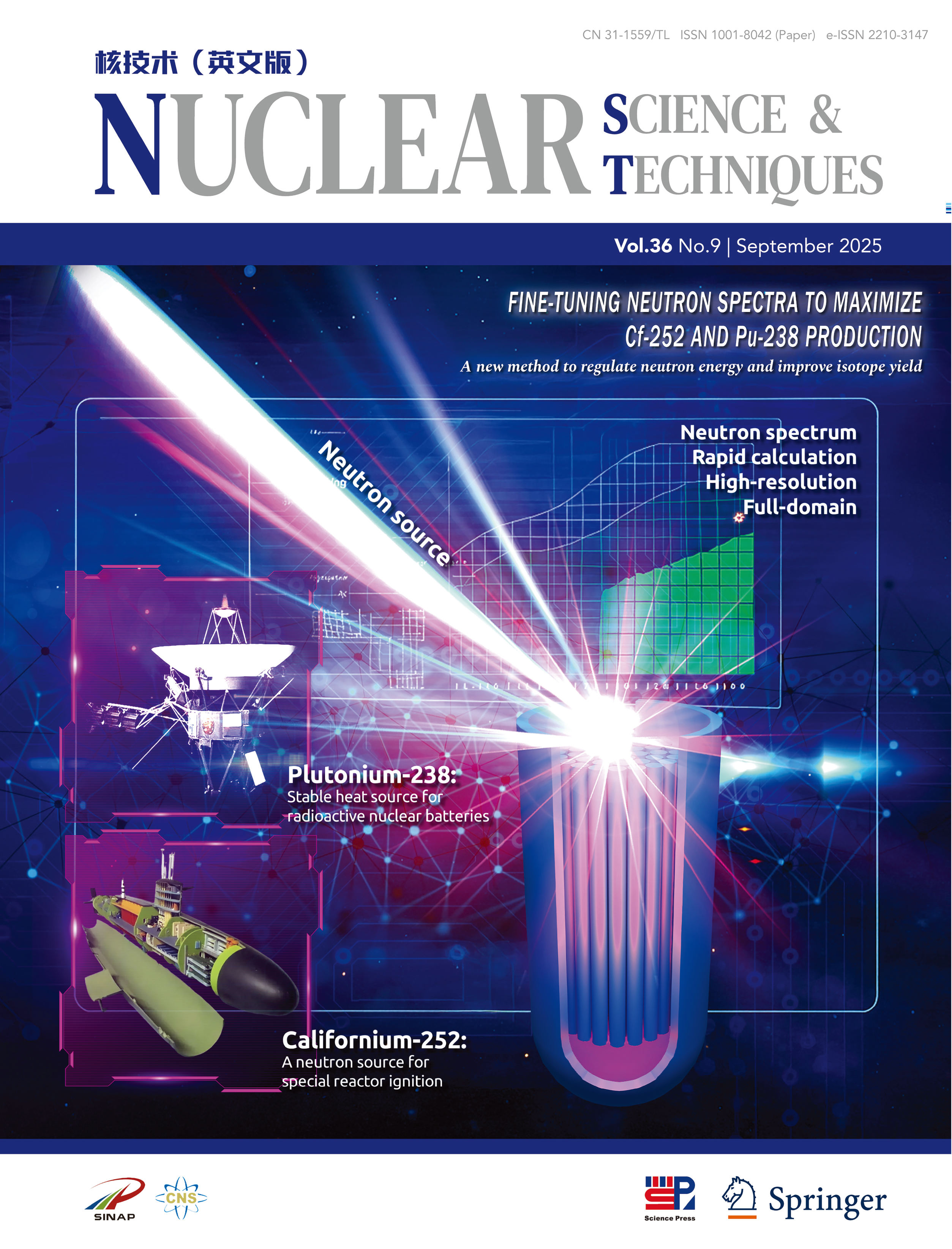
A method is proposed for high-resolution neutron spectrum regulation across the entire energy domain. It was applied to in-reactor transuranic isotope production. This method comprises four modules: a neutron spectrum perturbation module, a neutron spectrum calculation module, a neutron spectrum valuation module, and an intelligent optimization module. It makes it possible to determine the optimal neutron spectrum for transuranic isotope production and a regulation scheme to establish this neutron spectrum within the reactor. The state-of-the-art production schemes for 252Cf and 238Pu in the High Flux Isotope Reactor were optimized, improving the yield of 252Cf by 12.16% and that of 238Pu by 7.53% to 25.84%. Moreover, the proposed optimization schemes only disperse certain nuclides into the targets without modifying the reactor design parameters, making them simple and feasible. The new method achieves efficient and precise neutron spectrum optimization, maximizing the production of transuranic isotopes.
keyword:Genetic algorithm;High resolution;Californium-252;Plutonium-238;Neutron spectrum regulation;
NUCLEAR PHYSICS AND INTERDISCIPLINARY RESEARCH
Research article 28 Jun 2025
Wen Luo,Xue-Qing Yan,Mei-Zhi Wang,Hao-Yang Lan,Di Wu,Xin-Lu Xu,Rui-Rui Xu
The illicit trafficking of special nuclear materials (SNMs) poses a grave threat to global security and necessitates the development of effective nuclear material identification methods. This study investigated a method to isotopically identify the SNMs, including 233,235,238U, 239-242Pu, and 232Th, based on the detection of delayed γ-rays from photofission fragments. The delayed γ-ray spectra resulting from the photofission of SNMs irradiated by a 14 MeV γ beam with a total of 109 were simulated using Geant4. Three high-yield fission fragments, namely,138Cs, 89Rb, and 94Y, were selected as candidate fragments for SNM identification. The yield ratios of these three fragments were calculated, and the results from the different SNMs were compared. The yield ratio of 138Cs/89Rb was used to identify most SNMs, including 233,235,238U, 242Pu, and 232Th, with a confidence level above 95%. To identify 239-241Pu with the same confidence, a higher total number of 1011 γ beams is required. However, although the 94Y/89Rb ratio is suitable for elementally identifying SNMs, isotopic identification is difficult. In addition, the count rate of the delayed γ above 3 MeV can be used to rapidly detect the presence of nuclear materials.
keyword:Photofission;Yield ratio;Special nuclear material identifications;Active interrogation;
Research article 28 Jun 2025
Hai-Rui Guo,Tao Ye,Wen-Di Chen,Jia-Hao Chen,Bo Yang,Qing-Gang Jia,Rui Li,Wei-Li Sun
Prompt fission neutron spectra (PFNS) have a significant role in nuclear science and technology. In this study, the PFNS for 239Pu are evaluated using both differential and integral experimental data. A method that leverages integral criticality benchmark experiments to constrain the PFNS data is introduced. The measured central values of the PFNS are perturbed by constructing a covariance matrix. The PFNS are sampled using two types of covariance matrices; either generated with an assumed correlation matrix and incorporating experimental uncertainties, or derived directly from experimental reports. The joint Monte Carlo transport (JMCT) code is employed to perform transport simulations on five criticality benchmark assemblies by utilizing perturbed PFNS data. Extensive simulations result in an optimized PFNS that shows improved agreement with the integral criticality benchmark experiments. This study introduces a novel approach for optimizing differential experimental data through integral experiments, particularly when a covariance matrix is not provided.
keyword:Prompt fission neutron spectra;Differential nuclear data;Criticality benchmark;Random sample;Transport simulation;
Research article 29 Jun 2025
Jun Su,Long Zhu,Ying-Ge Huang,Hui Wang,Ze-Peng Gao,Jia-Li Huang,Er-Xi Xiao
The potential of high-intensity lasers to influence nuclear decay processes has attracted considerable interest. This study quantitatively evaluated the effects of high-intensity lasers on α decay and cluster radioactivity. Our calculations revealed that, among the parent nuclei investigated, 144Nd is the most susceptible to laser-induced alterations, primarily because of its relatively low decay energy. Additionally, circularly polarized lasers exhibit a greater impact on decay modifications than linearly polarized lasers. Given the limited time resolution of current detectors, it is essential to account for the time-averaging effect of the laser. By incorporating the effects of circular polarization, time averaging, and angular averaging, our theoretical predictions indicated that the modification of 144Nd decay could reach 0.1% at an intensity of 1027 W/cm2. However, this intensity significantly exceeds the current laser capability of 1023 W/cm2, and the predicted modification of 0.1% remains below the detection threshold of contemporary measurement techniques. Observing laser-assisted α decay and 14C cluster radioactivity will likely remain unfeasible until both ultrahigh laser intensities and significant advancements in experimental resolution are achieved.
keyword:α decay;Extreme laser field;Cluster radioactivity;frozen Hartree–Fock method;
Research article 29 Jun 2025
Guo-Liang Ma,Bang-Xiang Chen,Xin-Li Zhao
We investigated the chiral magnetic effect (CME) in relativistic heavy-ion collisions through an improved two-plane method analysis of the Δγ observable, probing CP-symmetry breaking in the strong interactions and topological properties of the QCD vacuum. Using a multiphase transport model with tunable CME strengths, we systematically compared the Au+Au and isobar collisions at sNN=200 GeV. We observed a reduced difference in the CME signal-to-background ratio between the spectator and participant planes for Au+Au collisions compared with isobar collisions. A comprehensive chi-square analysis across all three collision systems revealed stronger CME signatures in Au+Au collisions than in isobar collisions, particularly when measured with respect to the spectator plane. Our findings demonstrate the enhanced experimental reliability of the two-plane method for CME detection in Au+Au collisions.
keyword:Quark-Gluon Plasma;Relativistic heavy-ion collisions;Magnetic field;Chiral magnetic effect;
Research article 01 Jul 2025
Xiao-Cong Ai,Xing-Tao Huang,Hao Li,Hang Zhou,Jin Zhang,Jie Yang
Reconstructing the trajectories of charged particles in high-energy physics experiments is a complex task, particularly for long-lived particles. At the future Super Tau-Charm Facility (STCF), such particles are expected to appear in several key benchmark physics processes. The Common Tracking Software was used to reconstruct the trajectories of long-lived particles, revealing that the track-finding performance of the widely used Combinatorial Kalman Filter is limited by its seeding algorithm. This limitation can be mitigated by guiding the Combinatorial Kalman Filter using initial tracks provided by the Hough Transform. The track-finding performance of the combined Hough Transform and Combinatorial Kalman Filter was evaluated using the process J/ψ→Λ(→pπ−)Λ¯(→p¯π+) at STCF.
keyword:Hough Transform;Track finding;A Common tracking software;Long-lived particles;
Research article 01 Jul 2025
Jing-Jun Zhu,Zhu An,Hong Huang
β-ray-induced X-ray spectroscopy (BIXS) is a promising technique for tritium analysis that offers several unique advantages, including substantial detection depth, nondestructive testing capabilities, and ease of operation. For thin solid tritium-containing samples with substrates, the currently used BIXS analysis method can measure the tritium depth profile and content when the sample thickness is known. In this study, a backpropagation (BP) neural network algorithm was used to predict the tritium content and thickness of a thin solid tritium-containing sample with substrates and a uniformly distributed tritium profile. A semi-analytical method was used to generate datasets for training and testing the BP neural network. A dataset of β-decay X-ray spectra from 420 tritium-containing zirconium models with different known thicknesses and tritium-to-zirconium ratios was used as the input data. The corresponding zirconium thicknesses and tritium-to-zirconium ratios served as the output for training and testing the BP neural network. The mean relative errors (MREs) of the zirconium thickness in the training and test datasets were 0.56% and 0.42%, respectively, whereas the MREs of the tritium-to-zirconium ratio were 0.59% and 0.38%, respectively. Furthermore, the trained BP neural network demonstrates excellent predictive capability across various levels of statistical uncertainty. For the experimental β-decay X-ray spectra of two tritium-containing samples, the predicted zirconium thicknesses and tritium-to-zirconium ratios showed good agreement with the results obtained through the elastic backscattering spectrometry (EBS).
keyword:Tritium analysis;β-ray induced X-ray spectroscopy;Uniformly distributed tritium;Unknown thickness;Semi-analytical;Back propagation neural network;
Research article 04 Jul 2025
Hong-Fei Zhang,Di Xu
The study of uranium isotopes plays a crucial role in advancing our knowledge of nuclear physics, particularly in the realm of isospin and exotic nuclei. This study focused on the ground-state properties of uranium isotopes ranging from A = 203 to A = 305. The key physical quantities examined included binding energy, quadrupole deformation, isotopic displacement, single-particle energy levels, and nucleon density distributions. Recent experimental advancements in uranium isotope studies have emphasized the indispensable role of theoretical models in interpreting experimental data. Moreover, the industrial applications of uranium—especially in nuclear energy production and weapons development—underscore the importance and necessity of accurate theoretical insights. The framework of the finite-range droplet model (FRDM) was utilized for comparative analysis because its predictions closely align with the experimental results. Through an analysis of the single-particle energy levels and continuous-state occupancy, this study identified 207U as the proton drip line nucleus. This research not only deepens our understanding of uranium isotopes but also provides a solid theoretical foundation to guide future experimental investigations.
keyword:Relativistic mean field;BCS theory;Uranium isotopic chain;
NUCLEAR ELECTRONICS AND INSTRUMENTATION
Research article 28 Jun 2025
Jie Liu,Shi-Wei Zhao,Yang Jiao,Pei-Xiong Zhao,Li-Wen Yao,Jin-Hu Yang,Yu-Zhu Liu,Bo Li,Qi-Yu Chen,Xin-Yu Li,Tian-Qi Wang,Fan-Yu Liu,Jian-Tou Gao,Jian-Li Liu,Xing-Ji Li
This paper explores the impact of back-gate bias (Vsoi) and supply voltage (VDD) on the single-event upset (SEU) cross section of 0.18 μm configurable silicon-on-insulator (CSOI) static random-access memory (SRAM) under high linear energy transfer (LET) heavy-ion experimentation. The experimental findings demonstrate that applying a negative back-gate bias to NMOS and a positive back-gate bias to PMOS enhances the SEU resistance of SRAM. Specifically, as the back-gate bias for N-type transistors (Vnsoi) decreases from 0 to -10 V, the SEU cross section decreases by 93.23%, whereas an increase in the back-gate bias for P-type transistors (Vpsoi) from 0 V to 10 V correlates with an 83.7% reduction in SEU cross section. Furthermore, a significant increase in the SEU cross section was observed with increasing supply voltage, as evidenced by a 159% surge at VDD = 1.98 V compared with the nominal voltage of 1.8 V. To explore the physical mechanisms underlying these experimental data, we analyzed the dependence of the critical charge of the circuit and the collected charge on the bias voltage by simulating SEUs using technology computer aided design (TCAD).
keyword:Static Random-Access Memory (SRAM);Single-event upset (SEU);Back-gate voltage;Supply voltage;
Research article 02 Jul 2025
Ping Cao,Xiao-Hu Wang,Bin Zhou,Yuan-Da Wang,Yu Zhu
In-situ exploration of deep-sea seabed resources is a valuable research direction. Neutron activation-based in-situ exploration methods for seabed polymetallic nodules or crust resources are theoretically feasible because of the high content and high neutron capture cross-section of manganese in these nodules or crusts. However, to date, only a few relevant studies have been conducted. In this study, a prototype Deep-sea In-situ Neutron Activation Spectrometer (DINAS) was designed for resource exploration. Through an analysis of the principles of the spectrometer combined with Monte Carlo simulations of the physical principles and finite element simulations of deep-sea pressure, the structure and fundamental components of the spectrometer were determined. The inner core of the spectrometer comprised three components: a compact neutron generator for neutron production, gamma-ray detectors, and an electronics system. The gamma-ray detector array of the spectrometer consisted of LaBr3 and Bi4Ge3O12 (BGO) scintillation crystals coupled with silicon photomultiplier (SiPM) arrays. The electronics system was divided into two modules to implement the SiPM readout and digital signal analysis along the modular design lines. The experimental activation of neutron beamlines at the China Spallation Neutron Source demonstrated the capability of the spectrometer detectors to detect activated gamma rays and showed that the spectrometer achieved an energy resolution of 2.8% at 847 keV for the LaBr3 detector and 6.7% at 2.113 MeV for the BGO detector. The laboratory model experiment tested the functionality of the spectrometer prototype, whereas the Geant4 simulation verified the reliability of the Monte Carlo method. The method and prototype proposed in this study proved feasible for the in-situ detection of polymetallic nodules or crusts in deep-sea environments.
keyword:Readout electronics;Gamma-ray detector;Neutron activation;
DATA ARTICLE
Research article 29 Jun 2025
Mei-Rong Huang,Su-Ya-La-Tu Zhang,De-Xin Wang,Yong-Shun Huang,Wei Jiang,Jie Ren,Rui-Rui Fan,Chun-Lei Zhang,Guo- Li,Dan-Dan Niu
The neutron capture cross-section for 165Ho was measured at the backstreaming white neutron beam line (Back-n) of the China Spallation Neutron Source (CSNS) using total-energy detection systems, composed of a set of four C6D6 scintillator detectors coupled with pulse-height weighting techniques. The resonance parameters were extracted using the multilevel multichannel R-matrix code SAMMY to fit the measured capture yields of the 165Ho(n,γ) reaction in the neutron energy range below 100 eV. Subsequently, the resonance region’s capture cross-sections were reconstructed based on the obtained parameters. Furthermore, the unresolved resonance average cross-section of the 165Ho(n,γ) reaction was determined relative to that of the standard sample 197Au within the neutron energy range of 2 keV to 1 MeV. The experimental data were compared with the recommended nuclear data from the ENDF/B-VIII.0 library, as well as with results of calculations performed using the TALYS-1.9 code. The comparison revealed agreement between the measured 165Ho(n,γ) cross-sections and these data. The present results are crucial for evaluating the 165Ho neutron capture cross-section and thus enhance the quality of evaluated nuclear data libraries. They provide valuable guidance for nuclear theoretical models and nuclear astrophysical studies.
keyword:Cross-section;Neutron capture reaction;Holmium;Total-energy detection principle;C6D6 scintillator detector;China Spallation Neutron Source;
Published on 20 Sep 2025
