
The synchrotron radiation beamline BL17B of the National Facility for Protein Science (NFPS) in Shanghai, situated at the Shanghai Synchrotron Radiation Facility (SSRF), was originally designed for diffraction experiments and accommodates techniques including single-crystal diffraction, powder diffraction, and grazing-incidence wide-angle X-ray scattering (GIWAXS) to enable the characterization of long-range ordered atomic structures. The academic community associated with BL17B engages in research domains encompassing biology, environment, energy, and materials, and a pronounced demand for characterizing short-range ordered structures exists. To address these requirements, BL17B established an advanced X-ray absorption fine structure (XAFS) experimental platform that enabled it to address a wide range of systems, from crystalline to amorphous and from long-range order to short-range order. The XAFS platform allows simultaneous XAFS data acquisition for both the transmission and fluorescence modes within an energy range of 5–23 keV, encompassing the K-edges of titanium to ruthenium and the L3-edges of cesium to bismuth. The platform exemplifies high levels of automation achieved through automated sample assessment and data collection based on large-capacity sample wheels that facilitate remote sample loading. When integrated with a highly integrated control system that simplifies experimental preparation and data collection, the XAFS platform significantly bolsters experimental efficiency and enhances user experience. Notably, the platform boasts an impressively low extended X-ray absorption fine structure (EXAFS) detection limit of 0.04 wt% for dilute copper phthalocyanine (CuPc) samples and an even more remarkable X-ray absorption near edge structure (XANES) detection threshold of 0.01 wt%. These figures represent a hallmark of the unwavering commitment of the platform to high-fidelity XAFS data acquisition, thereby establishing a new benchmark for structural characterization.
Vol.36, No.11
Select issueYearIssue
1209
ACCELERATOR, RAY TECHNOLOGY AND APPLICATIONS
Research article 13 Aug 2025
Lan-Lu Lu,Wen-Ming Qin,Luo-Zhen Jiang,Yang Liu,Kang-Wen Bao,Chun-Yu Li,Zhong-Jie Zhu,Yi-Jun Gu,Jian-Chao Tang,Qing-Jie Xiao,Ting-Ting Wu,Yu-Pu Zhang,Wei-Zhe Zhang,Shu-Yu Zhou,Ya-Yun Yang,Zheng Jiang
keyword:Synchrotron radiation;XAFS;Short-range order;
Research article 13 Aug 2025
Cheng Wang,Jia-Hao Tian,Wen-Cheng Fang,Zhen-Tang Zhao
The application of radiofrequency (RF) electron guns operating at cryogenic temperatures can enhance the performance of a photoinjector. The low emittance and increased brightness of the electron beams resulting from the high gradient in the cryogenic photoinjector make it possible to improve the performance of new light sources. As an upgrading scheme for the Shanghai Soft X-ray Free-Electron Laser (SXFEL), this study explores a novel photocathode RF gun by introducing the TM02 mode into the cathode cell of a 2.6-cell electron gun, which improves the RF performance, particularly in terms of the monopole field. Furthermore, the optimized cathode cell with the TM02 mode can reduce the errors resulting from installation and decrease the dark current with alternative cathodes. In this study, the beam dynamics in a photoinjector were optimized using a 500 pC, 5 ps beam, and its feasibility was examined. This paper presents the entire RF design process, including the adjustment of the RF structure, coupler design, local field, and multipole mode suppression to provide theoretical guidance for subsequent manufacturing and assembly.
keyword:Beam dynamics;C-band;Accelerator physics;Cryogenic photoinjector;RF gun structure;Residual Resistivity Ratio (RRR);
Research article 31 Aug 2025
Bing-Sheng Tu,Jia-Rong Wang,Ji-Fei Wu,Tian-Hang Zhang,Jia-Lin Liu,Jia-Teng Peng,Jia-Wei Wang,Yang Shen,Bao-Ren Wei,Ya-Ming Zou
Accurate atomic mass data hold significant application value in various research fields, in which Penning-Trap mass spectrometry is considered the most precise experimental method. A cryogenic detection system is a key component for reading out the image charge of charged particles in Penning traps using the Fourier-transform ion cyclotron resonance technique. In this paper, we present the development and characteristics of this detection system, which includes a superconducting resonator and cryogenic low-noise amplifiers. The resonator consists of delicately woven thin NbTi wires configured into a multilayer helical coils, offering a quality factor of 98004 at around 1 MHz. Low-noise amplifiers are developed based on GaAs field-effect transistors, exhibiting amplification factors greater than 27 dB with a power consumption of approximately 6 mW in the frequency range of 0.1 to 10 MHz. The lowest input voltage noise is 0.8 at 1 MHz. The fabrication process, operation, and measurements are elucidated in detail.
keyword:Penning traps;Image charge detection;Cryogenic electronics;
Research article 20 Sep 2025
Sheng Wang,Jia-Yin Du,Yao-Shuo Yuan,Morteza Aslaninejad,Jing-Tong Du,Ming-Yang Huang
With the significant development of high-intensity hadron (proton and heavy ion) accelerator facilities, the space charge effect has become a major limiting factor for increasing beam intensity because it can drive particle resonance, forming beam halos and causing beam quality degradation or even beam loss. In studies on space charge, the particle-core model (PCM) has been widely adopted to describe halo particle formation. In this paper, we generalize the conventional PCM to include dispersion to investigate the physical mechanism of the beam halo in high-intensity synchrotrons. In particular, a "1:1 parametric resonance" driven by the combined effects of space charge and dispersion is identified. A large dispersion is proven to have a damping effect on the 2:1 parametric resonance. The analysis based on the generalized PCM agrees with particle-in-cell simulations. A beam halo with large mismatch oscillations is also discussed.
keyword:Space charge;Particle core model;Beam halo;
NUCLEAR PHYSICS AND INTERDISCIPLINARY RESEARCH
Research article 13 Aug 2025
Meng Wang,Yong Zheng,Min‑Liang Liu,Kai‑Long Wang
The low-energy excited states in the neutron-deficient nucleus 91Ru were populated via the 58Ni(36Ar, 2p1nγ)91Ru reaction at a beam energy of 111 MeV. Charged particles, neutrons, and γ rays were emitted in the reactions and detected using a DIAMANT CsI ball, neutron wall, and EXOGAM Ge clover array, respectively. Angular-correlation and linear polarization measurements were performed to determine the spins and parities of the excited states unambiguously. In addition to the previously reported states, a new low-energy-level structure of 91Ru, including one 7/2+ and two 11/2+ states, was established. Similar structures have also been reported in lighter N=47 even-odd isotones down to 85Sr, which were expected to come from the three-neutron–hole νg9/2−3 configuration. A semi-empirical shell model was used to explain the level systematics of the N=47 even-odd isotones. Calculated results indicated that the 7/2+ and the 11/21+ states are mainly associated with the seniority-three ν(g9/2)−3 excitations, while the 11/22+ level is most likely interpreted as a seniority υ=1 configuration of three neutron holes in the νg9/2 orbital weakly coupled to a 2+ excitation of the 88Sr core. A comparison between the calculation and experiment shows that the two 11/2+ excited states display an increase in mixing with proton number Z added from 87Zr up to 91Ru.
keyword:Level structure;Three-neutron-hole excitation;Semi-empirical shell model;Configuration mixing;
Research article 13 Aug 2025
Identification of 3He-3H clusters in the 6Li+89Y experiment using particle-γ coincidence measurement
Gao-Long Zhang,Guang-Xin Zhang,Shi-Peng Hu,M. Siciliano,J. Lubian,Ming-Li Wang,B. Pinheiro,Huan-Qiao Zhang,Hui-Bin Sun,H. Watanabe,Chun-Lei Zhang,D. Testov,P. R. John,J. J. Valiente-Dobón,A. Goasduff,F. Galtarossa,F. Recchia,D. Mengoni,D. Bazzacco,J. J. S. Alves,J. L. Ferreira
The 6Li+89Y experiment was performed to explore the reaction mechanism induced by a weakly bound nucleus 6Li and its cluster configuration. The particle-γ coincidence method was used to identify the different reaction channels. The γ-rays coincident with 3He/3H indicate that the 3H/3He stripping reaction plays a significant role in the formation of Zr/Nb isotopes. The obtained results support the existence of a 3He-3H cluster in 6Li. Direct and sequential transfer reactions are adequately discussed, and the FRESCO code is used to perform precise finite-range cyclic redundancy check (CRC) calculations. In the microscopic calculation, direct cluster transfer is more predominant than sequential transfer in 3H transfer. However, the direct cluster transfer is of comparable magnitude to the sequential transfer in the 3He transfer.
keyword:Coincidence measurement technique;Weakly bound nuclei;Direct cluster transfer;Sequential transfer;CRC calculations;
Research article 13 Aug 2025
Chang-Lin Lan,Bo Xie,Kuo-Zhi Xu,Yu-Ting Wei,Bo Gao,Xian-Lin Yang,Gong Jiang,Jia-Hao Wang,Yang-Bo Nie,Yan-Liang Chang,Ge Zhang,Fan Wu,Shi-Long Liu,Xi-Chao Ruan
Benchmark experiments are indispensable for the development of neutron nuclear data evaluation libraries. Given the lack of domestic benchmarking of nuclear data in the fission energy region, this study developed a neutron leakage spectrum measurement system using a spherical sample based on the 252Cf spontaneous fission source. The EJ309 detector (for high-energy measurements) and CLYC detector (for low-energy measurements) were combined to measure the time-of-flight spectrum using the γ tagging method. To assess the performance of the system, the time-of-flight spectrum without a sample was measured first. The experimental spectra were consistent with those simulated using the Monte Carlo method and the standard 252Cf spectrum from ISO:8529-1. This demonstrates that the system can effectively measure the neutron events in the 0.15–8.0 MeV range. Then, a spherical polyethylene sample was used as the standard to verify the accuracy of the system for the benchmark experiment. The simulation results were obtained using the Monte Carlo method with evaluated data from the ENDF/B-VIII.0, CENDL-3.2, JEFF-3.3, and JENDL-5 libraries. The measured neutron leakage spectra were compared with the corresponding simulated results for the neutron spectrum shape and calculated C/E values. The results showed that the simulated spectra with different data libraries reproduced the experimental results well in the 0.15–8.0 MeV range. This study confirms that the leakage neutron spectrum measurement system based on the 252Cf source can perform benchmarking and provides a foundation for evaluating neutron nuclear data through benchmark experiments.
keyword:Time-Of-Flight technique;Evaluated nuclear data;252Cf;Neutron leakage spectrum;Benchmark experiment;Spherical samples;
Research article 14 Aug 2025
Cen-Xi Yuan,Chang-Feng Jiao
The tensor force changes the nuclear shell structure, and thus may result in underlying influence the collectivity and decay properties of the nucleus. We carefully examined the impact of the monopole and multipole effects originating from the tensor force on both the collectivity and the matrix element for the neutrinoless double-β (0νββ) decay, using the generator-coordinate method with an effective interaction. To analyze the effect of the tensor force, we employed an effective Hamiltonian associated with the monopole-based universal interaction that explicitly consists of the central, tensor, and spin-orbit coupling terms. The interferences among the shell structure, quadrupole collectivity, nucleon occupancy, and 0νββ matrix elements were analyzed in detail. A better understanding of the tensor force would be of great importance in reducing the theoretical uncertainty in 0νββ nuclear matrix element calculations.
keyword:Neutrinoless double-beta decay;collective correlations;tensor force.;
Research article 14 Aug 2025
Yu-Gang Ma,Bo Zhou,Xiao-Quan Du,Cong-Wu Wang,De-Ye Tao
To investigate the structural configuration of 6He and 6Be in a three-cluster system and to highlight dinucleon correlations, we performed a Two-Cluster Overlap Amplitude (TCOA) calculation, which is an extension of the RWA formalism. The total wave functions were obtained using the generator coordinate method with microscopic cluster wave functions. Based on these wave functions, we calculated the overlap amplitudes to extract the relative motion and spatial correlations between clusters. The computed energy spectra showed reasonable agreement with the experimental data, emphasizing the effectiveness of the present framework for investigating dinucleon correlations in light nuclei. Our results revealed the presence of both dinucleon-like and cigar-like configurations in the ground states of 6He and 6Be, indicating a coexistence of compact and extended cluster structures. Furthermore, the 21+ state of 6He revealed a pronounced dineutron structure, with strong spatial correlations between the two valence neutrons. We also performed calculations for the higher-lying 22+ state, which showed a more spatially extended structure and provided potential references for future experimental investigations. These findings demonstrated that the TCOA method served as a powerful tool to explore cluster dynamics and dinucleon features in light, weakly bound nuclear systems.
keyword:Nuclear cluster model;Halo nuclei;Diproton;Dineutron;Overlap amplitude;
Research article 17 Aug 2025
S.D. Kolokolchikov,Yu.V. Senichev,A.E. Aksentyev,A.A. Melnikov
We propose a dual-purpose magneto-optical lattice to accelerate both heavy ions and light particles. Dispersion modulation allows for the control of the transition energy for light particles, whereas minimal modulation is optimal for heavy ions to reduce intrabeam scattering. Our results demonstrate that both particle types achieve stable acceleration with minimal structural modifications, thereby ensuring efficient beam dynamics and luminosity.
keyword:Transition energy;Intrabeam scattering;Stochastic cooling;Resonant lattice;Dual-purpose structure;
Research article 20 Aug 2025
Hao-Yu Shang,Yu Qiang,Jun-Chen Pei
We studied the energy partition between two well-separated fission fragments associated with the partition of nucleons owing to quantum entanglement. This is different from most fission models that invoke an explicit statistical partition of excitation energies. The dynamical fission evolution is described within the time-dependent Hartree-Fock+BCS framework. Excitation energies of isotopic fission fragments were obtained using the particle-number projection method after the dynamical splitting of 238U. The resulting excitation energies of the light and heavy fragments are consistent with the appearance of sawtooth structures. We found that the pairing correlation strengths have a significant influence on the partition of the excitation energies. Furthermore, the excitation energies of isotopic fragments increase with increasing neutron number, implying the suppression of the production of neutron-rich beams in rare-isotope beam facilities.
keyword:Nuclear fission;Energy partition;Time dependent density functional theory;
Research article 20 Aug 2025
Fu-Rong Xu,Jian-Guo Li,Shao-Liang Jin,Yuan Gao,Rong-Zhe Hu
The full configuration interaction quantum Monte Carlo (FCIQMC) method, originally developed in quantum chemistry, has also been successful for both molecular and condensed matter systems. Another natural extension of this methodology is its application to nuclear structure calculations. We developed an FCIQMC approach to study nuclear systems. To validate this method, we applied FCIQMC to a small model space, where the standard shell model remains computationally feasible. Specifically, we performed calculations for Fe isotopes using pf-shell GXPF1A interaction and compared the results with those obtained from the standard shell model calculations. To further demonstrate the capabilities of the FCIQMC, we investigated its performance in systems exhibiting strong correlations, where conventional nuclear structure models are less effective. Using an artificially constructed strongly correlated system with a modified GXPF1A interaction, our calculations revealed that FCIQMC delivered superior results compared to many existing methods. Finally, we applied FCIQMC to Mg isotopes in the sdpf-shell model space, showing its potential to perform accurate calculations in large model spaces that are inaccessible to the shell model because of the limitations of current computational resources.
keyword:Shell model;Full configuration interaction quantum Monte Carlo;Strong correlation;
Research article 21 Aug 2025
Si-Ze Chen,Bing Guo,Li-Yong Zhang,Zi-Ming Li,Xin-Yue Li,Zhi-Lin Shen,Jun Su,Lu-Yang Song,Lin Wang,Jian-Jun He,Shi-Lun Jin,Fei Lu,Yang-Ping Shen,Jun-Feng Chen,Yao-De Sheng,Xin Chen,Shen Lin,Zhi-Wei Qin,Hao Zhang,Luo-Huan Wang,Yin-Ji Chen,Xin-Zhi Jiang,Feng-Cheng Liu,Yi-Tong Huang,Wei-Ping Liu
The precise determination of cross sections for key nuclear reactions within the Gamow window is crucial for advancing the study of stellar evolution and nucleosynthesis. However, extremely low reaction yields combined with the cosmic-ray-induced background make these measurements highly challenging, particularly for capture reactions. This work demonstrates the second configuration of the Large-scale Modular BGO Detection Array (LAMBDA-II) designed to capture reaction measurements, and introduces a method for suppressing γ-ray detection background in ground laboratories. By employing active and passive shielding, the background of LAMBDA-II was significantly reduced by approximately two orders of magnitude, reaching 8.1×10⁻³ and 1.0×10⁻³ keV-1h-1 in the 6–11 and 11–20 MeV energy ranges, respectively. When combined with a mA-scale intensity beam, this reduced background enables the investigation of several capture reactions of astrophysical interest in ground laboratories.
keyword:Background;Shielding;Nuclear astrophysics;Capture reaction;Summing technique;γ detector array;
Research article 30 Aug 2025
Jian Li,Jian Liu,Kai-Zhong Tan,Lei Wang,Wan-Qing Gao,Tian-Shuai Shang,Chang Xu
Recently, machine learning has become a powerful tool for predicting nuclear charge radius RC, providing novel insights into complex physical phenomena. This study employs a continuous Bayesian probability (CBP) estimator and Bayesian model averaging (BMA) to optimize the predictions of RC from sophisticated theoretical models. The CBP estimator treats the residual between the theoretical and experimental values of RC as a continuous variable and derives its posterior probability density function (PDF) from Bayesian theory. The BMA method assigns weights to models based on their predictive performance for benchmark nuclei, thereby accounting for the unique strengths of each model. In global optimization, the CBP estimator improved the predictive accuracy of the three theoretical models by approximately 60%. The extrapolation analyses consistently achieved an improvement rate of approximately 45%, demonstrating the robustness of the CBP estimator. Furthermore, the combination of the CBP and BMA methods reduces the standard deviation to below 0.02 fm, effectively reproducing the pronounced shell effects on RC of the Ca and Sr isotope chains. The studies in this paper propose an efficient method to accurately describe RC of unknown nuclei, with potential applications in research on other nuclear properties.
keyword:Machine learning;Nuclear charge radii;Continuous Bayesian probability estimator;Bayesian model averaging;
Research article 30 Aug 2025
Feng-Shou Zhang,Zi-Long Wang,Xiao-Ye Zhang,Gen Zhang
Within the framework of the isospin-dependent quantum molecular dynamics model, the fusion cross section and fusion mechanism of neutron-deficient Pu isotopes in the reactions 24,26,30Si+196Hg were investigated. We found that the fusion cross sections are higher in the reaction with a more neutron-rich beam owing to the lower dynamical barrier. The dynamic barrier decreases with decreasing incident energy, which explains the fusion enhancement at the sub-barrier energy. The peak value of N/Z ratio in the neck region was the highest in reaction 30Si+196Hg, indirectly leading to the lowest dynamic barrier. Compared with the proton density distribution, the neck region for neutrons is larger, indicating that neutrons transfer more quickly than protons, leading to a high N/Z ratio in the neck. The time distribution of the appearance of dynamical barriers was wider at lower incident energies, indicating that the fusion process took longer to exchange nucleons. The single-particle potential barrier decreases with time evolution and finally disappears at a lower impact parameter, which is favorable for fusion events.
keyword:IQMD model;Fusion reaction;Neutron-deficient isotopes;Neck dynamics;
Research article 12 Sep 2025
Feng-Shou Zhang,Rong An,Li-Gang Cao,Shuai Sun,Ya-Lu Wang,Miao Qi
The continuum quasiparticle random phase approximation (CQRPA), which includes the Skyrme interaction for both ground and excited state calculations, is extended in a more consistent manner in the present work. The emergence, evolution, and origin of pygmy monopole strengths along the even-even Ni isotopes were investigated carefully within consistent Skyrme HF + BCS and CQRPA models. The SLy5 Skyrme interaction and density-dependent zero-range pairing interactions were adopted in the calculations. No pygmy monopole strength was observed in 70-78Ni. However, pronounced pygmy monopole strengths are clearly observed in 80-84Ni, which are attributed mainly to the neutron excitations from weakly bound orbitals into the continuum. The neutron states involved in the pygmy monopole strength include 1g9/2, 2d5/2, 3s1/2 and 2d3/2. We suggest that more efforts from experimental investigations of pygmy monopole resonance should be made to confirm or disprove the predictions from models in the future.
keyword:Pygmy monopole resonance;Continuum quasiparticle random phase approximation;Skyrme energy density functional;
Research article 12 Sep 2025
Jian-Guo Li,Liu-Yuan Shen,Qi Yuan,Hong-Hui Li,Meng-Ran Xie,Wei Zuo
Neutron-rich boron, carbon, and nitrogen isotopes have garnered extensive experimental and theoretical interest. In the present work, we conducted a comprehensive study of these nuclei by utilizing ab initio valence-space in-medium similarity renormalization group calculations with chiral nucleon-nucleon and three-nucleon interactions. First, we systematically calculated the spectra of nuclei. Our results align well with the available experimental data, which are comparable to phenomenological shell model calculations. Subsequently, the evolution of the N=14 and N=16 shell gaps is discussed based on the calculated spectra and the effective single-particle energies. Our calculations suggest that the N=14 neutron subshell is present in the oxygen isotopes but disappears in the boron, carbon, and nitrogen isotopic chains. Moreover, the N=16 subshell is present in all isotopes but gradually decreases from 24O to 21B. These results provide valuable information for future studies.
keyword:Ab initio calculations;Shell evolution;Chiral nuclear forces;Low-lying spectra;
Research article 12 Sep 2025
Qi Zhao,Yang-Bo Nie,Kuo-Zhi Xu,Shi-Yu Zhang,Xin-Yi Pan,Yan-Yan Ding,Xiao-Yu Wang,Bei-Bo He,Qi Sun,Jie Ren,Hong-Tao Chen,Xi-Chao Ruan,Zheng Wei
Beryllium (9Be) serves as a crucial neutron multiplier and reflection material, being extensively employed in the nuclear industry. The evaluated nuclear data are utilized in the design of the nuclear devices. Following the interaction between neutrons and 9Be, all neutrons generated stem from the 9Be(n, 2n)8Be reaction channel, except for the elastic scattering reaction channel. Nevertheless, the data of the outgoing neutron double differential cross section of the reaction channel provided by the latest internationally evaluated libraries still exhibit considerable discrepancies. A shielding integral experiment based on slab 9Be samples with measurements of neutron spectra leaked from different angles is an effective approach to verify the double differential cross section data. Hence, in this study, a shielding integral experiment of 9Be samples of different thicknesses was conducted using a nanosecond pulsed deuterium-tritium neutron source established by the China Institute of Atomic Energy. The neutron time-of-flight spectra of three thicknesses (4.4 cm, 8.8 cm, and 13.2 cm) and six angles (47°, 58°, 73°, 107°, 122°, and 133°) were measured by the neutron time-of-flight method, and 18 sets of experimental data were obtained. Additionally, the MCNP-4C program was used to obtain the simulated results of the leakage neutron spectra using the evaluated nuclear data of 9Be from the CENDL-3.2, ENDF/B-VIII.0, JENDL-5, and JEFF-3.3 libraries. The simulated results of the leakage neutron spectra were compared with the experimental results, and the results showed that in the elastic scattering energy region, the simulated results from the CENDL-3.2, ENDF/B-VIII.0, and JENDL-5 libraries were slightly higher at small angles and slightly lower at large angles. In the (n, 2n) energy region, the simulated results from the CENDL-3.2 library were significantly different from the experimental results in terms of spectral shape, and the simulated results from the ENDF/B-VIII.0 and the JENDL-5 libraries were in good agreement with the experimental results at small angles but low at large angles. The simulated results from the JEFF-3.3 library showed serious underestimation at all angles.
keyword:Evaluated nuclear data;Beryllium;Shielding integral experiment;Deuterium tritium neutron source;Neutron time-of flight spectrum;MCNP-4C program;
Research article 12 Sep 2025
Philip Malzard Walker,Fu-Rong Xu,Qi Yuan,Si-Qin Fan
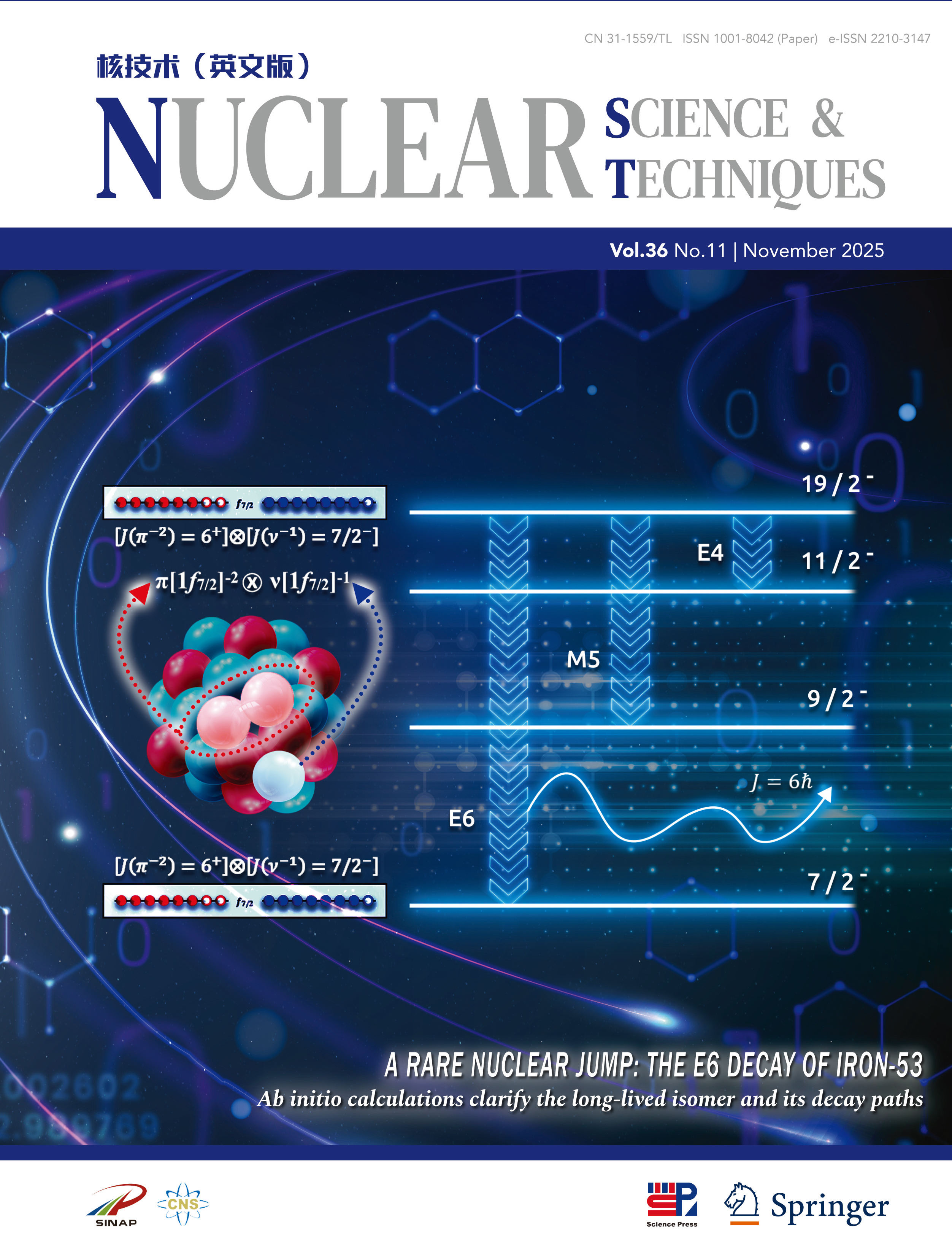
High multipole electromagnetic transitions are rare in nature. The highest multipole transition observed in atomic nuclei is the electric hexacontatetrapole E6 transition from the T1/2=2.54(2)-min Jπ=19/2- isomer to the 7/2- ground state in 53Fe with an angular momentum change of six units. In the present work, we performed ab initio calculations for this unique case by employing chiral effective field theory (EFT) forces. The in-medium similarity renormalization group is used to derive the valence-space effective Hamiltonian and multipolar transition operators. Bare nucleon charges were used in all the multipolar transition rate calculations, providing good agreement with the experimental data. The valence space takes the full fp shell. In 53Fe, the low-lying states were dominated by the 0f7/2 component. Two different versions of the chiral EFT two- plus three-nucleon interaction were used to test the dependence on the interaction used. We also tested the convergence of the transition rate calculations against the harmonic oscillator parameter ℏΩ and basis truncations emax and E3max for two- and three-nucleon forces, respectively.
keyword:Ab initio calculations;Isomerism;Highest-multipole electromagnetic transitions;Chiral two- plus three-nucleon forces;Valence-space in-medium similarity renormalization group;
DATA ARTICLE
Research article 14 Aug 2025
Jie Ren,Yong-Hao Chen,Jie-Ming Xue,Rui-Rui Fan,Min-Hao Gu,Ya-Kang Li,Ping Cao,Wei Jiang,Han Yi,Peng Hu
This article introduces the methodologies and instrumentation for data measurement and propagation at the Back-n white neutron facility of the China Spallation Neutron Source (CSNS). The Back-n facility employs backscattering techniques to generate a broad spectrum of white neutrons. Equipped with advanced detectors such as the Light Particle Detector Array (LPDA) and the Fission Ionization Chamber Detector (FIXM), the facility achieves high-precision data acquisition through a general-purpose electronics system. Data were managed and stored in a hierarchical system supported by the National High Energy Physics Science Data Center (NHEPDC), ensuring long-term preservation and efficient access. The data from the Back-n experiments significantly contribute to nuclear physics, reactor design, astrophysics, and medical physics, enhancing the understanding of nuclear processes and supporting interdisciplinary research.
keyword:White neutron beam;Data acquisition;Nuclear physics;Data sharing;Data storage and management;Neutron experiments;
Research article 12 Sep 2025
Zheng-Yun You,Ming-Hua Liao,Jian-Shu Liu,Xin-Nan Wang,Sheng-Sen Sun
In the BESIII detector at Beijing electron-positron collider, billions of events from e+e- collisions were recorded. These events passing through the trigger system were saved in raw data format files. They play an important role in the study of physics in τ-charm energy region. Here, we published an e+e- collision dataset containing both Monte Carlo simulation samples and real data collected by the BESIII detector. The data passes through the detector trigger system, file format conversion, and physics information extraction, and finally saves the physics information and detector response in text format files. This dataset is publicly available and is intended to provide interested scientists and those outside of the BESIII collaboration with event information from BESIII, which can be used to understand physics research in e+e- collisions, developing visualization projects for physics education, public outreach, and science advocacy.
keyword:Visualization;BESIII;Data sharing;Electron-positron collision;Education;
Research article 20 Sep 2025
Hao Ma,Zhi Zeng,Li-Tao Yang,Zhen-Yu Zhang,Qian Yue
Founded in 2009, the China Dark Matter Experiment (CDEX) collaboration was dedicated to the detection of dark matter (DM) and neutrinoless double beta decay using high purity germanium (HPGe) detectors in the China Jinping Underground Laboratory. HPGe detectors are characterized by a high energy resolution, low analysis threshold, and low radioactive background, making them an ideal platform for the direct detection of DM. Over the years, CDEX has accumulated a massive amount of experimental data, based on which various results on DM detection and neutrinoless double beta decay have been presented. Because the dataset was collected in a low-background environment, apart from the analysis of DM-related physical channels, it has great potential as an indicator in other rare physical events searches. Furthermore, by providing raw pulse shapes, the dataset can serve as a tool for effectively understanding the internal mechanisms of HPGe detectors.
keyword:Raw data;Low background experiment;Pulse shapes;HPGe detectors;CDEX;
INVITED REVIEW
Review article 14 Aug 2025
Feng-Shou Zhang,Ming-Hao Zhang,Zhi-Yuan Zhang,Zai-Guo Gan,Shan-Gui Zhou
The synthesis of superheavy nuclei remains a critical area of research in nuclear physics, with the aim of extending the periodic table and deepening our understanding of the properties of nuclei. This review provides a comprehensive overview of the latest advancements in superheavy nuclei synthesis, focusing on both the experimental and theoretical developments. We discuss the primary synthesis methods, including early fusion reactions with light nuclei, cold fusion reactions using lead and bismuth targets, and hot fusion reactions involving 48Ca projectiles and actinide targets. In addition, we introduce the major experimental facilities and theoretical models currently employed worldwide. This review also summarizes the experimental plans and theoretical predictions for the synthesis new superheavy elements. Furthermore, we discuss future directions, including the potential of employing heavier projectiles, radioactive beam-induced reactions, and multi-nucleon transfer reactions, which may offer new pathways for discovering unknown superheavy nuclei.
keyword:Superheavy nuclei;Multi-nucleon transfer reaction;Reaction mechanism;Fusion reactions;Heavy Ion Physics;
Review article 17 Aug 2025
Xu-Guang Huang
Spin polarization and spin transport are common phenomena in many quantum systems. Relativistic spin hydrodynamics provides an effective low-energy framework to describe these processes in quantum many-body systems. The fundamental symmetry underlying relativistic spin hydrodynamics is angular momentum conservation, which naturally leads to inter-conversion between spin and orbital angular momenta. This inter-conversion is a key feature of relativistic spin hydrodynamics, which is closely related to entropy production and introduces ambiguity in the construction of constitutive relations. In this article, we present a pedagogical introduction of relativistic spin hydrodynamics. We demonstrate how to derive constitutive relations by applying local thermodynamic laws and explore several distinctive aspects of spin hydrodynamics. These include pseudo-gauge ambiguity, the behavior of the system in the presence of strong vorticity, and the challenges of modeling the freeze-out of spin in heavy-ion collisions. We also outline some future prospects for spin hydrodynamics.
keyword:Heavy-ion collision;Spin polarization;Spin hydrodynamics;
Review article 23 Sep 2025
Wei Xu,Ding She,Jian Li,Heng Xie,Zhi-Hong Liu,Lei Shi
High flux reactors (HFRs) are a special type of research reactor aimed at providing a high neutron flux. Compared with power reactors and other research reactors, HFRs have unique technical features in terms of reactor core design, irradiation capability, and operating characteristics. They can be applied to the irradiation tests of nuclear fuels and materials, radioisotope production, neutron science, and experiments. This paper reviews HFRs, including their development history, technical features, and application areas, as well as trends in the development of new and advanced HFRs.
keyword:Review;high flux reactor;development;design features;application fields;
NUCLEAR CHEMISTRY, RADIOCHEMISTRY, AND NUCLEAR MEDICINE
Research article 14 Aug 2025
Wen-Guan Liu,Hui-Qin Yin,Lin-Bing Jiang,Xuan-Chun Wu,Biao Hu,Yang Wang
Thermodynamic optimization of the AF-BeF2 (A = K, Rb, and Cs), KF-CsF, and RbF-CsF systems was performed within the framework of phase diagrams calculation. The model parameters were optimized based on experimental data and theoretically calculated values. The results show that the thermodynamically calculated values for the AF-BeF2 (A = K, Rb, and Cs), KF-CsF, and RbF-CsF systems agree well with the experimental data. Next, a set of reliable and self-consistent thermodynamic databases was built, and the liquidus projections and invariant points of the sub-ternary systems of the KF-RbF-CsF-BeF2 system were calculated. Furthermore, the melting temperature with the corresponding composition was predicted using the phase diagrams calculation technique, and the radial distribution functions, coordination numbers, angular distribution functions, and diffusion coefficients of the quaternary KF-RbF-CsF-BeF2 system were calculated using ab initio molecular dynamics. The results show that the quaternary KF-RbF-CsF-BeF2 system with the proportion 3.50-28.92-21.78-45.80 mol% or 1.80-35.42-52.40-10.38 mol% is one of the most promising candidate coolants for molten salt reactors in terms of thermodynamics and kinetics. This work provides direct guidelines for the screening and optimization of molten salts in the nuclear energy field.
keyword:Keywords Molten salt;KF-RbF-CsF-BeF2;Calculation of phase diagrams;Ab initio molecular dynamics;
RESEARCH HIGHLIGHT
Editorial 17 Aug 2025
Jiangyong Jia
The challenge in searching for fundamental symmetry violation. Neutrinoless double-beta (0νββ) decay represents one of the most profound tests of fundamental symmetries in nature. This hypothetical nuclear process, in which two neutrons simultaneously decay into two protons with the emission of two electrons but no neutrinos, would demonstrate that lepton number is not conserved and confirm that neutrinos are their own antiparticles (Majorana particles). The observation of 0νββ decay would provide crucial insights into the absolute neutrino mass scale and could illuminate the origin of matter-antimatter asymmetry in the universe.
NUCLEAR ENERGY SCIENCE AND ENGINEERING
Research article 17 Aug 2025
Xiao-Jing Liu,Lin Zhang,Chang Deng,Guang-Chao Yang,Hui He
The vapor diffusion and transport resulting from steam generator tube rupture (SGTR) accidents are a major concern threatening lead-based reactor core safety. In this study, a high-parameter SGTR experimental platform and the multiphase multi-physics processes numerical simulation were developed to investigate the phase behavior and interaction mechanisms. This study revealed the interaction mechanisms of lead–bismuth liquid metal and water driven by flash vaporization, jet impingement boiling, and moderate boiling. The migration and evolution of the discrete phases (vapor–water mixture) were inferred from the temperature transient laws and a numerical simulation. The results revealed that the evolution of the discrete phases consists of three stages: cavity formation, flanking diffusion, and stable up-floating. The jet pressure significantly extended the disturbance period. Variations in the water temperature mainly affected the decompression boiling process, altering the diffusion region of the discrete phases. The temperature of the liquid metal and the duration of the jet had a minimal impact on the behavior of the discrete phases. This study provides a crucial reference for constructing a complete picture of accident evolution.
keyword:steam generator tube rupture;Discrete phases migration;LBE-water interaction;lead-cooled fast reactors;
NUCLEAR ELECTRONICS AND INSTRUMENTATION
Research article 21 Aug 2025
Cheng-Jian Lin,Gao-Long Zhang,Yong-Jin Yao,Guang-Xin Zhang,Lei Yang,Yan-Song Wu,Nan-Ru Ma,Shi-Peng Hu,Huan-Qiao Zhang,Marco Mazzocco,Zhen-Wei Jiao,Ming-Li Wang,Xue-Dou Su,Hao-Bo Lv,Kun Dong
A new detector array with a large solid angle coverage for the coincidence measurement of charged fragments was developed to study the breakup reaction mechanisms of weakly bound nuclear systems at energies around the Coulomb barrier. The array has been used to explore the breakup reaction mechanisms of 6,7Li + 209Bi systems at Ebeam = 30, 40, 47 MeV, showing good performance in particle identification and complete kinematic measurements. Based on this, different breakup modes and breakup components were clearly distinguished, and some new breakup modes were discovered, such as 7Li → α + t breakup mode in 6Li + 209Bi system and 7Li → 6He + p breakup mode in 7Li + 209Bi system. This array can also be used to explore other breakup reaction mechanisms induced by weakly bound nuclei.
keyword:Coincidence measurement;Breakup reaction;Weakly bound nuclei;Detector array;
Research article 20 Sep 2025
A. Zubankov,S. Afanasiev,M. Golubeva,F. Guber,A. Ivashkin,N. Karpushkin,O. Kutinova,D. Lyapin,A. Makhnev,S. Morozov,P. Parfenov,I. Pshenichnov,D. Sakulin,S. Savenkov,A. Shabanov,E. Sukhov,A. Svetlichnyi,G. Taer,V. Ustinov
A time-of-flight Highly Granular Neutron Detector (HGND) with a multilayer longitudinal structure of interleaved absorber and scintillator plates, high transverse granularity, and time resolution of approximately 150 ps is currently under development. The detector is designed to identify neutrons produced in nucleus-nucleus collisions and measure neutron kinetic energies of 0.3–4 GeV by the time-of-flight method in the BM@N experiment at the NICA accelerator complex at JINR. To validate the concept of full-scale HGND, a compact HGND prototype was first designed and built, and its performance was studied in the BM@N experiment. The acceptance of the HGND prototype and the detection efficiency of forward neutrons emitted in hadronic fragmentation and electromagnetic dissociation (EMD) of 3.8A GeV 124Xe projectiles interacting with a CsI target were calculated by means of the DCM-QGSM-SMM and RELDIS models, respectively. The energy distributions of the forward spectator neutrons and neutrons from the EMD were measured and compared with the simulations. The developed methods will be used to calibrate the full-scale HGND and study its efficiency.
keyword:Neutron detectors;High-energy neutrons;Particle identification methods;
Published on 20 Nov 2025
