
In this study, we performed a systematic analysis of the multiplicity dependence of hadron production at mid-rapidity (|y|<0.5), ranging from the light to the charm sector in proton—proton (pp) collisions at s=13 TeV. This study used a multi-phase transport (AMPT) model coupled with PYTHIA8 initial conditions. We investigated the baryon-to-meson and the strange-to-non-strange meson ratios varying with the charged particle density. By tuning the coalescence parameters, the AMPT model provides a reasonable description of the experimental data for the inclusive production of both light and charm hadrons, comparable to the string fragmentation model calculations with color reconnection effects. Additionally, we analyzed the relative production of hadrons by examining the self-normalized particle ratios as a function of the charged hadron density. Our findings suggest that parton evolution effects and the coalescence hadronization process in the AMPT model result in a strong flavor hierarchy in the multiplicity dependence of the baryon-to-meson ratio. Furthermore, our investigation of the pT differential double ratio of the baryon-to-meson fraction between high- and low-multiplicity events revealed distinct modifications to the flavor associated baryon-to-meson ratio pT shape in high-multiplicity events when comparing the coalescence hadronization model to the color reconnection model. These observations highlight the importance of understanding the hadronization process in high-energy pp collisions through comprehensive multiplicity-dependent multi-flavor analysis.
Vol.36, No.8
Select issueYearIssue
1202
NUCLEAR PHYSICS AND INTERDISCIPLINARY RESEARCH
Research article 02 Jun 2025
Liang Zheng,Ao-Gui Zhang,Xin-Ye Peng
keyword:AMPT;small system;Heavy flavor;Multiplicity dependence;
Research article 02 Jun 2025
Cheng-Xin Zhao,Hong-Lin Zhang,Xurong Chen,Xiong-Hong He,Qiang Hu,De-Xu Lin,Yang Liu,Hao Qiu,Xu Sun,Ye Tian,Rong Wang,Ya-Peng Zhang
As an approximate Goldstone boson with zero quantum number and zero standard model charge, the long-lived η meson exhibits the decay processes that offer a unique opportunity to explore physics beyond the standard model and new sources of charge parity violation. Further, they facilitate the testing of the low-energy quantum chromodynamics theory and measurement of the fundamental parameters of light quarks. To pursue these goals, we propose a plan to construct a super η factory at HIAF high-energy terminal or at CiADS after its energy upgrade. The high-intensity proton beam at HIAF enables the production of many η samples, exceeding 1013 events per year during the first stage, utilizing multiple layers of thin targets composed of light nuclei. This paper presents the physics goals, the first-version conceptual design of the spectrometer, and preliminary simulation results.
keyword:High-intensity frontier;Eta meson factory;New physics;Symmetry breaking;Strong interaction;Silicon-pixel detector;
Research article 03 Jun 2025
Guo-Yun Shao,Xin-Ran Yang,Chong-Long Xie,Zhi-Peng Li
We investigated the correlations between the net baryon number and electric charge up to the sixth order related to the interactions of nuclear matter at low temperature and explored their relationship with the nuclear liquid-gas phase transition (LGPT) within the framework of the nonlinear Walecka model. The calculations showed that strong correlations between the baryon number and electric charge existed near the LGPT, and higher-order correlations were more sensitive than the lower-order correlations near the phase transition. However, in the high-temperature region away from the LGPT, the rescaled lower-order correlations were relatively larger than most of the higher-order correlations. In addition, some of the fifth- and sixth-order correlations possibly changed sign from negative to positive along the chemical freeze-out line with decreasing temperature. In combination with future experimental projects at lower collision energies, the derived results can be used to study the phase structure of strongly interacting matter and analyze the related experimental signals.
keyword:Heavy-ion collision;Nuclear matter;Correlations of conserved charges;Nuclear liquid-gas phase transition;
Research article 03 Jun 2025
Ying-Xun Zhang,Ying Cui,Yuan Tian,Cheng-Jun Xia,Zhu-Xia Li
In this paper, we constrain the symmetry energy at high densities in nuclear matter using recent observations of neutron stars based on the calculations of relativistic mean-field (RMF) models. Using the observations of the neutron stars, we obtain the constraint on the symmetry energy at high densities, S(2ρ0) =40.54±12.47 MeV, and S(3ρ0) =44.12±29.38 MeV.
keyword:Symmetry energy;Neutron star;Equation of state;
Research article 03 Jun 2025
P. Lu,R. Kavak,A. Dubla,S. Masciocchi,I. Selyuzhenkov
While the abundances of the final state hadrons in relativistic heavy-ion collisions are rather well described by the thermal particle production, the shape of the transverse momentum, pT, distribution below pT≈500 MeV/c, is still poorly understood. We propose a procedure to quantify the model-to-data differences using Bayesian inference techniques, which allows for consistent treatment of the experimental uncertainties and tests the completeness of the available hydrodynamic frameworks. Using relativistic fluid framework FLIDuM with PCE coupled to TRENTo initial state and decays, we analyse pT distribution of identified charged hadrons measured in heavy-ion collisions at top RHIC and the LHC energies, and identify an excess of pions produced below pT≈500 MeV/c. Our results provide new input for the interpretation of the pion excess as either missing components in the thermal particle yield description or as an evidence for a different particle production mechanism.
keyword:Heavy-ion collision;Quark-Gluon Plasma;Hydrodynamic models;
Research article 04 Jun 2025
Wei-Ping Lin,Xiao-Dong Tang,Ning-Tao Zhang,Shuo Wang,Yun-Zhen Li,Long-Hui Ru,Xin-Yu Wang,Yi-Hua Fan,Yu-Cheng Feng,Bing-Shui Gao,Hao Huang,Tao-Yu Jiao,Hao Jian,Kuo-Ang Li,Jia-Qing Li,Li-Bin Li,Xiao-Bin Li,Chen-Gui Lu,En-Qiang Liu,Bing-Feng Lv,Hong-Yi Ma,Hooi-Jin Ong,Fu-Shuai Shi,Liang-Ting Sun,Yu Tang,Bing Wang,Hou-Qing Wang,Yao Yang,Yu-Han Zhai,Jin-Long Zhang,Bo Zhang,Peng Zhang,Zhi-Chao Zhang,Xiao-Dong Xu,Chun Wen,De-Hao Xie,Zhi-Yong Zhang,Xiao Fang,Hong-Yi Wu,Tao Tian,Jun-Rui Ma,Cheng-Lin Hao,Yu-Na Yang,Yu-Yang Yu,Xue Liu,Yun-Long Lu,Si-Tao Zhu
Highly oriented pyrolytic graphite (HOPG) is frequently adopted as the reaction target in 12C+12C fusion-reaction experiments owing to its superior purity. In this study, we investigate the reaction-yield dependence on the accumulated beam dose on HOPG target using a novel detection system consisting of a time-projection chamber and silicon array. The reaction yields are significantly reduced under intense beam bombardment owing to radiation damage to the HOPG surface. The α0 and p0,1 yields decrease by 51.5% and 25%, respectively, when the 12C2+ beam dose accumulates at 5 C. Using the novel detection system and HOPG target, the α0 yield is determined to be 2.68−1.69+4.69×10⁻¹⁷/12C after correcting for the yield loss due to radiation damage. Our result represents the highest sensitivity achieved to date in direct measurements of 12C(12C,α0)20Ne.
keyword:Low background;Fusion reaction;Massive star;Projection chamber;
Research article 04 Jun 2025
Cen-Xi Yuan,Dan-Yang Pang,Wei-Jia Kong,Rui-Ying Chen,Yi-Ping Xu,Wen-Di Chen,Wen-Long Hai,Jing-Jing Yan
The Glauber/eikonal model is a widely used tool for studying intermediate- and high-energy nuclear reactions. When calculating the Glauber/eikonal model phase-shift functions, the optical limit approximation (OLA) is often used. The OLA neglects the multiple scattering of the constituent nucleons in the projectile and target nuclei. However, the nucleon-target version of the Glauber model (the NTG model) proposed by Abu-Ibrahim and Suzuki includes multiple scattering effects between the projectile nucleons and target nuclei. The NTG model was found to improve the description of the elastic scattering angular distributions and total reaction cross sections of some light heavy-ion systems with respect to the OLA. In this work, we study the single-nucleon removal reactions (SNRRs) induced by carbon isotopes on 12C and 9Be targets using both the NTG model and the OLA. Reduction factors (RFs) of the single-nucleon spectroscopic factors were obtained by comparing the experimental and theoretical SNRR cross sections. On average, the RFs obtained with the NTG model were smaller than those obtained using the OLA by 7.8%, in which the average difference in one-neutron removal was 10.6% and that in one-proton removal was 4.2%. However, the RFs were still strongly dependent on the neutron-proton asymmetry ΔS of the projectile nuclei, even when the NTG model was used.
keyword:spectroscopic factors;Glauber model of nuclear reactions;Single-nucleon removal reactions;
Research article 04 Jun 2025
Hai-Rui Guo,Tao Ye,Zhi-Hao Sun,Hao-Yang Fan,Yi-Ting E,Wei-Li Sun,Xu Han,Wen-Di Chen,Yang-Jun Ying,Yong-Li Xu,Dong-Hong Zhang,Yin-Lu Han
This study investigates the mechanism of 6Li+7Li anomalous large-angle scattering. First, elastic scattering is analyzed using an optical model with the São Paulo potential, and inelastic scattering to the first excited state of 7Li is analyzed by distorted wave born approximation method. The experimental data of the elastic scattering angular distributions could be described reasonably well by the optical model at forward angles; however, anomalous large-angle scattering is observed in the angular distributions of both the elastic and inelastic channels for all measured energies. Elastic and inelastic scatterings are investigated using the coupled reaction channel method. The elastic and inelastic scattering, transfer reactions for the ground and excited states, and their coupling effects are considered in the coupled reaction channel scheme. In addition, the influence of the breakup effects of the weakly bound 6Li and 7Li is investigated by including three resonance states of 6Li and two resonance states of 7Li in the coupled reaction channel framework. The observed anomalous large-angle scattering is explained using the transfer reaction mechanism and breakup effect, and the calculated results reproduce the experimental data reasonably well.
keyword:Transfer reaction;Anomalous large-angle scattering;Coupled reaction channel;Breakup effect;
Research article 05 Jun 2025
Shanjin Wu
The sign of higher-order multiplicity fluctuations is a very important parameter for exploring QCD phase transitions. The kurtosis of the net-baryon is typically negative in simulations of the dynamics of the conserved net-baryon density near the QCD critical point. This paper considers the effects of finite size on multiplicity fluctuations with critical equilibrium fluctuations. It is found that the multiplicity fluctuations (or the magnitude of the correlation function Dij) are dramatically suppressed with decreasing system size when the size of the system is small compared with the correlation length, which is the so-called acceptance dependence. Consequently, the small correlation function of the small system size results in the magnitude of the negative contribution (∼Dij4) in the four-point correlation function dominating the positive term (∼Dij5), and this finite-size effect induces a dip structure near the QCD critical point.
keyword:Relativistic heavy-ion collisions;QCD phase transition;Multiplicity fluctuations;Finite-size effects;
Research article 05 Jun 2025
Zhong-Zhou Ren,Hai-Lan Zheng,Da-Ming Deng
The α-nucleus interaction is crucial in the description of α decay. Recently, we developed a pocket-type dynamical double-folding potential (DDFP) that effectively incorporates both the surface-medium effect and interior Pauli repulsion in α decay [H. Zheng et al., Phys. Rev. C 109, L011301 (2024)]. This potential results in a pocket geometry within the nuclear surface region, which is consistent with the α-clustering characteristics predicted by microscopic calculations. In this study, the accuracy of the pocket-type DDFP was validated via systematic calculations of α-decay half-lives and an extended evaluation of the nuclear charge radii of the daughter nuclei. The results demonstrate good agreement with the experimental data for both quantities, thereby confirming the reliability of the DDFP model. Compared with calculations that use α-nucleus interactions derived from conventional double-folding procedures, DDFP employs fewer adjustable parameters to achieve a more accurate description of the charge radii based on the experimental α-decay energies.
keyword:α decay;Nuclear charge radii;α-clustering effect;
Research article 09 Jun 2025
Hong-Fei Zhang,Jia-Xing Li
This paper provides a comprehensive analysis of all stages of the heavy-ion fusion evaporation reaction, aiming to enhance the understanding of the entire process and identify the influencing factors in calculating the evaporation residue cross-section. By focusing on the synthesis of superheavy nuclei with Z=114, we discuss the capture cross-section, fusion probability, and survival probability of the 48Ca+244Pu reaction and compare them with those of the 40Ar+248Cm reaction. Moreover, a systematic study examined the evaporation residue cross-sections for the synthesis of superheavy nuclei with Z=112−116 using 40Ar as the projectile nucleus. The results indicate that utilizing 40Ar as the projectile nucleus for synthesizing isotopes with Z=114 offers advantages such as lower incident energy and reduced experimental costs. Furthermore, using 40Ar as the projectile nucleus enables the synthesis of a new key isotope, 285115, thereby facilitating its identification.
keyword:Dinuclear system model;Superheavy nuclei;Heavy-ion fusion;
Research article 09 Jun 2025
Yu-Gang Ma,Liang Zheng,Qi-Ye Shou,Dong-Fang Wang,Mei-Yi Chen,Song Zhang
The measurement of momentum correlations of identical pions serves as a fundamental tool for probing the space-time properties of a particle-emitting source created in high-energy collisions. Recent experimental results have shown that in pp collisions, the size of the one-dimensional primordial source depends on the transverse mass (mT) of the hadron pairs, following a common scaling behavior similar to that observed in Pb–Pb collisions. In this study, a systematic analysis of the π−π source and correlation functions was performed using the multiphase transport model (AMPT) to understand the properties of the emitting source created in high-multiplicity pp collisions at s=13 TeV. The mT-scaling behavior and pion emission source radii measured by the ALICE experiment can be described well by a model with a subnucleon structure. This work sheds new light on the effective size of the π−π emission source and the study of intensity interferometry in small systems using a transport model.
keyword:AMPT;Femtoscopy;Emission source;mT-scaling;
Research article 09 Jun 2025
Chun-Wang Ma,Xin-Yue Diao,Fen-Hai Guan,Li-Min Duan,Ying-Xun Zhang,Hong-Wei Wang,Li Ou,Zhi-Gang Xiao,Xiao-Bao Wei,Yu-Hao Qin,Yi-Jie Wang,Yan-Yun Yang,Zhi Qin,Jian-Song Wang,Sheng Xiao,Meng-Ting Wan,Dong Guo,Da-Wei Si,Bo-Yuan Zhang,Bai-Ting Tian,Jun-Huai Xu,Qiang-Hua Wu,Xiang-Lun Wei,He-Run Yang,Peng Ma,Rong-Jiang Hu,Fang-Fang Duan,Jun-Bing Ma,Shi-Wei Xu,Qiang Hu,Zhen Bai,Wen-Bo Liu,Wan-Qing Su,Xin-Xiang Li,Michał Warda,Arthur Dobrowolski,Bożena Nerlo-Pomorska,Krzysztof Pomorski
The neutron richness of the light charged particles emitted out of the fission plane in heavy ion reactions has been experimentally investigated via the production of A=3 mirror nuclei in 86Kr +natPb reactions at 25 MeV/u. The energy spectra and angular distributions of triton (t) and 3He in coincidence with two fission fragments are measured with the Compact Spectrometer for Heavy IoN Experiment (CSHINE). The energy spectrum of 3He is observed harder than that of triton in the fission events, in accordance with the phenomena reported as "3He-puzzle" in inclusive measurements. With a data driven energy spectrum peak cut scenario, it is observed that the yield ratio R(t/3He) increases with the angle to the fission plane, showing an enhancement of neutron rich particle emission from out-of-fission-plane. A qualitative comparison with the transport model calculations suggests that this observation may serve as a new probe for the nuclear symmetry energy.
keyword:Fast fission;Nuclear symmetry energy;Heavy ion reaction;3He-puzzle;out-of-fission-plane emission;
Research article 26 Jun 2025
Yu-Gang Ma,Chang-Bo Fu,Kai Zhao,Xiang-Jin Kong
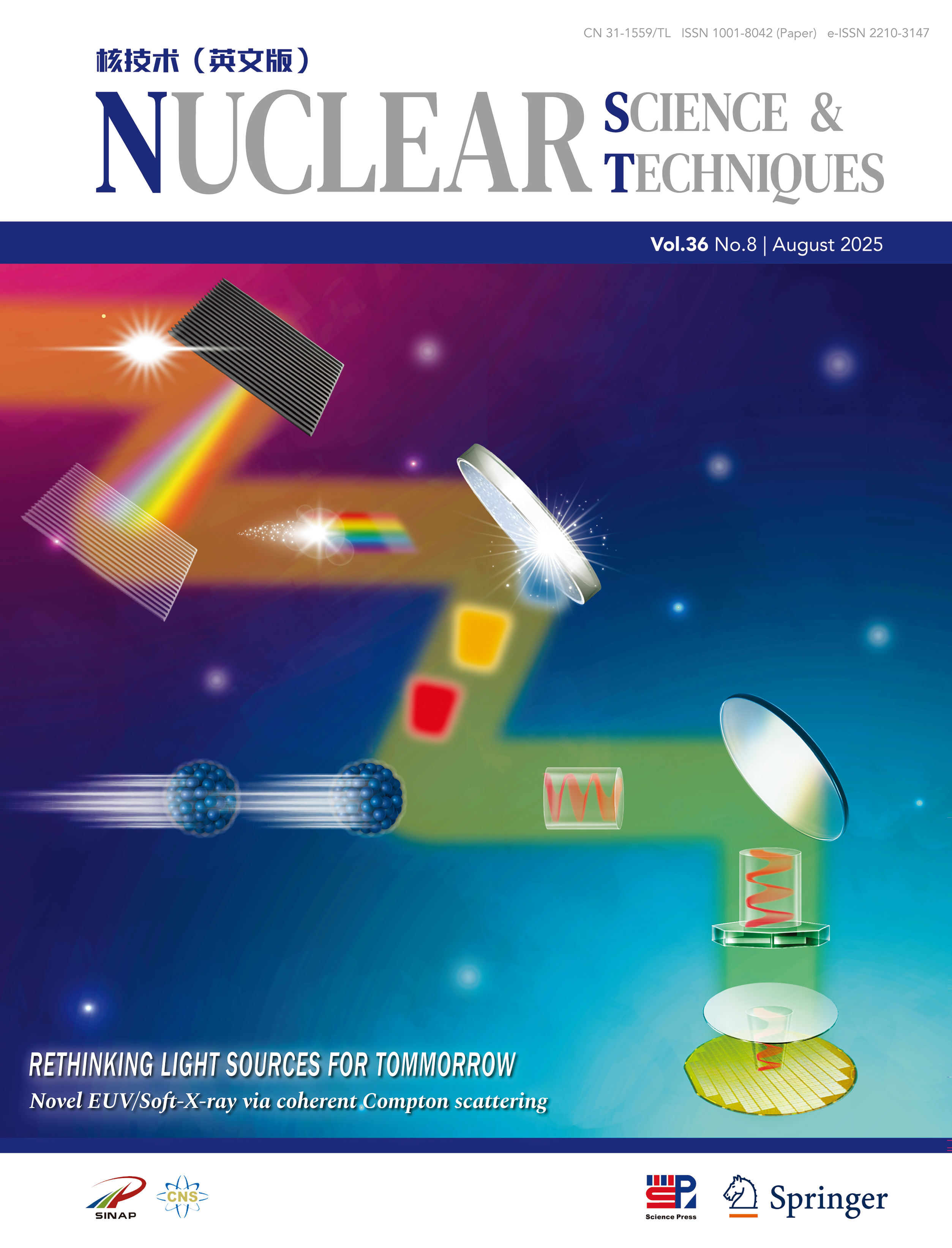
Extreme ultraviolet (EUV) lithography is crucial for advancing semiconductor manufacturing; however, current EUV light sources, such as laser-produced plasma (LPP), have significant limitations, including low energy-conversion efficiency and debris contamination. Various schemes, including optical free-electron laser undulators, have been studied to generate coherent EUV light. However, optical undulators suffer from limited focal lengths, which pose a significant challenge in achieving a higher gain. In this study, a novel approach is proposed that employs a stretched off-axis paraboloid (sOAP) mirror, thus extending the focus distance to the centimeter range while achieving a well-controlled periodic light field. This enables high-intensity 92-eV EUV sources to exceed 1016/s, as demonstrated in the simulations. The proposed setup provides an efficient and powerful solution for advanced applications including semiconductor lithography.
keyword:Free-electron laser (FEL);Laser Compton scattering (LCS);Coherent scattering;
ACCELERATOR, RAY TECHNOLOGY AND APPLICATIONS
Research article 02 Jun 2025
Sakhorn Rimjaem,Siriwan Pakluea,Kanlayaporn Kongmali,Monchai Jitvisate,Jatuporn Saisut,Chitrlada Thongbai
Terahertz (THz) radiation possesses unique properties that make it a promising light source for applications in various fields, particularly spectroscopy and imaging. Ongoing research and development in THz technology has focused on developing or improving THz sources, detectors, and applications. At the PBP-CMU Electron Linac Laboratory (PCELL) of the Plasma and Beam Physics Research Facility in Chiang Mai University, high-intensity THz radiation has been generated in the form of coherent transition radiation (TR) and investigated since 2006 for electron beams with energies ranging from 8 to 12 MeV. In this study, we investigate and optimize the coherent TR arising from short electron bunches with energies ranging from 8 to 22 MeV using an upgraded linear-accelerator system with a higher radio-frequency (RF) power system. This radiation is then transported from the accelerator hall to the experimental room, in which the spectrometers are located. Electron-beam simulations are conducted to achieve short bunch lengths and small transverse beam sizes at the TR station. Radiation properties, including the radiation spectrum, angular distribution, and radiation polarization, are thoroughly investigated. The electron-bunch length is evaluated using the measuring system. The radiation-transport line is designed to achieve optimal frequency response and high transmission efficiency. A radiation-transmission efficiency of approximately 80–90% can be achieved with this designed system, along with a pulse energy ranging from 0.17 to 0.25 μJ. The expected radiation spectral range covers up to 2 THz with a peak power of 0.5–1.25 MW. This coherent, broadband, and intense THz radiation will serve as a light source for THz spectroscopy and THz time-domain spectroscopy applications at the PCELL in the near future.
keyword:Transition radiation;Radiation transportation;THz radiation;
Research article 02 Jun 2025
Jing-Yi Li,Tian-Yi Li,Hao-Yan Jia,Jun-Tao Liu,Lin Lin,Fei Jiao,Li-Wen Feng,Sheng-Wen Quan,Sen-Lin Huang
Low-dark-current photocathode guns are highly desired for high-brightness continuous-wave operations. Direct-current superconducting radio-frequency (DC-SRF) gun, a hybrid photocathode gun combining a DC gap and an SRF cavity, effectively isolates the photocathode from the SRF cavity and offers significant advantages in terms of minimizing dark-current levels. This paper presents an in-depth analysis of the dark current of a newly developed high-brightness DC-SRF photocathode gun (DC-SRF-II gun). Particularly, a systematic experimental investigation of the dark current was conducted, and a comprehensive understanding of its formation was achieved through compliant simulations and measurements. Additionally, measures for attaining sub-nanoampere dark currents in the DC-SRF-II gun are presented, including design considerations, cavity processing, assembly, and conditioning. The findings of this study establish a strong foundation for achieving high-performance operation of the DC-SRF-II gun and provide a valuable reference for other photocathode guns.
keyword:RF conditioning;Dark current;Photocathode gun;DC conditioning;Tracking simulation;
Research article 03 Jun 2025
Hai-Sheng Yu,Jian-Qiu Zhu,Jia-Xing Wu,Yao-Tian Guo,Song Li,Yan Zhang,Xiao-Xu Qian,Jian-Qiang Wang,Lin-Juan Zhang
This study describes the design and performance of a laboratory-based tender X-ray spectrometer for X-ray absorption spectroscopy. The system enables effective absorption spectra to be measured within the 2.0–9.0 keV range using Rowland circle geometry; it covers the K edge of 3d transition metals, the L edge of lanthanides, and the M edge of actinides. The spectrometer is configured with a Rowland circle with a diameter of 500 mm and integrates a 250-W liquid metal-jet X-ray source, spherical bent crystal analyzer, and energy-resolving silicon drift detector. The X-ray source is installed outside the vacuum chamber and remains fixed, while the analyzer crystals and detector are adjusted to change the Bragg angle, maintaining the Rowland condition. The energy resolution is 0.36–1.30 eV at 2.0–9.0 keV, and the monochromatic flux is approximately 5 × 10⁵ counts/s at 7040 eV. This study highlights the primary characteristics of the spectrometer and demonstrates its capabilities using selected experimental examples. The successful development of this spectrometer can facilitate research on actinide elements, which are often constrained in synchrotron radiation experiments owing to their radioactivity, thus fostering advancements in related nuclear energy fields.
keyword:EXAFS;Laboratory X-ray spectroscopy;XANES;Tender X-ray;
Research article 04 Jun 2025
Wei-Min Pan,Fei-Si He,Rui Ge,Mei Li,Tong-Ming Huang,Miao-Fu Xu,Chang-Cheng Ma,Sheng Wang,Wen-Zhong Zhou,Zheng-Hui Mi,Dai Jin,Ye Han,Zhe-Xin Xie,Ming Liu,Qun-Yao Wang,Hai-Ying Lin,Bai-Qi Liu,Xiao-Long Wang,Zhen-Qiang He,Qiang Ma,Xu Chen,Min-Jing Sang,Ke-Yu Zhu,Tong-Xian Zhao,Rui Ye,Zheng-Ze Chang,Liang-Rui Sun,Meng-Xu Fan,Cong Zhang,Hua-Chang Liu,Zhen-Cheng Mu,Tong Wang,Bin Ye,Yang Meng,Lin-Yang Rong,Hui Zhang,Bo Wang,Ma-Liang Wan,Yun Wang
The China Spallation Neutron Source (CSNS) is the fourth pulsed accelerator-driven neutron source in the world, and it achieved its design target of 100 kW in 2020. The planned China Spallation Neutron Source Phase II (CSNS-II) commenced in 2024. The CSNS-II linac design primarily involves the addition of a radio-frequency ion source and a section of a superconducting linear accelerator composed of two types of superconducting cavities, namely double-spoke and six-cell elliptical cavities, after the drift tube linac (DTL). The development of the double-spoke superconducting cavity began in early 2021, and by January 2023, the welding, post-processing, and vertical tests of two 324 MHz double-spoke cavity prototypes were completed, with vertical test gradients of 11.6 and 15 MV/m, and Q0 ≥ 3×10¹⁰ @ Eacc≤3×10 MV/m. The R&D of the cryomodule began in January 2022. In October 2023, the clean assembly of the double-spoke cavity string and cold mass installation of the cryomodule commenced, with the installation of the cryomodule and valve box completing in two months. In January 2024, a horizontal test of the cryomodule was completed, making it the first double-spoke cavity module in China. The test results showed that the maximum gradients of the two superconducting cavities at a pulse width of 4 ms and repetition frequency of 25 Hz were 12.8 and 15.2 MV/m, respectively. This article provides a detailed introduction to the double-spoke superconducting cavity, tuner, coupler, and cryomodule, elaborates on the clean assembly of the cavity string and cold-mass installation of the cryomodule, and provides a detailed analysis of the horizontal test results.
keyword:Vertical test;Horizontal test;Cryomodule;Double-spoke cavity;Cavity string;
DATA ARTICLE
Research article 03 Jun 2025
Qing-Quan Pan,Guo Lv,Sheng-Dian Zou,Xiao-Jing Liu
Medical isotopes are the foundation material for nuclear medicine and are primarily produced through in-reactor irradiation. Neutron spectrum regulation is the main technical approach for enhancing the production of medical isotopes, and it requires determining the optimal neutron spectrum and quantifying the values of neutrons in different energy regions. We calculated the neutron energy region values for 20 medical isotopes (14C, 32P, 47Sc, 60Co, 64Cu, 67Cu, 89Sr, 90Y, 99Mo, 125I, 131I, 153Sm, 161Tb, 166Ho, 177Lu, 186Re, 188Re, 92Ir, 225Ac, 252Cf). The entire energy range was divided into 238 energy regions to improve the energy spectrum resolution, and both fast and thermal reactors were simulated to enhance universal applicability. A dataset of neutron energy region values across the entire energy range was built, and this identified positive and negative energy regions as well as guided the neutron spectrum regulation process during in-reactor medical isotope production. We conducted neutron spectrum regulation based on this dataset, which effectively improved the production efficiency of medical isotopes and demonstrated the correctness and feasibility of the dataset.
keyword:Medical isotopes;High-flux isotope reactor;Neutron energy region value;Spectrum regulation.;
Research article 05 Jun 2025
Hai-Xiao Deng,Tao Li,Xian-Zhe Li,Jun Wan,Bin Zhang,Xin-Yu Yang,Qi-Rong Huang,Lie Feng,Wei Huang,Kai-Qing Zhang
There is a growing interest in the rapid assessment of terahertz (THz) spectroscopy owing to its promising application prospects in nondestructive testing, security screening, and communication. In this study, we introduce a swift characterization method for THz spectroscopy that utilizes a THz-to-optical conversion system in a warm atomic vapor cell. By subtracting the photoluminescence (PL) spectra of cesium atoms with the THz field from those without the THz field, we obtained differential PL spectra that effectively characterized the 0.548 THz field. The differential PL spectra of Rydberg atoms offer the opportunity to quantify the THz field’s intensity and frequency, potentially paving the way for the development of THz spectroscopy based on warm atomic vapor cells.
keyword:Terahertz;Cesium;Rydberg state;Photoluminescence spectra;
INVITED REVIEW
Review article 04 Jun 2025
Chang-Bo Fu,Yi Yang,Han-Xu Zhang,Yuan-Bin Wu,Song Guo,Xu Wang,Yang Sun,Yu-Gang Ma
Nuclear excitation by electron capture (NEEC) is a fundamental process in nuclear physics. Despite its theoretical framework established nearly half a century ago, the experimental confirmation of NEEC remains elusive because of significant technical challenges. A notable effort to validate NEEC experimentally involved the enhanced 93mMo isomer-depletion experiment, which was ultimately hindered by substantial noise interference. This mini-review provides a brief historical overview of NEEC studies and explores the role of NEEC processes in astrophysical environments and laser-induced plasmas. Several platforms have been proposed to facilitate the observation of NEEC, including traditional cooling-storage rings, ion accelerators, and electron-beam ion traps. These approaches aim to enhance the nuclear excitation rate, thereby improving the signal-to-noise ratio. In addition, the employment of exotic vortex beams is discussed as a potential methodological approach to address these challenges.
keyword:Accelerator;NEEC;Isomer;Plasmas;
NUCLEAR CHEMISTRY, RADIOCHEMISTRY, AND NUCLEAR MEDICINE
Research article 04 Jun 2025
Jing-Ye Li,Bo-Wu Zhang,Kai-Xuan Huo,Yong-Chang Song,Yu Meng,Zi-Qiang Wang,Ming Yu
Herein, a new method was developed for efficient and lasting fluorescent whitening cotton fabric by synthesizing and using a vinyl-containing fluorescent whitening agent to covalently grafting onto fiber surfaces with the assistance of electron beam irradiation. The results from FT-IR spectroscopic, X-ray photoelectron spectroscopic, and energy dispersive spectrometric analyses showed that the fluorescent whitening agent was successfully anchored on cotton fiber via radiation-induced grafting copolymerization. The optimized whiteness value at 110.81 (that of raw cotton fabric, 74.50) was achieved using just 0.3 wt% fluorescent whitening agent. Notably, the whiteness value of the treated cotton fabric remained 110+ even after 100 equivalent home-washing cycles, substantiating its excellent washing durability. Skin stimulation experiments on rabbits showed that the primary stimulation index of all experimental groups was 0 and no abnormal clinical symptoms were found in all tested rabbits, demonstrating the outstanding skin safety. Furthermore, energy generated by irradiation grafting technology was much lower than that of traditional processes and water consumption greatly reduced. Even the effluent from this process completely met the discharge standard of industrial wastewater without any treatment. This study explores a new method for textile finishing via electron beam irradiation, providing a green and sustainable perspective for the textile industry.
keyword:Electron beam irradiation;Fluorescent whitening;Cotton fabric;Washing durability;Skin safety;Sustainable;
NUCLEAR ELECTRONICS AND INSTRUMENTATION
Research article 05 Jun 2025
Ran Li,Jun Li,Guo-Dong Zhao,Wen-Qing Zhang,Yun-Tao Liu,Yuan Huang,Xin Qi
The rapid-cycling synchrotron (RCS) is a crucial device for proton beam acceleration at the China Spallation Neutron Source, operating at a repetition frequency of 25 Hz. The beam power was increased from 100 kW to 140 kW. This increase makes the on-orbit beam more sensitive to disturbances in various parts of the accelerator, including the RCS magnet power supply system. This paper presents a method for reducing the high-order harmonic current error in resonant power supplies for dipole magnets and examines its impact on the horizontal orbit offset of the beam. It adopts a control scheme that combines high-order harmonic current compensation with PI double-loop control of the resonant power supply. By utilizing the existing digital controller hardware in the RCS power supply system, this study demonstrates how to achieve precise control of the 50 Hz harmonic current output in a cost-effective manner. Ultimately, it enhances performance by reducing the current error by up to 50% and provides methodological support for future upgrades to the power supply system. Such improvements enhance the stability of the RCS, reducing the beam horizontal orbit deviation by at least 19.8%.
keyword:FPGA;Current error analysis;Magnets saturation;White resonant circuit;Harmonic current compensation algorithm;
Published on 20 Aug 2025
